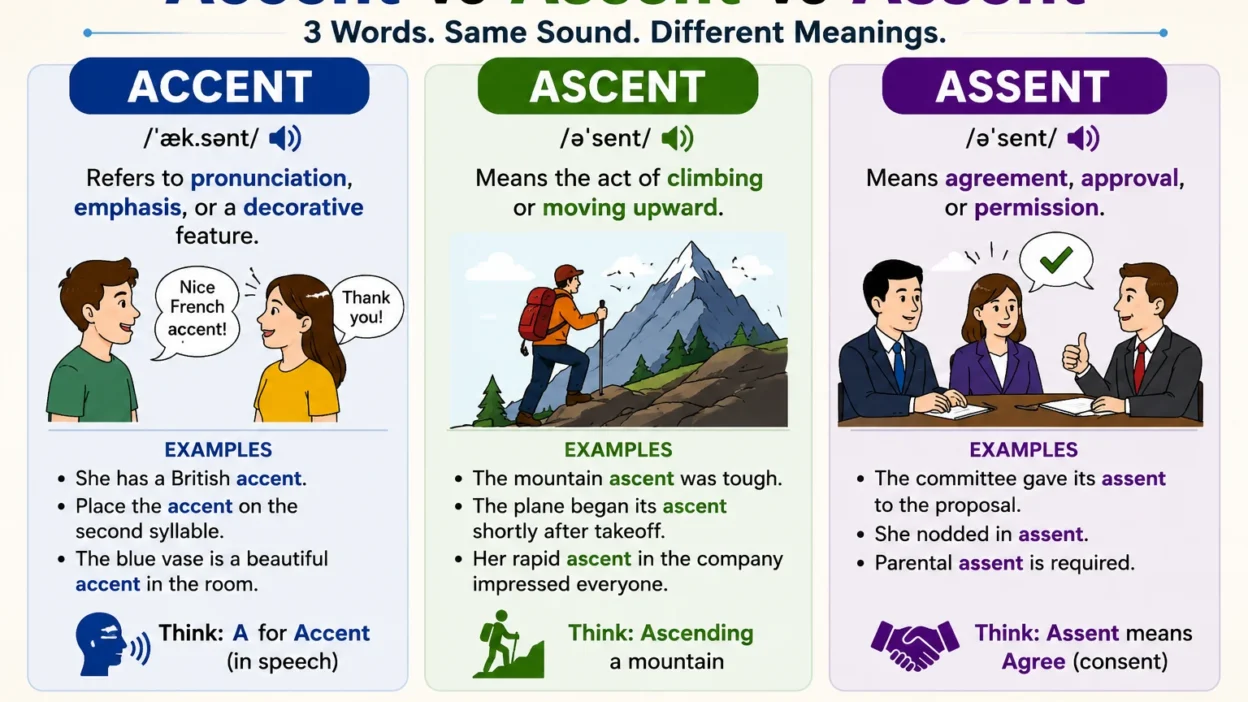
The words accent vs ascent vs assent often confuse English learners because they sound almost identical but have completely different meanings.
These are homophones, meaning they share the same pronunciation while having different spellings and definitions.
Knowing when to use each word correctly can greatly improve your writing and speaking skills.
Understanding accent vs ascent vs assent is important in school, business, professional communication, and everyday conversations.
In this guide, you’ll learn the meaning of each word, their differences, grammar, usage, examples, common mistakes, memory tricks, and much more to help you use them confidently.
Quick Answer
Accent refers to pronunciation, emphasis, or a decorative feature.
Ascent means the act of climbing or moving upward.
Assent means agreement or permission.
Although they sound alike, their meanings and usage are entirely different.
Accent vs Ascent vs Assent Comparison Table
| Word | Part of Speech | Meaning | Example |
|---|---|---|---|
| Accent | Noun | Pronunciation, emphasis, or decorative detail | She has a British accent. |
| Ascent | Noun | Upward movement or climb | The mountain ascent took five hours. |
| Assent | Noun, Verb | Agreement or approval | The committee gave its assent. |
What Does Accent Mean?
Accent has several meanings depending on the context.
It most commonly refers to the distinctive way a person pronounces words based on their region or country.
It can also mean emphasis placed on a syllable or a decorative feature added to something.
Examples
- He speaks English with an Australian accent.
- Put the accent on the second syllable.
- The room’s blue cushions provide a colorful accent.
What Does Ascent Mean?
Ascent means moving upward or climbing toward a higher place. It is often used when discussing mountains, airplanes, careers, or progress.
Examples
- The hikers began their ascent before sunrise.
- The plane’s ascent was smooth.
- Her rapid ascent to management impressed everyone.
What Does Assent Mean?
Assent means agreement, approval, or consent. It can be used as both a noun and a verb.
Examples
- The board gave its assent to the proposal.
- She nodded to assent.
- Without parental assent, the trip was canceled.
Accent vs Ascent vs Assent: Key Differences
| Feature | Accent | Ascent | Assent |
|---|---|---|---|
| Meaning | Pronunciation or emphasis | Climbing upward | Agreement or approval |
| Part of Speech | Noun | Noun | Noun, Verb |
| Related Idea | Language | Movement | Permission |
| Common Context | Speech, design | Hiking, aviation, career | Meetings, law, business |
Pronunciation and Why They Are Confusing
One reason people mix up accent vs ascent vs assent is that all three words are pronounced nearly the same.
| Word | Pronunciation |
|---|---|
| Accent | AK-sent |
| Ascent | uh-SENT |
| Assent | uh-SENT |
Although ascent and assent sound exactly alike, their meanings are completely unrelated.
Grammar Forms
| Word | Noun | Verb | Adjective |
|---|---|---|---|
| Accent | ✔ | ✘ | Accented |
| Ascent | ✔ | ✘ | Ascending (related) |
| Assent | ✔ | ✔ | Assenting |
When Should You Use Accent?
Use accent when talking about:
- Pronunciation
- Stress in words
- Decorative features
- Musical emphasis
Examples
- His French accent is easy to recognize.
- The designer used gold as an accent color.
- Place the accent on the first syllable.
When Should You Use Ascent?
Use ascent whenever you’re describing upward movement.
Examples
Travel
- The mountain ascent was difficult.
Aviation
- The pilot announced the aircraft’s ascent.
Career
- Her ascent to CEO took only six years.
Sports
- Cyclists struggled during the steep ascent.
When Should You Use Assent?
Use assent when someone agrees or gives permission.
Examples
Business
- Investors gave their assent to the merger.
Education
- Parents signed forms indicating their assent.
Government
- Parliament gave royal assent to the bill.
Meetings
- Everyone nodded in assent.
Real-Life Examples
| Situation | Correct Word | Example |
|---|---|---|
| Language class | Accent | Her Spanish accent is improving. |
| Hiking trip | Ascent | The ascent took three hours. |
| Company meeting | Assent | The directors gave their assent. |
| Interior design | Accent | A red pillow added an accent. |
| Air travel | Ascent | The plane’s ascent was gradual. |
| Legal agreement | Assent | The judge requested the witness’s assent. |
Professional Usage Table
| Industry | Word Used | Example |
|---|---|---|
| Education | Accent | Students practiced their English accent. |
| Aviation | Ascent | The ascent began immediately after takeoff. |
| Law | Assent | The contract required written assent. |
| Business | Assent | Shareholders gave their assent. |
| Tourism | Ascent | Guides prepared visitors for the ascent. |
| Interior Design | Accent | Wooden panels created a natural accent. |
Memory Tricks
Remember these simple tricks:
| Word | Memory Trick |
|---|---|
| Accent | Think of A for Accent in speech. |
| Ascent | Think of Ascending a mountain. |
| Assent | Think of Agree starts with A, just like assent. |
These associations make it easier to remember the correct word.
Why People Confuse Accent, Ascent, and Assent
There are several reasons:
- They sound nearly identical.
- English has many homophones.
- Only one letter changes between them.
- Their meanings belong to completely different topics.
- Spell-check cannot always detect misuse.
Common Mistakes
| Incorrect Sentence | Correct Sentence |
|---|---|
| His ascent is British. | His accent is British. |
| We reached the mountain assent. | We reached the mountain ascent. |
| The board gave its accent. | The board gave its assent. |
| Their ascent in English sounds natural. | Their accent in English sounds natural. |
| She nodded in ascent. | She nodded in assent. |
Practice Sentences
Choose the correct word.
- Her American ______ is easy to recognize.
Answer: accent - The climbers completed the ______ before sunset.
Answer: ascent - The committee gave its ______ to the proposal.
Answer: assent - The plane’s ______ lasted fifteen minutes.
Answer: ascent - He spoke with a strong Scottish ______.
Answer: accent
Quick Usage Guide
| If you’re talking about… | Use |
|---|---|
| Pronunciation | Accent |
| Climbing upward | Ascent |
| Agreement | Assent |
| Language | Accent |
| Mountains | Ascent |
| Permission | Assent |
People Also Ask
Is accent, ascent, and assent pronounced the same?
Yes. They are homophones and sound almost identical, but their meanings differ.
Can assent be used as a verb?
Yes. You can say, “I assent to the proposal.”
Is ascent only used for mountains?
No. It also refers to upward movement in aviation, careers, and other situations.
Can accent refer to decoration?
Yes. An accent can be a decorative feature, such as an accent wall or accent color.
Which word relates to agreement?
Assent is the correct word for agreement, approval, or consent.
FAQs
What is the main difference between accent vs ascent vs assent?
Accent relates to pronunciation, ascent means upward movement, and assent means agreement.
Are these words homophones?
Yes. They sound alike but have different meanings and spellings.
Which word is used in aviation?
Ascent describes the aircraft’s upward climb after takeoff.
Which word is common in legal writing?
Assent is frequently used in legal, governmental, and business documents.
Can accent describe stress in pronunciation?
Yes. It also refers to emphasizing a particular syllable in a word.
Conclusion
Understanding accent vs ascent vs assent becomes much easier once you connect each word with its unique meaning. Accent relates to pronunciation, emphasis, or decoration.
Ascent refers to climbing or moving upward, while assent means agreement or approval.
Although these homophones sound alike, remembering their different will help you avoid common mistakes.
With regular practice and real-life examples, you’ll confidently choose the correct word every time.