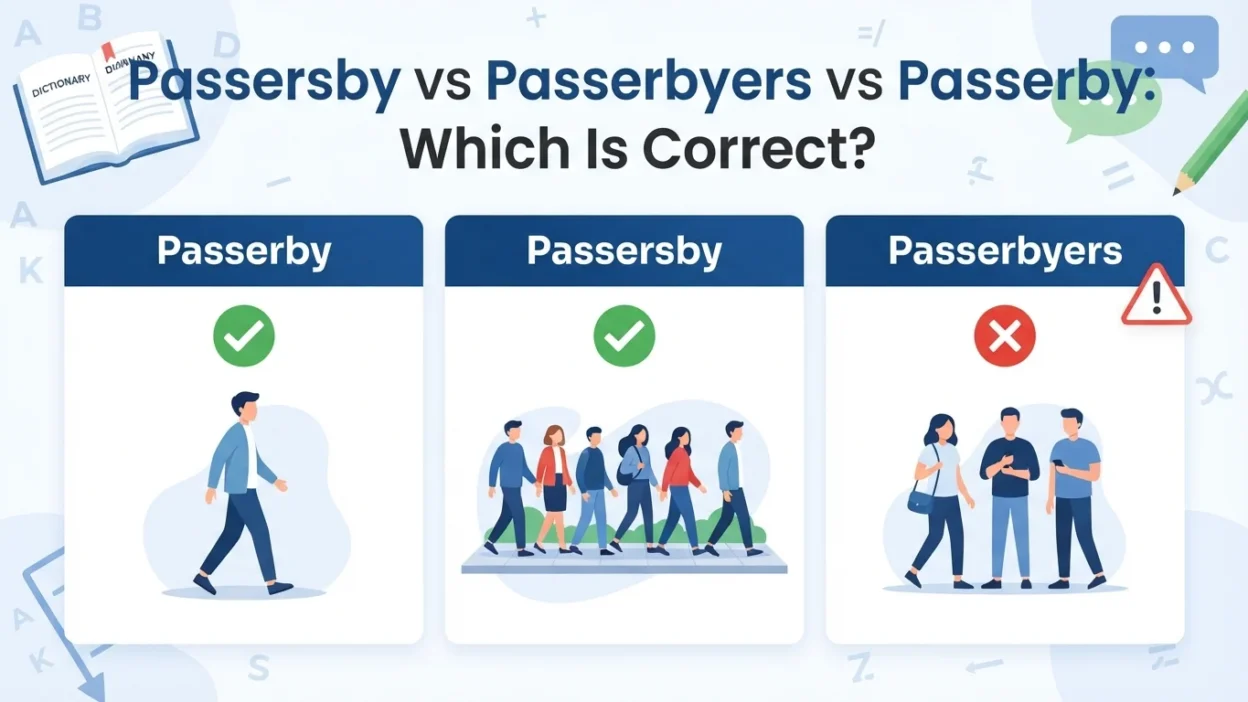
The comparison passersby vs passerbyers vs passerby often confuses English learners because the plural form of passerby does not follow the usual grammar rules.
Many people mistakenly assume that adding s or ers creates the correct plural, leading to forms like passerbyers, which are incorrect in standard English.
Understanding passersby vs passerbyers vs passerby is important for writing accurately in everyday conversations, journalism, academic work, and professional communication.
This guide explains the meaning of each term, grammar rules, examples, common mistakes, and memory tricks so you can confidently use the correct form every time.
Quick Answer
- Passerby is the correct singular form.
- Passersby is the correct plural form.
- Passerbyers is incorrect and should not be used in standard English.
Passersby vs Passerbyers vs Passerby: Main Comparison Table
| Word | Correct? | Meaning | Usage |
|---|---|---|---|
| Passerby | ✔ | One person passing by | Singular |
| Passersby | ✔ | More than one person passing by | Plural |
| Passerbyers | ✘ | Incorrect form | Never use |
What Does “Passerby” Mean?
A passerby is a person who happens to walk or travel past a particular place.
It refers to one individual.
Examples
- A passerby helped the injured cyclist.
- The passerby stopped to ask for directions.
- Police interviewed the passerby.
What Does “Passersby” Mean?
Passersby is the plural form of passerby.
It refers to two or more people passing a location.
Examples
- Several passersby witnessed the accident.
- Curious passersby gathered outside the building.
- Passersby watched the street performance.
What Does “Passerbyers” Mean?
Passerbyers is not a correct English word.
Some learners incorrectly create this form by adding -ers, but English grammar does not allow it.
Correct:
- Passerby
- Passersby
Incorrect:
- ❌ Passerbyers
Why Is the Plural “Passersby”?
The word passerby is a compound noun.
The main noun is passer, while by functions as an adverb.
To form the plural, the main noun changes.
- passer → passers
- by → remains unchanged
Therefore:
Passerby → Passersby
Grammar Forms Table
| Form | Word | Example |
|---|---|---|
| Singular | Passerby | A passerby called the police. |
| Plural | Passersby | Passersby stopped to help. |
| Possessive Singular | Passerby’s | The passerby’s bag was returned. |
| Possessive Plural | Passersby’s | The passersby’s statements were recorded. |
Key Differences Between the Three Terms
| Feature | Passerby | Passersby | Passerbyers |
|---|---|---|---|
| Singular | ✔ | ✘ | ✘ |
| Plural | ✘ | ✔ | ✘ |
| Dictionary Word | ✔ | ✔ | ✘ |
| Standard English | ✔ | ✔ | ✘ |
| Professional Writing | ✔ | ✔ | ✘ |
Real-Life Examples
Journalism
- A passerby witnessed the robbery.
- Several passersby called emergency services.
Business
- A passerby entered the store after seeing the display.
- Passersby noticed the new advertising banner.
Education
- Students interviewed passersby for a survey.
- One passerby volunteered to participate.
Law Enforcement
- Officers questioned a passerby.
- Passersby provided useful information.
Everyday Conversation
- A passerby smiled at us.
- Many passersby stopped to watch the musician.
Professional Usage Table
| Industry | Example |
|---|---|
| Journalism | Passersby reported the incident. |
| Police Reports | A passerby witnessed the event. |
| Marketing | Passersby noticed the billboard. |
| Research | Scientists surveyed passersby. |
| Tourism | Passersby photographed the monument. |
Common Compound Nouns Like “Passerby”
The plural of many compound nouns changes the main noun rather than the last word.
| Singular | Plural |
|---|---|
| Passerby | Passersby |
| Mother-in-law | Mothers-in-law |
| Attorney General | Attorneys General |
| Commander-in-Chief | Commanders-in-Chief |
| Brother-in-law | Brothers-in-law |
Why Do People Confuse Passersby vs Passerbyers vs Passerby?
There are several reasons.
- Most English nouns simply add -s.
- Compound nouns have unique plural rules.
- The word by appears at the end, making learners think it should change.
- Many people have never learned irregular compound noun plurals.
Common Mistakes
| Incorrect | Correct |
|---|---|
| Two passerby was waiting. | Two passersby were waiting. |
| Several passerbyers watched the parade. | Several passersby watched the parade. |
| Many passerby arrived. | Many passersby arrived. |
| One passersby helped me. | One passerby helped me. |
| The passerbyers reported the accident. | The passersby reported the accident. |
Memory Trick
Remember this simple rule:
The person passes, not the word “by.”
So the plural becomes:
Passer → Passers
By → stays by
Result:
Passersby
Choosing the Correct Word
| Situation | Correct Word |
|---|---|
| One person walking past | Passerby |
| Two or more people walking past | Passersby |
| Academic writing | Passerby / Passersby |
| News reports | Passerby / Passersby |
| Casual conversation | Passerby / Passersby |
| Formal documents | Passerby / Passersby |
Tips for Correct Usage
- Use passerby for one person.
- Use passersby for more than one person.
- Never use passerbyers.
- Remember that the first part of the compound noun becomes plural.
- Practice with similar compound nouns.
Frequently Asked Questions
Is “passerbyers” a real word?
No. It is not accepted in standard English.
What is the plural of “passerby”?
The correct plural is passersby.
Why isn’t it “passerbys”?
Because the main noun is passer, and only the noun changes to form the plural.
Is “passersby” used in formal writing?
Yes. It is the correct plural form in journalism, academic writing, legal documents, and everyday English.
How can I remember the correct plural?
Think: The passer becomes passers; “by” never changes.
Conclusion
Understanding passersby vs passerbyers vs passerby becomes easy once you know the grammar rule for compound nouns.
Passerby is the correct singular form, while passersby is the correct plural. Passerbyers is incorrect and should never be used in standard English.
By remembering that the main noun passer changes to passers while by remains unchanged, you can confidently use these words in academic writing, journalism, professional communication, and everyday conversations.