Introduction
The city vs town vs village comparison is one of the most common geography and English vocabulary questions.
Although these three terms all describe human settlements, they differ in population, infrastructure, services, and administration.
Understanding the difference helps you use the right word in everyday conversations, academic writing, and professional communication.
Many people confuse city vs town vs village because the definitions vary from country to country. In some places, a town may be larger than expected, while in others, a village may have modern facilities. This guide explains the meaning, difference, examples, and usage of each term with easy-to-understand tables and real-life examples.
Quick Answer
A village is usually the smallest type of settlement, a town is larger and offers more services, and a city is the largest with advanced infrastructure, government, and economic activities.
In simple terms: Village → Town → City (from smallest to largest).
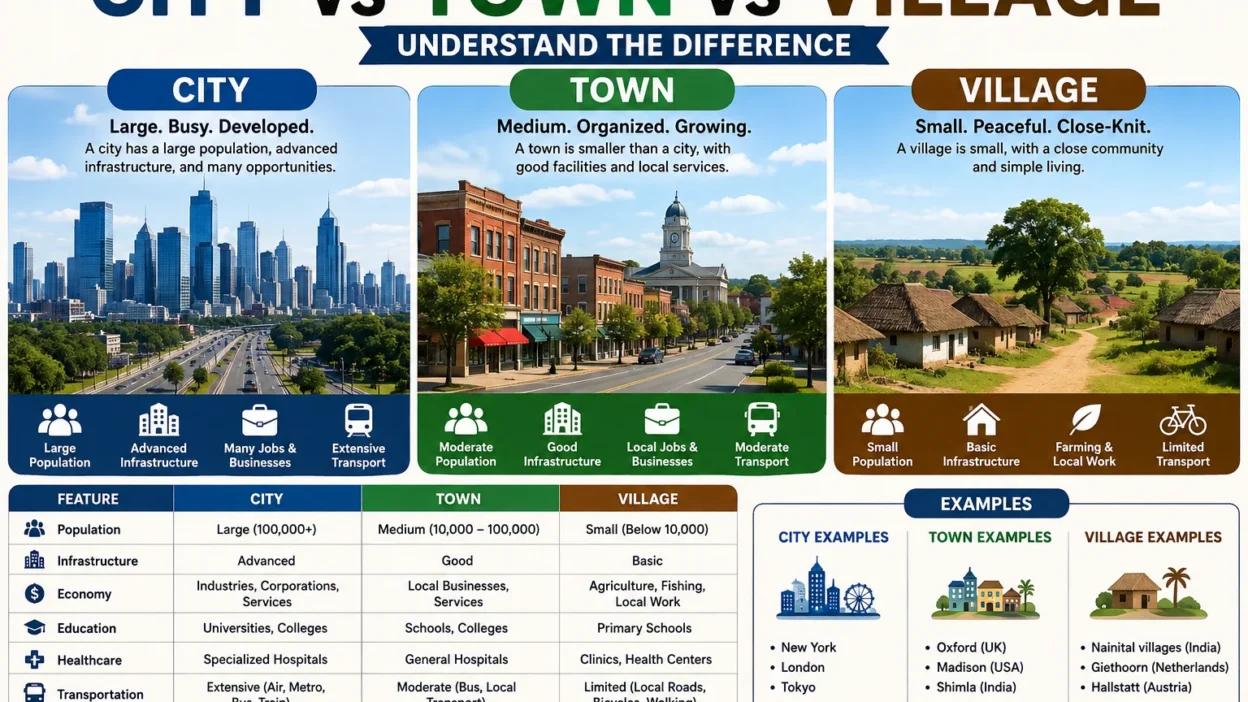
City vs Town vs Village at a Glance
| Feature | Village | Town | City |
|---|---|---|---|
| Size | Small | Medium | Large |
| Population | Low | Moderate | High |
| Infrastructure | Basic | Developed | Highly developed |
| Economy | Mainly agriculture | Mixed | Diverse industries |
| Transportation | Limited | Moderate | Extensive |
| Government | Local council | Municipal authority | City government |
| Employment | Mostly farming | Business and services | Multiple industries |
What Is a Village?
A village is a small settlement with a relatively low population. Villages often have close-knit communities where people know one another.
Many villages depend on farming, fishing, or small local businesses. Public services such as schools, hospitals, and transportation are usually limited compared to larger settlements.
Examples
- My grandparents live in a peaceful village.
- The village has one primary school and a local market.
- Farmers from the village sell fresh vegetables every weekend.
What Is a Town?
A town is larger than a village but smaller than a city. Towns usually have better infrastructure, more businesses, schools, healthcare facilities, and public transportation.
Many people live in towns while working in nearby cities.
Examples
- She moved to a small town after college.
- The town has several shopping centers.
- A new hospital opened in the town last year.
What Is a City?
A city is a large urban area with a high population and advanced infrastructure. Cities usually serve as centers for business, education, healthcare, government, and transportation.
Cities offer more employment opportunities and public services than towns or villages.
Examples
- New York is one of the world’s largest cities.
- The city has an international airport.
- Many companies have offices in the city center.
Main Difference Between City, Town, and Village
The primary difference is size, population, and level of development.
| Feature | Village | Town | City |
|---|---|---|---|
| Population | Smallest | Medium | Largest |
| Roads | Basic | Improved | Advanced |
| Hospitals | Few | Several | Many specialized hospitals |
| Schools | Basic | Multiple schools | Universities and colleges |
| Businesses | Small shops | Local businesses | Large corporations |
| Entertainment | Limited | Moderate | Extensive |
Why Do People Confuse City, Town, and Village?
Several factors contribute to the confusion.
- Definitions vary by country.
- Population limits differ worldwide.
- Some towns are larger than cities in other countries.
- Administrative rules are different.
- Modern villages may have urban facilities.
Because of these differences, the classification often depends on local laws rather than population alone.
Population Comparison
Although there is no universal rule, the following ranges are common.
| Settlement | Typical Population |
|---|---|
| Village | Hundreds to a few thousand |
| Town | Several thousand to around 100,000 |
| City | Usually over 100,000 (varies by country) |
These numbers are only general guidelines.
City vs Town vs Village in Real Life
Business
Large corporations usually establish headquarters in cities, while local businesses thrive in towns and villages.
Education
Villages often have primary schools, towns have secondary schools, and cities usually have universities.
Healthcare
Cities provide specialized hospitals, towns offer general hospitals, and villages often rely on clinics.
Tourism
Villages attract visitors seeking nature and traditional culture, while cities are popular for museums, shopping, and nightlife.
Agriculture
Most farming activities occur in villages, while cities depend on villages for agricultural products.
Industry Usage Comparison
| Industry | Village | Town | City |
|---|---|---|---|
| Agriculture | Primary activity | Moderate | Minimal |
| Manufacturing | Small-scale | Medium industries | Large industries |
| Technology | Rare | Growing | Major technology hubs |
| Banking | Limited branches | Regional offices | Headquarters |
| Tourism | Rural tourism | Local attractions | International tourism |
| Healthcare | Clinics | Hospitals | Specialized medical centers |
Grammar Forms and Usage
| Word | Part of Speech | Plural | Example |
|---|---|---|---|
| City | Noun | Cities | The city is expanding. |
| Town | Noun | Towns | Several towns joined the project. |
| Village | Noun | Villages | The villages celebrated together. |
Common Phrases
| Phrase | Example |
|---|---|
| City center | We met in the city center. |
| Small town | She enjoys small-town life. |
| Rural village | The rural village attracts tourists. |
| Capital city | Paris is France’s capital city. |
| Coastal town | They bought a house in a coastal town. |
How Settlements Typically Develop
| Stage | Description |
|---|---|
| Village | Small community forms |
| Town | Population grows and businesses expand |
| Infrastructure | Roads, schools, and healthcare improve |
| City | Large population and advanced services develop |
Not every village becomes a town, and not every town becomes a city, but this is a common pattern.
Memory Trick to Remember the Difference
A simple way to remember is:
Village = Very Small
Town = Transitional Size
City = Crowded Center
Or simply remember:
Village → Town → City
Think of it as moving from rural life to urban life.
Common Mistakes
| Incorrect Sentence | Correct Sentence |
|---|---|
| The village has fifty skyscrapers. | The city has fifty skyscrapers. |
| I live in a city of only 200 people. | I live in a village of only 200 people. |
| Every town has an international airport. | Some cities have international airports. |
| Villages are always isolated. | Some villages are modern and well connected. |
| Every city is larger than every town worldwide. | City status depends on local laws and definitions. |
How to Choose the Correct Term
| Situation | Best Word |
|---|---|
| Small farming community | Village |
| Medium-sized settlement | Town |
| Large urban center | City |
| Government capital | Usually City |
| Rural community | Village |
| Business district | City |
Real-World Examples
| Settlement | Example |
|---|---|
| Village | A farming community with local markets |
| Town | A regional shopping and service center |
| City | A metropolitan area with universities and airports |
People Also Ask
What is the difference between a city, town, and village?
A village is the smallest settlement, a town is medium-sized, and a city is the largest with advanced infrastructure and services.
Is every town bigger than a village?
Generally yes, although official classifications vary by country.
Can a town become a city?
Yes. If population, infrastructure, and legal requirements grow, a town may receive city status.
Is a village always rural?
Most villages are rural, but some are located near urban areas.
Which is larger: city or town?
A city is usually larger than a town in population, infrastructure, and economic activity.
FAQs
Can a city have farming areas?
Yes. Some cities include agricultural land on their outskirts.
Why do countries define cities differently?
Each country has its own legal and administrative criteria for settlement classification.
Are villages always peaceful?
Many villages are quieter than cities, but every village is unique.
Which is better for business?
Cities generally offer more opportunities due to larger markets and better infrastructure.
Can a village become a town?
Yes. As population and public services grow, a village may be officially recognized as a town.
Conclusion
Understanding city vs town vs village is simple once you focus on their size, population, infrastructure, and services. A village is typically the smallest and most rural settlement, a town is medium-sized with more facilities, and a city is the largest urban center with advanced transportation, healthcare, education, and business opportunities.
Although definitions vary between countries, remembering the progression Village → Town → City will help you choose the correct term in writing and conversation.