The forgo vs forego confuses many learners and even native speakers because the two look almost but have different meanings.
Although they are used interchangeably in modern writing, understanding the correct usage can improve your grammar and make your writing more precise.
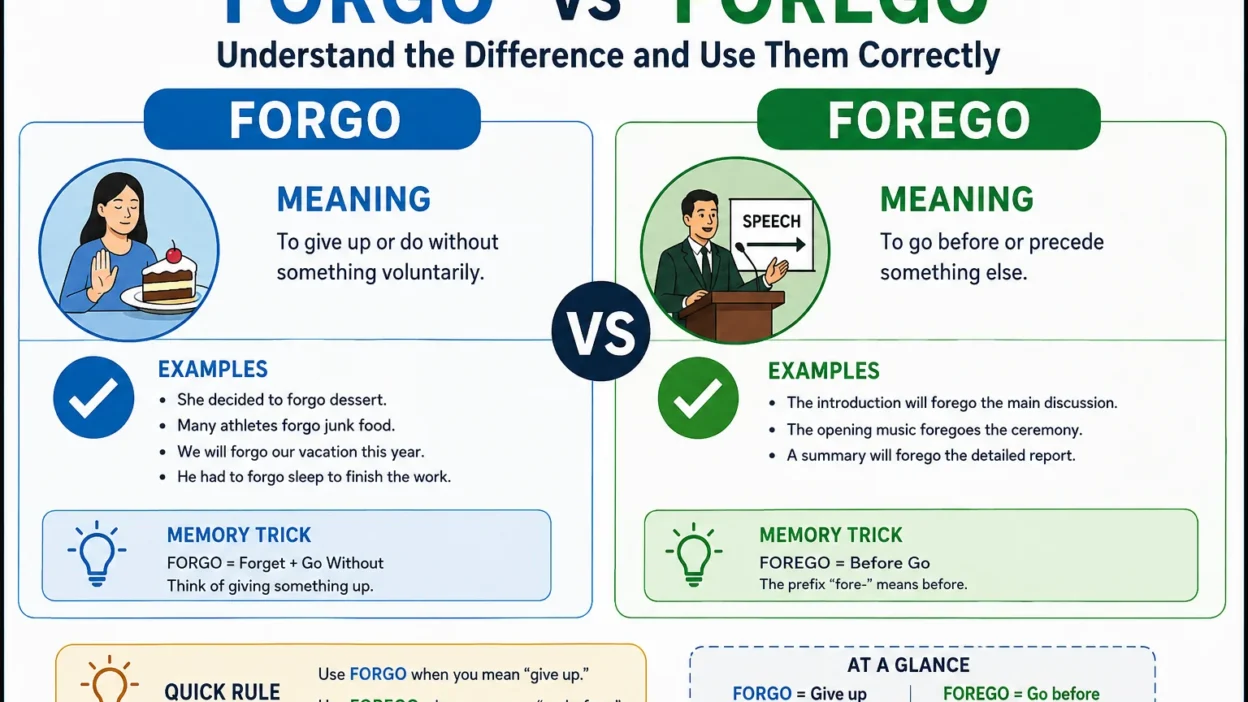
When comparing forgo vs forego, the biggest difference is that forgo means to give up or do without something, while forego means to go before or precede.
However, modern also accept forego as a variant spelling of forgo in many contexts. This guide explains the meaning, difference, examples, grammar, and correct usage of both words.
Quick Answer
Forgo means to voluntarily give up or do without something.
Forego traditionally means to come before or precede, although it is often used today as an alternative spelling of forgo, especially in American English.
Forgo vs Forego at a Glance
| Feature | Forgo | Forego |
|---|---|---|
| Primary meaning | Give up or do without | Go before; precede |
| Traditional usage | Correct | Correct |
| Modern alternate meaning | Yes | Sometimes means “give up |
| Common in modern writing | Very common | Less common for “precede” |
| Risk of confusion | Low | Higher |
| Best practice | Use for giving something up | Use for preceding events |
What Does Forgo Mean?
Forgo is a verb that means to willingly give up, sacrifice, or do without something.
It usually refers to giving up a benefit, opportunity, pleasure, or possession.
Examples
- She decided to forgo dessert.
- Many students forgo vacations to prepare for exams.
- The company chose to forgo profits this year to invest in research.
- He had to forgo sleep to finish the project.
What Does Forego Mean?
Traditionally, forego means to go before, precede, or come earlier than something else.
Although many modern dictionaries recognize forego as a spelling variant of forgo, writers often avoid this use because it can confuse readers.
Examples (Traditional Meaning)
- The introduction will forego the main discussion.
- The ceremony was foregone by a welcome speech.
- The announcement will forego the awards presentation.
Main Difference Between Forgo and Forego
The biggest distinction is their original meanings.
| Forgo | Forego |
|---|---|
| Means to give something up | Means to come before something |
| Refers to sacrifice | Refers to sequence or order |
| Most common modern usage | Less common traditional usage |
| Clear and preferred for “give up” | Can create confusion |
Simple Rule
- Forgo = Give up
- Forego = Go before
Why Do People Confuse Forgo and Forego?
Several reasons explain the confusion.
- They differ by only one letter.
- They sound almost identical.
- Many dictionaries now list forego as an accepted spelling of forgo.
- Spellcheck software sometimes accepts both.
- Older English used the words differently than modern English.
Because of this overlap, many professional editors recommend using forgo whenever you mean “give up.”
When Should You Use Forgo?
Use forgo whenever someone voluntarily gives up something valuable.
Common Situations
- Giving up food
- Skipping opportunities
- Sacrificing money
- Declining rewards
- Avoiding luxury
Examples
- We decided to forgo the bonus.
- They forgo unnecessary expenses.
- She forgoes social media during exams.
- Athletes often forgo unhealthy foods.
When Should You Use Forego?
Use forego only when referring to something that comes before another event or object.
Examples
- A summary will forego the detailed report.
- The opening remarks forego the keynote speech.
- Safety instructions forego the demonstration.
In everyday English, this meaning is relatively uncommon.
Grammar Forms of Forgo and Forego
| Form | Forgo | Forego |
|---|---|---|
| Base verb | forgo | forego |
| Third person | forgoes | foregoes |
| Present participle | forgoing | foregoing |
| Past tense | forwent | forewent |
| Past participle | forgone | foregone |
Example Sentences
Forgo
- I forgo expensive coffee.
- She forgoes desserts.
- They are forgoing vacations.
- He forwent his salary.
- We have forgone several opportunities.
Forego
- The introduction foregoes the report.
- The ceremony was foregone by music.
Forgo vs Forego in Different Industries
| Industry | Forgo Example | Forego Example |
|---|---|---|
| Business | Forgo short-term profits | Opening remarks forego presentation |
| Education | Students forgo holidays | Introduction foregoes lecture |
| Healthcare | Patients forgo unnecessary treatment | Medical briefing foregoes surgery |
| Government | Citizens forgo certain benefits | Public notice foregoes announcement |
| Research | Scientists forgo assumptions | Abstract foregoes detailed findings |
Real-Life Examples
Business
The startup decided to forgo immediate profits to expand internationally.
Education
Many students forgo entertainment before final exams.
Science
Researchers may forgo weak evidence to maintain accuracy.
Sports
Athletes often forgo junk food before competitions.
Publishing
A preface may forego the first chapter in traditional book structure.
Forgo vs Forego Comparison Table
| Situation | Correct Word | Example |
|---|---|---|
| Give up dessert | Forgo | I’ll forgo dessert tonight. |
| Skip vacation | Forgo | We forgo travel this year. |
| Sacrifice income | Forgo | She forgone extra income. |
| Come before speech | Forego | The introduction will forego the speech. |
| Precede ceremony | Forego | Music foregoes the event. |
Memory Trick to Remember the Difference
A simple trick can help.
Forgo = Forget + Go Without
Think of giving something up.
Forego = Before Go
The prefix fore- often means before, like forecast or foreword.
If something comes first, forego fits.
If someone gives something up, forgo is almost always the better choice.
Common Mistakes
| Incorrect Sentence | Correct Sentence |
|---|---|
| I will forego dessert. | I will forgo dessert. |
| She forgone the meeting yesterday. | She forwent the meeting yesterday. |
| The preface forgoes the book. | The preface foregoes the book. |
| We have forwent our vacation. | We have forgone our vacation. |
| They forewent dessert. | They forwent dessert. (Accepted only if using forego as variant spelling.) |
How to Choose the Right Word
Follow these steps.
| Question | Use |
|---|---|
| Are you giving something up? | Forgo |
| Does something come before another thing? | Forego |
| Want to avoid confusion? | Forgo |
| Writing formal English? | Keep traditional distinction |
People Also Ask
Is forgo or forego correct?
Both are correct, but forgo is preferred when you mean “give up,” while forego traditionally means “precede.”
What is the difference between forgo and forego?
Forgo means to give something up. Forego originally means to come before something.
Can forego mean give up?
Yes. Many modern dictionaries accept forego as a spelling variant of forgo, although many editors still recommend using forgo for clarity.
Which spelling is more common?
Forgo is much more common when referring to giving something up.
Is forego old-fashioned?
Its original meaning (“precede”) is less common today, making it seem more formal or old-fashioned.
FAQs
Is “forgo” a formal word?
Yes. It is commonly used in both formal and informal English.
Can I always replace forego with forgo?
Not if you mean “precede.” In that case, forego is the traditional choice.
Which word should students use in essays?
Use forgo when talking about giving something up because it is clearer and less likely to confuse readers.
Why do dictionaries allow both spellings?
Language changes over time, and many dictionaries recognize common modern usage where forego also means “forgo.
Is “forwent” a real word?
Yes. Forwent is the correct past tense of forgo, although many writers avoid it by rephrasing the sentence.
Conclusion
Understanding forgo vs forego is easier once you remember their original meanings.
Forgo means to voluntarily give up or do without something, while forego traditionally means to come before or precede.
Although modern dictionaries often accept forego as an alternative spelling of forgo, using forgo for the meaning “give up” is the clearest and safest choice.
Following this simple rule will make your writing more accurate, professional, and easier for readers to understand.