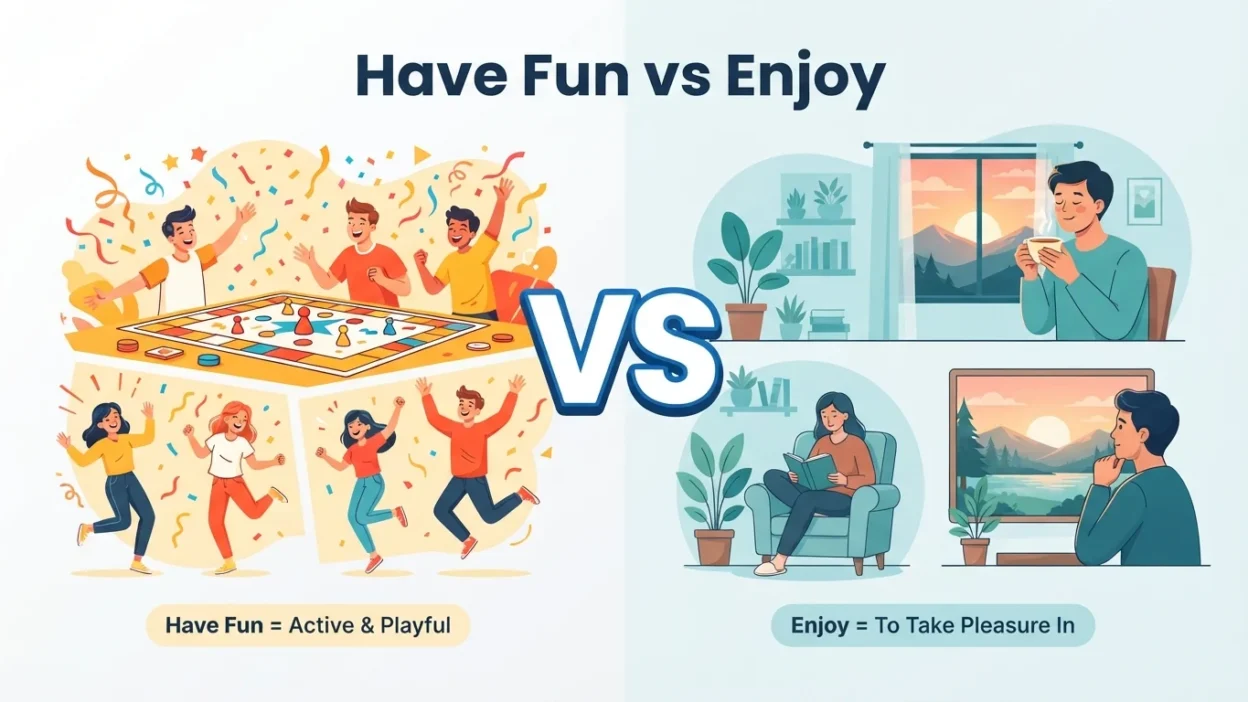
Many English learners wonder about have fun vs enjoy because both expressions relate to pleasure, happiness, and positive experiences. Although they seem similar, they are not always interchangeable. Understanding have fun vs enjoy helps you communicate more naturally in conversations, emails, classrooms, and professional settings.
The difference between have fun vs enjoy mainly depends on grammar and context.
“Have fun” is commonly used as a friendly wish or invitation, while “enjoy” is a verb that usually needs an object.
This guide explains their meanings, grammar, examples, and common mistakes so you can use both expressions confidently.
Quick Answer
Have fun is an expression used to wish someone an enjoyable time or describe having a good time.
Enjoy is a verb that means to take pleasure in something and is usually followed by an object.
Example:
- ✅ Have fun at the party!
- ✅ Enjoy the party!
Have Fun vs Enjoy: Main Comparison Table
| Feature | Have Fun | Enjoy |
|---|---|---|
| Part of Speech | Verb phrase | Verb |
| Main Meaning | Experience a good time | Take pleasure in something |
| Needs an Object? | Usually no | Usually yes |
| Common Use | Friendly wishes | Daily conversations, formal and informal writing |
| Formality | Informal to neutral | Neutral to formal |
| Example | Have fun at school! | Enjoy your meal! |
What Does “Have Fun” Mean?
Have fun means to experience enjoyment while doing an activity. It is often used when wishing someone well before they begin an event.
Examples
- Have fun at the concert.
- Have fun during your vacation.
- We had fun playing basketball.
- Have fun with your friends.
The phrase focuses on the experience rather than the object.
What Does “Enjoy” Mean?
Enjoy means to take pleasure in someone or something. It is an action verb that generally requires an object.
Examples
- Enjoy your dinner.
- I enjoy reading books.
- She enjoys learning languages.
- They enjoyed the movie.
Unlike “have fun,” enjoy usually answers the question “Enjoy what?”
Have Fun vs Enjoy: Key Differences
| Point | Have Fun | Enjoy |
|---|---|---|
| Focus | Good experience | Pleasure from something |
| Grammar | Fixed phrase | Regular verb |
| Object Required | No | Yes, usually |
| Used as a Wish | Yes | Yes |
| Used for Personal Preferences | Rarely | Frequently |
Simple Rule
Use have fun when talking about experiences.
Use enjoy when talking about liking or taking pleasure in something specific.
Grammar Forms
| Grammar Form | Have Fun | Enjoy |
|---|---|---|
| Base Form | have fun | enjoy |
| Present | have fun | enjoy |
| Past | had fun | enjoyed |
| Present Participle | having fun | enjoying |
| Past Participle | had fun | enjoyed |
Sentence Patterns
| Pattern | Example |
|---|---|
| Have fun + at/in/with | Have fun at the park. |
| Have fun + doing something | Have fun learning English. |
| Enjoy + noun | Enjoy your trip. |
| Enjoy + pronoun | Enjoy yourself. |
| Enjoy + gerund | Enjoy swimming. |
When Should You Use “Have Fun”?
Use have fun when:
- Wishing someone before an activity
- Talking about enjoyable experiences
- Speaking casually
- Giving friendly advice
Examples
- Have fun on your holiday.
- Have fun at the wedding.
- Have fun playing soccer.
- I hope you have fun.
When Should You Use “Enjoy”?
Use enjoy when:
- Talking about preferences
- Expressing satisfaction
- Giving polite wishes
- Describing something pleasant
Examples
- Enjoy your coffee.
- Enjoy your weekend.
- I enjoy painting.
- We enjoyed the presentation.
Real-Life Examples in Different Contexts
Business
Have Fun
- Have fun at the company retreat.
- Have fun during the team-building event.
Enjoy
- Enjoy today’s workshop.
- We hope you enjoy our services.
Education
Have Fun
- Have fun during the school trip.
- Students had fun in science class.
Enjoy
- She enjoys mathematics.
- The children enjoy reading.
Science
Have Fun
- Have fun with the laboratory experiment.
- Students had fun building the model.
Enjoy
- Scientists enjoy solving complex problems.
- Researchers enjoy discovering new ideas.
Travel
Have Fun
- Have fun in Paris.
- Have fun exploring the beach.
Enjoy
- Enjoy your vacation.
- Enjoy the beautiful scenery.
Daily Conversation
Have Fun
- Have fun tonight!
- Have fun at the party.
Enjoy
- Enjoy your meal.
- Enjoy the movie.
Industry Usage Table
| Industry | Have Fun | Enjoy |
|---|---|---|
| Business | Team events | Customer service |
| Education | School trips | Learning activities |
| Tourism | Vacation wishes | Travel experiences |
| Hospitality | Friendly farewell | Dining greetings |
| Entertainment | Concerts and festivals | Movies and performances |
Why Do People Confuse Have Fun vs Enjoy?
The confusion happens because both expressions involve happiness and pleasure.
Reasons include:
- Both express positive emotions.
- Both can be used before events.
- Many languages translate them using one word.
- Beginners often ignore the grammar difference.
Learning the sentence patterns helps remove this confusion.
Common Mistakes
| Incorrect | Correct |
|---|---|
| Enjoy! your trip | Enjoy your trip. |
| Have fun your trip. | Have fun on your trip. |
| I enjoy very much. | I enjoy it very much. |
| Have enjoy. | Have fun. |
| Enjoy at the party. | Enjoy the party. |
More Correct vs Incorrect Examples
❌ I have enjoyed at school.
✅ I enjoyed school.
❌ Enjoy in your vacation.
✅ Enjoy your vacation.
❌ Have fun your game.
✅ Have fun at your game.
❌ I enjoy.
✅ I enjoy music.
Comparison Examples
| Situation | Better Choice | Example |
|---|---|---|
| Saying goodbye | Have Fun | Have fun at the concert! |
| Before dinner | Enjoy | Enjoy your meal! |
| Talking about hobbies | Enjoy | I enjoy hiking. |
| School trip | Have Fun | Have fun on the trip! |
| Watching a movie | Enjoy | Enjoy the movie! |
Memory Tricks
Remember these simple tricks:
Have Fun = Experience
Think of activities.
- Have fun skiing.
- Have fun camping.
Enjoy = Object
Think of things.
- Enjoy the meal.
- Enjoy the book.
- Enjoy your vacation.
Easy memory formula:
Have Fun = Good Time
Enjoy = Like Something
Can You Use Them Together?
Yes.
Examples:
- Have fun and enjoy your vacation.
- Have fun at the festival and enjoy the music.
- Have fun during the event and enjoy every moment.
Using both sounds natural because they emphasize different ideas.
Step-by-Step Guide to Choosing the Right Expression
| Step | Question | Use |
|---|---|---|
| 1 | Are you wishing someone before an activity? | Have Fun |
| 2 | Are you talking about liking something? | Enjoy |
| 3 | Is there a noun after the verb? | Enjoy |
| 4 | Is the focus on the experience? | Have Fun |
| 5 | Are you describing a hobby? | Enjoy |
Tips for Using Have Fun vs Enjoy Naturally
- Use have fun before events.
- Use enjoy before meals, vacations, movies, and books.
- Remember that enjoy usually needs an object.
- Avoid adding unnecessary prepositions after enjoy.
- Listen to native speakers to recognize common patterns.
Frequently Asked Questions
Is “have fun” more informal than “enjoy”?
Yes. “Have fun” sounds slightly more casual, while “enjoy” works in both casual and formal situations.
Can I say “Enjoy!” by itself?
Yes. Native speakers often say “Enjoy!” when the object is understood from the situation.
Can “have fun” replace “enjoy”?
Not always. “Have fun” refers to having a good experience, while “enjoy” refers to taking pleasure in something.
Which is better for professional emails?
“Enjoy your weekend” and “Enjoy your holiday” are common in professional communication. “Have fun” is better for casual conversations.
Do both expressions have positive meanings?
Yes. Both express positive feelings, but they follow different grammar rules and emphasize different ideas.
Conclusion
Understanding have fun vs enjoy is easier once you remember their main difference.
Have fun focuses on experiencing a good time during an activity, while enjoy means taking pleasure in a specific person, thing, or activity and usually requires an object.
if you’re speaking with friends, writing professional emails, traveling, or studying English, choosing the correct expression makes your communication more natural and accurate.
Keep practicing with real-life examples, and soon you’ll know exactly when to say “Have fun!“ and when to say “Enjoy!”