A predicate nominative is one of the most important grammar concepts in English, yet mait with a direct object or a predicate adjective.
Understanding the predicate nominative helps you write clearer sentences and improve your grammar for school, exams, and professional writing.
If you’ve ever wondered why John is a doctor is different from John kicked the ball, you’re not alone.
This guide explains the predicate nominative in simple language, covers its meaning, rules, examples, common mistakes, and practical usage across different contexts.
Quick Answer
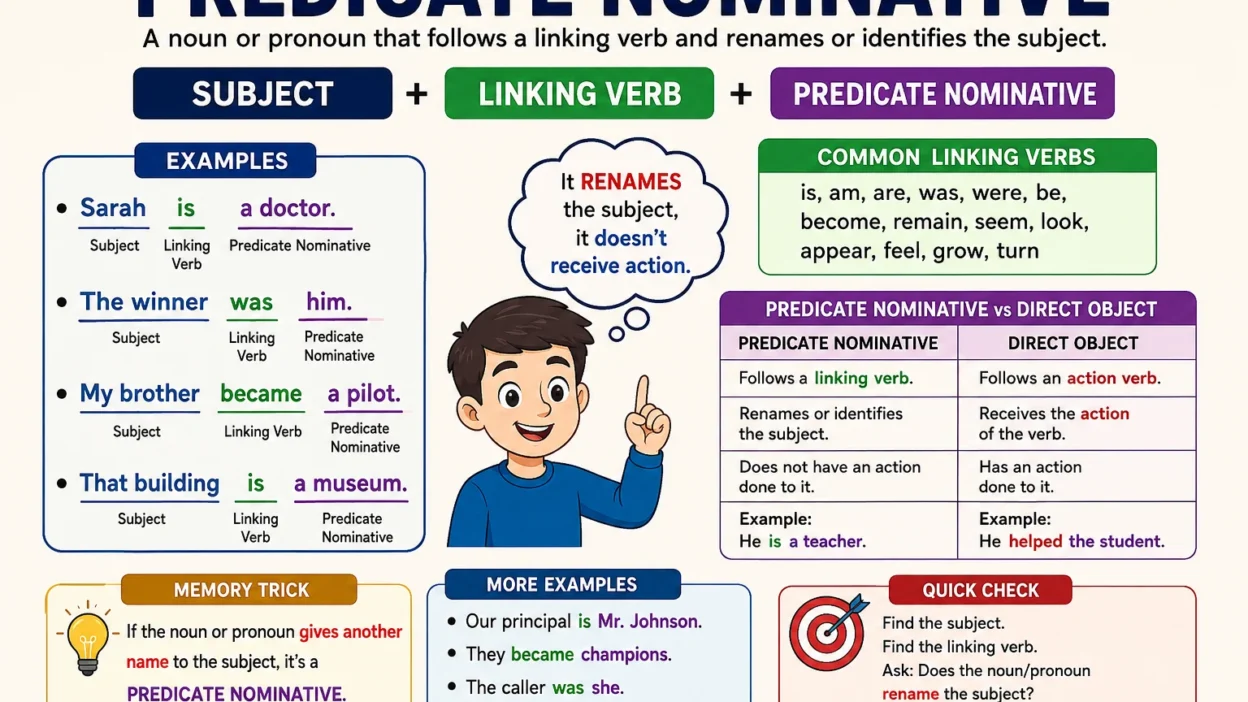
A predicate nominative is a noun or pronoun that follows a linking verb and renames or identifies the subject.
Example:
- Sarah is a teacher.
- The winner was he.
The predicate nominative never receives the action of the verb. Instead, it simply identifies the subject.
What Is a Predicate Nominative?
A predicate nominative is a noun or pronoun that appears after a linking verb and gives another name to the subject.
Formula:
Subject + Linking Verb + Predicate Nominative
Examples:
- Emma is an engineer.
- My brother became a pilot.
- The leader was she.
In each sentence, the highlighted word renames the subject rather than receiving an action.
Basic Structure Table
| Part | Example |
|---|---|
| Subject | Emma |
| Linking Verb | is |
| Predicate Nominative | an engineer |
| Complete Sentence | Emma is an engineer. |
How Does a Predicate Nominative Work?
A predicate nominative works by connecting the subject to another noun or pronoun through a linking verb.
Instead of showing action, the sentence simply identifies who or what the subject is.
Examples:
| Sentence | Predicate Nominative |
|---|---|
| David is the manager. | the manager |
| My pet became a champion. | a champion |
| The caller was she. | she |
| That building is a museum. | a museum |
Predicate Nominative vs Direct Object
Many students confuse these two grammar terms.
| Predicate Nominative | Direct Object |
|---|---|
| Renames the subject | Receives the action |
| Comes after a linking verb | Comes after an action verb |
| Identifies the subject | Answers “what?” or “whom?” |
| No action involved | Action is involved |
Examples:
Predicate Nominative:
- Olivia is a nurse.
Direct Object:
- Olivia treated the patient.
Notice that a nurse identifies Olivia, while the patient receives the action.
Predicate Nominative vs Predicate Adjective
These grammar concepts look similar but serve different purposes.
| Predicate Nominative | Predicate Adjective |
|---|---|
| Noun or pronoun | Adjective |
| Renames the subject | Describes the subject |
| She is a doctor. | She is kind. |
| They became winners. | They became tired. |
Examples:
Predicate Nominative:
- Mike is a firefighter.
Predicate Adjective:
- Mike is brave.
Common Linking Verbs Used with Predicate Nominatives
Predicate nominatives follow linking verbs.
Most Common Linking Verbs
| Linking Verb | Example |
|---|---|
| is | Lisa is a teacher. |
| am | I am the captain. |
| are | They are neighbors. |
| was | Tom was the winner. |
| were | We were volunteers. |
| be | To be a leader takes courage. |
| become | She became a scientist. |
| remain | He remained president. |
| seem | He seems a stranger. (Less common in modern English) |
How to Identify a Predicate Nominative
Follow these simple steps.
| Step | What to Check |
|---|---|
| 1 | Find the subject. |
| 2 | Locate the verb. |
| 3 | Ask if the verb is a linking verb. |
| 4 | See whether the following noun renames the subject. |
| 5 | If yes, it is a predicate nominative. |
Example:
Sentence:
The winner is James.
Subject:
The winner
Linking verb:
is
Predicate nominative:
James
Real-Life Examples of Predicate Nominatives
Understanding grammar becomes easier when you see it in everyday situations.
Business
- Maria became the CEO.
- James is our accountant.
- Their newest employee is Daniel.
Education
- Mr. Smith is our principal.
- Emily became class president.
- The tutor is my cousin.
Science
- Water is a compound.
- The largest planet is Jupiter.
- Carbon is an element.
Sports
- Our captain is Alex.
- The champion was Mia.
- Their coach became a mentor.
Daily Life
- My favorite meal is pizza.
- Our neighbor is a doctor.
- That woman is my aunt.
Grammar Forms Related to Predicate Nominatives
| Sentence Pattern | Example |
|---|---|
| Subject + is + noun | Anna is a writer. |
| Subject + was + noun | Ben was the captain. |
| Subject + became + noun | Sara became a lawyer. |
| Subject + remains + noun | David remains chairman. |
| Subject + will be + noun | Emma will be president. |
Why People Confuse Predicate Nominatives
There are several reasons learners mix up grammar terms.
- Both appear after verbs.
- Predicate nominatives and direct objects both use nouns.
- Linking verbs are often mistaken for action verbs.
- Predicate adjectives have nearly identical sentence structures.
- Grammar books sometimes introduce all three concepts together.
Common Mistakes and Corrections
Here are mistakes learners frequently make.
| Incorrect | Correct | Why |
|---|---|---|
| John is quickly. | John is quick. | Use an adjective, not an adverb. |
| Sarah became happily. | Sarah became happy. | Predicate adjective needed. |
| John is teacher. | John is a teacher. | Article required. |
| He is him. (Informal) | He is he. (Formal grammar) | Predicate nominative pronoun. |
| They elected John president. | Not a predicate nominative. | “Elected” is an action verb. |
Professional and Academic Usage
Predicate nominatives appear frequently in professional communication.
| Industry | Example |
|---|---|
| Business | Sarah is the finance manager. |
| Healthcare | Dr. Lee is the surgeon. |
| Education | Mrs. Brown became principal. |
| Government | Ahmed is the mayor. |
| Law | James is the attorney. |
| Technology | Maya became lead developer. |
Memory Tricks for Remembering Predicate Nominatives
These simple tips make identification easier.
- Think rename, not receive.
- Linking verbs connect rather than perform actions.
- If the noun gives another name to the subject, it’s a predicate nominative.
- Replace the linking verb with an equals sign.
Example:
Emma is a scientist.
Emma = a scientist
That confirms scientist is the predicate nominative.
Practice Examples
Identify the predicate nominative.
| Sentence | Predicate Nominative |
|---|---|
| My uncle is a chef. | a chef |
| Lucy became captain. | captain |
| Their leader was Mark. | Mark |
| The tallest student is Ethan. | Ethan |
| This building is a library. | a library |
Tips for Using Predicate Nominatives Correctly
- Learn the common linking verbs.
- Check whether the noun renames the subject.
- Do not confuse it with a direct object.
- Remember that no action is taking place.
- Practice identifying subjects before analyzing sentence structure.
Frequently Asked Questions
What is a predicate nominative?
A predicate nominative is a noun or pronoun that follows a linking verb and renames the subject.
Can a pronoun be a predicate nominative?
Yes. Example: The winner was he.
Does every sentence have a predicate nominative?
No. Only sentences with linking verbs followed by a noun or pronoun that identifies the subject contain one.
Is a predicate nominative the same as a direct object?
No. A direct object receives an action, while a predicate nominative simply renames the subject.
Which verbs usually introduce predicate nominatives?
Common linking verbs include is, am, are, was, were, become, remain, and be.
How can I quickly identify a predicate nominative?
Find the linking verb. If the noun after it gives another name to the subject instead of receiving an action, it is a predicate nominative.
Conclusion
A predicate nominative is a noun or pronoun that follows a linking verb and renames the subject.
Unlike a direct object, it does not receive an action. Instead, it identifies who or what the subject is.
By recognizing linking verbs, checking whether the noun renames the subject, and practicing with real-life examples, you can easily master predicate nominatives and avoid common grammar mistakes.
if you’re writing essays, business emails, or preparing for English exams, understanding this grammar concept will make your sentences more accurate and professional.

Julian Wyatt is a passionate researcher and writer who explores symbols, mythology, cultural traditions, and hidden meanings. Through engaging articles, he helps readers uncover the fascinating stories and significance behind symbols worldwide.