
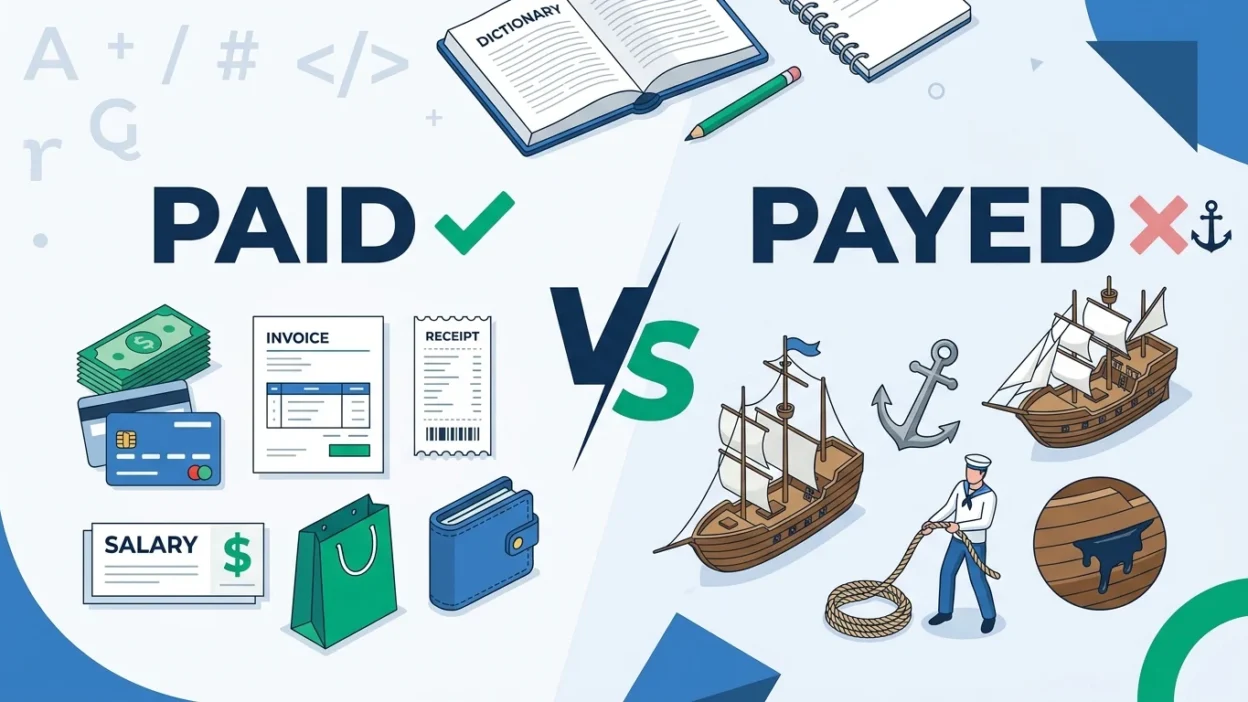
The confusion between paid vs payed is surprisingly common because both words exist in English, but they are not interchangeable.
Most people use paid when referring to money, bills, salaries, or purchases, while payed is a rare term used in specific nautical and technical contexts
Understanding paid vs payed helps you avoid one of the most common spelling mistakes in English writing.
If you’ve ever wondered whether to write “I paid the bill” or “I payed the bill,” you’re not alone.
This guide explains paid vs payed with simple definitions, grammar rules, comparison tables, real life examples, and practical tips so you can confidently choose the correct word in every situation.
Quick Answer
Paid is the correct past tense and past participle of pay when referring to money, wages, debts, or purchases.
Payed is a correct but rare word used mainly in nautical contexts, meaning to let out rope or coat a ship with tar.
For almost every everyday situation, paid is the correct choice.
Paid vs Payed Comparison Table
| Feature | Paid | Payed |
|---|---|---|
| Grammar Status | Correct for money-related uses | Correct only in nautical contexts |
| Part of Speech | Past tense and past participle | Specialized past tense form |
| Everyday Usage | Very common | Extremely rare |
| Used for Money | Yes | No |
| Standard English | Yes | Only in technical contexts |
What Does “Paid” Mean?
Paid is the standard past tense and past participle of the verb pay.
It is used whenever you’re talking about money, salaries, debts, purchases, bills, fees, wages, or rewards.
Examples
- I paid the electricity bill.
- She paid for dinner.
- The company paid employee bonuses.
- We paid our taxes on time.
What Does “Payed” Mean?
Payed is a legitimate English word, but it is not used when talking about money.
Instead, it has specialized meanings in maritime and nautical language.
It can mean:
- To let rope or cable move freely.
- To coat the seams of a wooden ship with tar or pitch.
Examples
- The sailors payed out the anchor rope.
- Workers payed the ship’s seams before sailing.
These uses are uncommon outside maritime industries.
Key Differences Between Paid and Payed
| Paid | Payed |
|---|---|
| Related to money | Related to ships and ropes |
| Common in everyday English | Rare technical word |
| Correct for payments | Incorrect for financial payments |
| Used worldwide | Mostly nautical |
Grammar Forms of Pay
| Verb Form | Word |
|---|---|
| Base Form | Pay |
| Present Participle | Paying |
| Past Tense | Paid |
| Past Participle | Paid |
Exception
In nautical English:
- Base Form: Pay
- Past Form: Payed (specialized meaning)
When to Use “Paid”
Use paid whenever discussing:
- Bills
- Salaries
- Loans
- Purchases
- Fees
- Taxes
- Rewards
- Compensation
Examples
- I paid my rent yesterday.
- She paid for the groceries.
- They paid the contractor.
- We paid our employees.
When to Use “Payed”
Use payed only in specialized nautical situations.
Examples
- The crew payed out the rope.
- Sailors payed the ship’s hull with tar.
- The cable was carefully payed out.
Outside these meanings, avoid using payed.
Real-Life Examples
Business
| Sentence | Correct Word |
|---|---|
| The customer ______ the invoice. | Paid |
| Employees were ______ on Friday. | Paid |
Education
| Sentence | Correct Word |
|---|---|
| She paid the tuition fees. | Paid |
| Students paid for textbooks. | Paid |
Maritime Industry
| Sentence | Correct Word |
|---|---|
| The sailors ______ out the rope. | Payed |
| Workers ______ the deck seams. | Payed |
Everyday Conversation
- I paid for lunch.
- Have you paid your phone bill?
- She paid the membership fee.
- We paid cash.
Industry Usage Table
| Industry | Paid | Payed |
|---|---|---|
| Business | Very common | Never |
| Banking | Very common | Never |
| Education | Very common | Never |
| Retail | Very common | Never |
| Maritime | Occasionally | Common for technical meaning |
| Shipping | Occasionally | Used with ropes and ships |
Why People Confuse Paid vs Payed
Several reasons explain the confusion.
- Many regular verbs end in -ed.
- Learners assume pay follows the same pattern.
- Spell-check sometimes doesn’t explain the difference.
- Most people have never encountered the nautical meaning of payed.
- English contains many irregular verbs.
Common Mistakes
| Incorrect Sentence | Correct Sentence |
|---|---|
| I payed the bill. | I paid the bill. |
| She payed her rent. | She paid her rent. |
| They payed the employees. | They paid the employees. |
| Have you payed your taxes? | Have you paid your taxes? |
| We payed for dinner. | We paid for dinner. |
Memory Tricks
Paid = Payment
Both words begin with Pay, and Paid always relates to payment.
Payed = Pirates
Think of payed as belonging to old sailing ships, ropes, and pirates.
Easy Rule
Money?
✔ Paid
Ships and ropes?
✔ Payed
Comparison Table by Situation
| Situation | Correct Word |
|---|---|
| Paying rent | Paid |
| Paying employees | Paid |
| Paying taxes | Paid |
| Buying groceries | Paid |
| Letting out rope | Payed |
| Waterproofing a ship | Payed |
Step-by-Step Guide to Choosing the Correct Word
| Step | Question | Choose |
|---|---|---|
| 1 | Is money involved? | Paid |
| 2 | Is it about a bill or salary? | Paid |
| 3 | Is it about ships or ropes? | Payed |
| 4 | Is it everyday writing? | Paid |
| 5 | Unsure? | Use Paid |
Professional Usage
Professionals almost always use paid.
Examples:
- The company paid its suppliers.
- Customers paid online.
- Employees are paid monthly.
- Contractors are paid after completion.
Only maritime professionals regularly use payed.
Common Expressions
With Paid
- Paid in full
- Paid vacation
- Paid leave
- Paid subscription
- Paid invoice
- Paid employee
With Payed
- Payed out rope
- Payed the cable
- Payed the seams
FAQs
Is “payed” a real word?
Yes. It is a real English word but only in specialized nautical contexts.
Is “paid” the correct past tense of pay?
Yes. Paid is the standard past tense and past participle when referring to money.
Can I say “I payed the bill”?
No. The correct sentence is I paid the bill.
Why does “payed” exist?
It survives from older maritime vocabulary relating to ships, ropes, and waterproofing.
Which spelling is more common?
Paid is overwhelmingly more common in modern English.
How do I remember the difference?
Remember:
Money = Paid
Ships = Payed
Conclusion
Understanding paid vs payed is simple once you know their meanings. Paid is the correct past tense and past participle of pay whenever you’re talking about money, salaries, purchases, or bills.
Payed, although a real word, is reserved for rare nautical meanings involving ships and ropes. For almost every situation in everyday writing, emails, business communication, and academic work, paid is the correct choice.
Remember the simple rule: if money is involved, always use paid.