If you have ever seen the words calvary vs cavalry you may have wondered whether they are simply different spellings of the same word.
They look and sound remarkably similar, but their meanings are completely different.
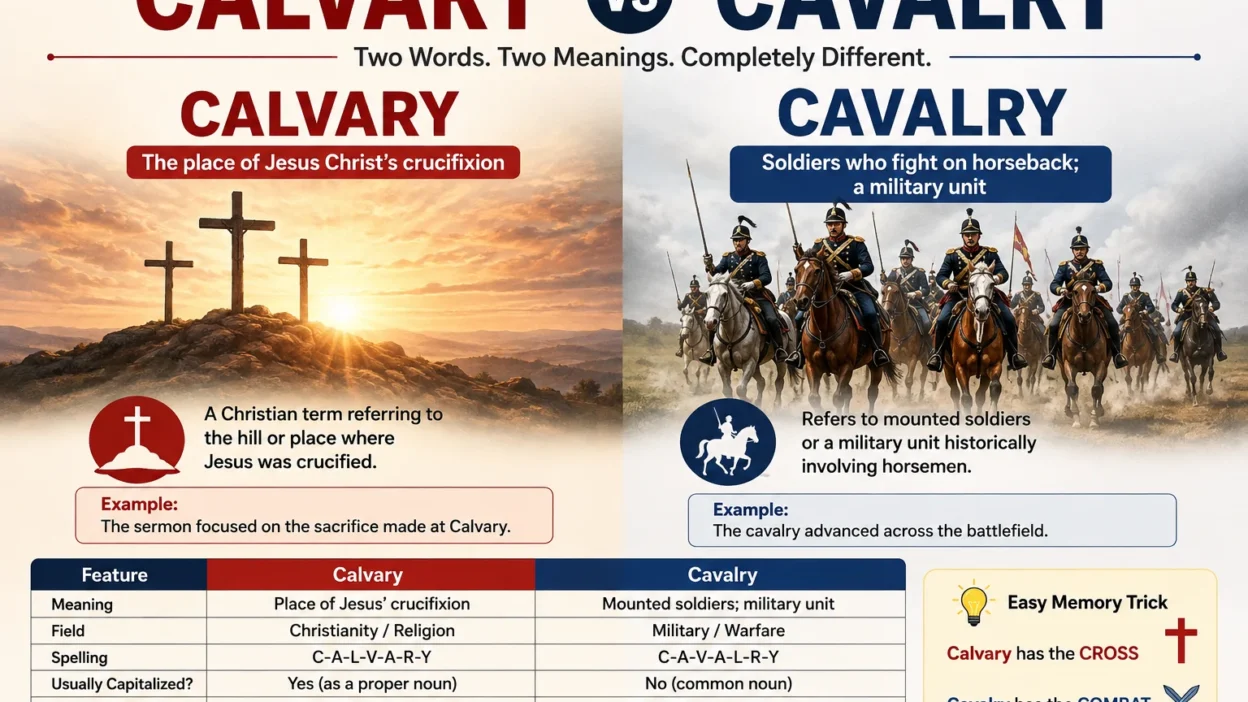
One is primarily associated with Christianity and the place where Jesus was crucified, while the other refers to soldiers who historically fought on horseback.
Understanding calvary vs cavalry is important because confusing these words can change the meaning of a sentence completely.
Although both words are pronounced similarly in many varieties of English, they belong to very different contexts.
In this guide, we will explain the calvary vs cavalry difference, their meanings, pronunciation, usage, examples, common mistakes, and easy memory tricks so you can confidently choose the correct word.
Quick Answer: Calvary vs Cavalry
Calvary is a Christian term referring to the hill or place associated with the crucifixion of Jesus Christ.
Cavalry refers to soldiers who traditionally fought on horseback, and in modern military usage, it can refer to military units descended from that tradition.
Memory trick: Calvary = Cross; Cavalry = Combat on horseback.
What Does Calvary Mean?
Calvary is a proper noun in Christian contexts. It traditionally refers to the place outside Jerusalem where Jesus Christ was crucified.
The word comes from the Latin Calvaria, meaning “skull,” and is related to the biblical name Golgotha.
Because it refers to a specific religious place and event, Calvary is usually capitalized when used in its Christian sense.
Examples of Calvary
- Christians remember Calvary as the place of Christ’s crucifixion.
- The painting depicts Jesus carrying the cross toward Calvary.
- The sermon focused on the sacrifice made at Calvary.
- The church held a special service commemorating Calvary.
In religious writing, you may also see phrases such as the cross of Calvary or the road to Calvary.
What Does Cavalry Mean?
Cavalry is a military noun. Historically, it referred to soldiers who fought while mounted on horses.
Before modern military technology became widespread, cavalry units were important because horses allowed soldiers to move quickly across battlefields and attack from a position of mobility.
Today, the word can describe military units that preserve the traditional name or role of cavalry even when they use modern vehicles rather than horses.
Examples of Cavalry
- The cavalry arrived on the battlefield at dawn.
- The general ordered the cavalry to advance.
- Historically, cavalry soldiers were trained to fight from horseback.
- The army deployed a modern cavalry unit for reconnaissance.
The word is therefore strongly connected with military history, warfare, mounted soldiers, and military units.
Calvary vs Cavalry: The Main Difference
The easiest way to understand calvary vs cavalry is to remember that they belong to entirely different subjects.
| Word | Meaning | Main Context | Example |
|---|---|---|---|
| Calvary | The place associated with Jesus Christ’s crucifixion | Christianity | Jesus was crucified at Calvary. |
| Cavalry | Mounted soldiers or a military unit | Military | The cavalry advanced across the field. |
The spelling difference is small, but the meaning difference is significant.
Calvary has a religious meaning, while cavalry has a military meaning.
Calvary vs Cavalry Pronunciation
The two words are often confused partly because their pronunciations are very similar.
| Word | Common Pronunciation | Meaning |
|---|---|---|
| Calvary | KAL-vuh-ree | Christian place of crucifixion |
| Cavalry | KAV-uhl-ree / KAL-vuh-ree, depending on accent | Mounted military unit |
Pronunciation can vary by speaker and region. In some accents, the distinction between the words may be difficult to hear.
That is why remembering their spelling and context is more reliable than relying only on pronunciation.
Why Do People Confuse Calvary and Cavalry?
There are several reasons people mix up these words.
First, both words contain nearly the same letters. Calvary has one fewer “a” after the initial “c” than cavalry, making them visually similar.
Second, their pronunciations can sound almost identical, particularly in fast speech.
Third, both words can appear in serious or historical contexts. Someone reading about a battle may see cavalry, while someone reading religious history may encounter Calvary.
The easiest solution is to connect each word with its subject:
- Calvary → Christianity → Crucifixion
- Cavalry → Combat → Soldiers
Calvary Meaning in Religious Contexts
In Christianity, Calvary is associated with the crucifixion of Jesus.
The term is especially common in Christian sermons, hymns, books, Bible-related discussions, and religious literature.
Here are some examples:
The pastor spoke about Christ’s sacrifice at Calvary.
The hymn described the journey toward Calvary.
The artwork portrayed the crucifixion at Calvary.
In these examples, cavalry would be incorrect because the sentences have nothing to do with soldiers or military forces.
Cavalry Meaning in Military Contexts
Cavalry traditionally refers to mounted soldiers.
Historically, cavalry played important roles in reconnaissance, charges, communication, pursuit, and battlefield maneuvering.
Modern military organizations may still use the term cavalry for units that perform reconnaissance, surveillance, security, or other mobile combat functions.
Military Examples
- The cavalry moved quickly across the battlefield.
- The commander sent the cavalry ahead to scout the area.
- Historical cavalry units often relied on horses for mobility.
- The museum displays uniforms worn by cavalry soldiers.
In all of these sentences, cavalry is the correct spelling.
Grammar and Word Forms
Both words function primarily as nouns, but their grammatical behavior differs because of their meanings.
| Word | Part of Speech | Singular/Plural Use | Example |
|---|---|---|---|
| Calvary | Proper noun | Generally treated as a singular place/name | Calvary is central to Christian tradition. |
| cavalry | Noun | Usually collective/mass noun | The cavalry advanced. |
| cavalryman | Noun | Singular person | The cavalryman rode across the field. |
| cavalrymen | Noun | Plural people | The cavalrymen prepared for battle. |
Cavalry is often treated as a collective noun, so you will commonly see constructions such as the cavalry was in American English.
For an individual soldier, cavalryman or cavalry soldier can be used.
Calvary vs Cavalry in Real-Life Usage
The context usually tells you immediately which word is needed.
| Context | Correct Word | Example |
|---|---|---|
| Christianity | Calvary | The sermon discussed Calvary. |
| Crucifixion | Calvary | The painting shows Christ at Calvary. |
| Bible studies | Calvary | The lesson focused on Calvary. |
| Military history | Cavalry | The cavalry charged forward. |
| Horse soldiers | Cavalry | The cavalry rode across the plain. |
| Battlefield strategy | Cavalry | The commander positioned the cavalry on the flank. |
| Military museums | Cavalry | The museum contains cavalry equipment. |
Professional and Industry Usage
The two words appear in very different professional fields.
| Industry or Field | Word Commonly Used | Typical Usage |
|---|---|---|
| Theology | Calvary | Discussions of the crucifixion |
| Christianity | Calvary | Sermons and religious education |
| Religious literature | Calvary | Descriptions of Christ’s sacrifice |
| Military history | Cavalry | Historical military units |
| Armed forces | Cavalry | Names and roles of military units |
| History education | Cavalry | Battles and military tactics |
| Museums | Cavalry | Historical military exhibits |
A simple rule is to identify the field first. If the subject is Christian theology, think Calvary. If the subject is warfare or military history, think cavalry.
Common Mistakes With Calvary and Cavalry
Because the words are so similar, spelling mistakes are common.
Incorrect: The soldiers marched toward Calvary.
If the sentence means soldiers or a military unit, cavalry is probably intended.
Correct: The soldiers marched with the cavalry.
Here, the sentence is about military forces.
Incorrect: Jesus was crucified at cavalry.
The religious place is Calvary.
Correct: Jesus was crucified at Calvary.
Incorrect: The pastor spoke about the cavalry of Christ.
If the intended meaning is the Christian place, the correct word is Calvary.
Correct: The pastor spoke about the sacrifice at Calvary.
Common Mistakes Table
| Incorrect | Correct | Why? |
|---|---|---|
| Jesus was crucified at cavalry. | Jesus was crucified at Calvary. | Religious context |
| The cavalry was a place of crucifixion. | Calvary was associated with the crucifixion. | Calvary is the religious term |
| The Calvary charged the enemy. | The cavalry charged the enemy. | Military context |
| He joined the Calvary. | He joined the cavalry. | Military unit |
| The sermon described the cavalry. | The sermon described Calvary. | Christian context |
How to Remember Calvary vs Cavalry
A good memory trick can make the difference easy.
Calvary = Cross
Think:
Calvary → Cross → Christ
The word Calvary has the shorter spelling and is associated with the Christian crucifixion.
Cavalry = Combat
Think:
Cavalry → Combat → Soldiers
The extra a in cavalry can remind you of armed forces and mounted soldiers.
Another simple memory sentence is:
Calvary has the Cross; cavalry has the combat.
This distinction is useful when writing quickly or proofreading your work.
Calvary vs Cavalry in Education
Students may encounter both words in completely different subjects.
In religious studies, history, or theology, Calvary may appear in lessons about Jesus, the crucifixion, and Christianity.
In history or military studies, cavalry may appear in lessons about warfare, armies, mounted soldiers, and military strategy.
Educational Examples
Religious studies:
The class studied the significance of Calvary in Christian theology.
Military history:
The students learned how cavalry units influenced medieval warfare.
The surrounding vocabulary usually makes the intended word clear.
Calvary vs Cavalry in Literature
Both words can appear in literature, but they create very different images.
Calvary can evoke sacrifice, suffering, faith, crucifixion, and redemption.
Cavalry can evoke soldiers, horses, battles, movement, warfare, and military rescue.
For example:
The novel describes the character’s spiritual journey toward Calvary.
This has a religious meaning.
Compare:
The cavalry arrived just before the battle began.
This clearly describes military forces.
Is Cavalry Always About Horses?
Historically, yes, cavalry was strongly associated with mounted soldiers, particularly soldiers on horseback.
However, modern military terminology can use cavalry for units whose missions are similar to traditional cavalry roles even when horses are no longer used.
Modern cavalry units may operate using armored vehicles, helicopters, or other forms of transportation depending on the military organization.
Therefore, cavalry should not always be understood literally as “soldiers riding horses.”
Is Calvary a Place?
Yes. In Christian usage, Calvary refers to the place associated with the crucifixion of Jesus Christ.
It is traditionally identified with Golgotha, the site described in the New Testament.
Because Calvary is a proper name in this context, it is normally capitalized.
For example:
- Correct: Jesus was crucified at Calvary.
- Incorrect: Jesus was crucified at calvary.
However, lowercase calvary can sometimes occur in figurative or extended usage, particularly when referring to a painful ordeal or experience. Such usage is less common than the proper-name religious sense.
Is Cavalry Singular or Plural?
Cavalry is a collective noun rather than a typical plural form.
For example:
The cavalry arrived.
This means the military unit or group of cavalry soldiers arrived.
You generally do not need to write cavalries when simply referring to cavalry soldiers collectively.
When referring to an individual, use terms such as:
- cavalryman
- cavalrywoman
- cavalry soldier
Examples
| Meaning | Example |
|---|---|
| Collective military unit | The cavalry advanced. |
| Individual male soldier | The cavalryman rode ahead. |
| Multiple soldiers | The cavalrymen followed the commander. |
| Modern unit | The cavalry unit conducted reconnaissance. |
Calvary vs Cavalry: A Quick Comparison
| Feature | Calvary | Cavalry |
|---|---|---|
| Meaning | Place associated with Christ’s crucifixion | Mounted military soldiers/unit |
| Field | Christianity | Military |
| Word type | Proper noun | Common noun |
| Usually capitalized? | Yes, in Christian usage | No |
| Associated with | Jesus, cross, crucifixion | Soldiers, horses, warfare |
| Example phrase | Road to Calvary | Cavalry unit |
| Memory word | Cross | Combat |
A Simple Process for Choosing the Right Word
When you are unsure between calvary vs cavalry, follow these steps.
| Step | Question | Choice |
|---|---|---|
| 1 | Is the sentence about Christianity? | Consider Calvary |
| 2 | Is it about Jesus’ crucifixion? | Calvary |
| 3 | Is it about soldiers or warfare? | Consider cavalry |
| 4 | Is it about mounted military forces? | Cavalry |
| 5 | Is the context still unclear? | Look at the surrounding nouns and verbs |
The key is not to memorize the entire dictionary definitions. Just identify the subject of the sentence.
Calvary vs Cavalry Examples in Sentences
Here are additional examples showing the difference clearly.
Calvary Examples
- The priest spoke about Christ’s sacrifice at Calvary.
- The painting depicts the journey to Calvary.
- The hymn reflects on the suffering of Calvary.
- The students learned about the Christian significance of Calvary.
- The speaker described the crucifixion at Calvary.
Cavalry Examples
- The cavalry moved rapidly across the battlefield.
- The commander ordered the cavalry to advance.
- The museum has an exhibit about medieval cavalry.
- The novel describes a charge by the cavalry.
- The army used cavalry for reconnaissance.
What Is the Difference Between Calvary and Cavalry?
The difference is simple: Calvary is a Christian term connected with the crucifixion of Jesus, while cavalry is a military term referring historically to mounted soldiers or military units.
They look and sound similar, but they cannot normally be substituted for one another.
If your sentence contains words such as Jesus, Christ, cross, crucifixion, church, sacrifice, or Golgotha, choose Calvary.
If it contains words such as soldiers, horses, army, battlefield, military, charge, or reconnaissance, choose cavalry.
Frequently Asked Questions
Is Calvary the same as cavalry?
No. Calvary is associated with the place of Jesus Christ’s crucifixion, while cavalry refers to soldiers or military units traditionally associated with mounted warfare.
What does Calvary mean in the Bible?
Calvary is the Christian name traditionally used for the place where Jesus was crucified. It is associated with Golgotha.
What does cavalry mean?
Cavalry refers historically to soldiers who fought on horseback. In modern military terminology, the term can also describe certain mobile military units.
How do you remember Calvary vs cavalry?
Remember Calvary = Cross and cavalry = Combat. The first is religious, while the second is military.
Is Calvary capitalized?
Yes, when Calvary refers to the Christian place associated with Jesus’ crucifixion, it is normally capitalized.
Is cavalry still used today?
Yes. Although traditional horse-mounted cavalry is largely historical, modern armed forces may use the term cavalry for mobile, reconnaissance, or armored units.
Final Conclusion: Calvary vs Cavalry
The difference between calvary vs cavalry is easy once you connect each word with its context. Calvary is the Christian term associated with the place of Jesus Christ’s crucifixion. Cavalry is a military term referring historically to mounted soldiers and, in modern usage, certain military units.
When you see Christ, cross, crucifixion, or Golgotha, think Calvary. When you see soldiers, horses, battles, army, or military units, think cavalry.
The simplest rule to remember is: Calvary = Cross; Cavalry = Combat. Once you learn this distinction, you can avoid one of the most common spelling and word choice mistakes in English.