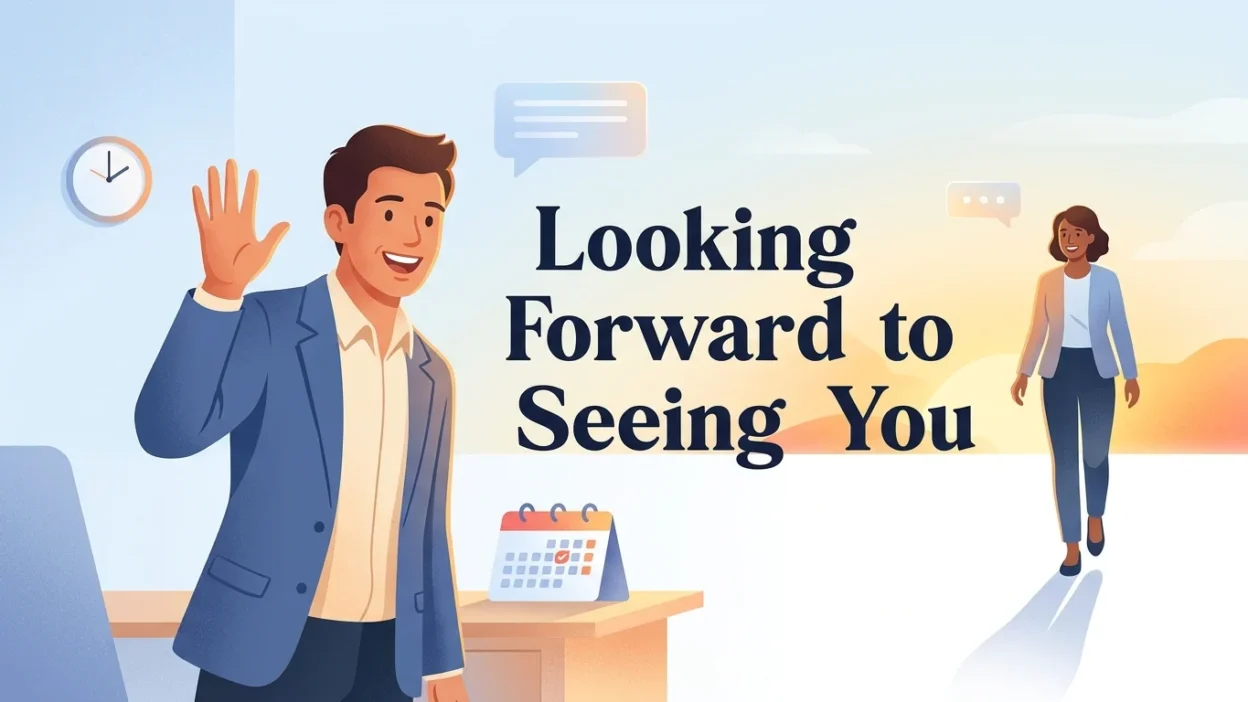
The phrase looking forward to seeing you is one of the most commonly used expressions in English conversations and emails.
People use it to express excitement, anticipation, or happiness about meeting someone in the future.
However, many English learners wonder about the exact meaning, proper usage, and whether it is suitable for professional situations.
Understanding looking forward to seeing you can improve both written and spoken communication.
The phrase appears frequently in business emails, invitations, friendly messages, and academic communication. Knowing when and how to use it correctly helps you sound natural, polite, and confident.
Quick Answer
Looking forward to seeing you means that you are excited or pleased about meeting someone in the future. It is a polite and friendly expression used in personal and professional communication.
Examples:
- Looking forward to seeing you at the meeting tomorrow.
- We are looking forward to seeing you at our event.
What Does Looking Forward to Seeing You Mean?
The phrase expresses positive anticipation about an upcoming meeting.
Definition: Feeling happy, excited, or eager about meeting someone in the future.
Example Sentences
- I’m looking forward to seeing you next week.
- We’re looking forward to seeing you at the conference.
- She is looking forward to seeing her family during the holidays.
Main Meaning Table
| Phrase | Meaning | Tone | Common Use |
|---|---|---|---|
| Looking forward to seeing you | Excited about meeting someone soon | Friendly and positive | Emails, invitations, messages |
| Looking forward to meeting you | Excited to meet someone for the first time | Professional and polite | Interviews, introductions |
Why Do People Use Looking Forward to Seeing You?
People use this phrase because it sounds warm and respectful. It tells the other person that their presence matters.
Common reasons include:
- Showing enthusiasm
- Building positive relationships
- Ending emails politely
- Confirming future plans
- Expressing friendliness
Looking Forward to Seeing You vs Looking Forward to Meeting You
These phrases are similar but not identical.
| Phrase | Used With | Example |
|---|---|---|
| Looking forward to seeing you | Someone you already know | Looking forward to seeing you next month. |
| Looking forward to meeting you | Someone you have never met | Looking forward to meeting you during the interview. |
Key Difference
Use seeing you for familiar people and meeting you for first-time introductions.
Grammar Structure of Looking Forward to Seeing You
The phrase follows a specific grammatical pattern.
Looking forward to + noun/pronoun/verb + ing
Examples:
- Looking forward to seeing you.
- Looking forward to hearing from you.
- Looking forward to working with you.
Grammar Forms Table
| Structure | Correct Example |
|---|---|
| Looking forward to + noun | Looking forward to the event |
| Looking forward to + pronoun | Looking forward to seeing you |
| Looking forward to + verb-ing | Looking forward to working together |
Is Looking Forward to Seeing You Formal or Informal?
The phrase works in both formal and informal situations.
Formal Examples
- We are looking forward to seeing you at the annual conference.
- I am looking forward to seeing you during tomorrow’s meeting.
Informal Examples
- Looking forward to seeing you this weekend!
- I’m looking forward to seeing you at the party.
Real-Life Examples of Looking Forward to Seeing You
Business
“I’m looking forward to seeing you at our project meeting next Tuesday.”
Education
“The teacher said she was looking forward to seeing the students after summer vacation.”
Healthcare
“The doctor said he was looking forward to seeing the patient’s recovery.”
Science Conference
“The organizers are looking forward to seeing researchers from around the world.”
Personal Life
“I’m looking forward to seeing my grandparents this weekend.”
Industry Usage Table
| Industry | Example Sentence |
|---|---|
| Business | Looking forward to seeing you at our quarterly meeting. |
| Education | Looking forward to seeing everyone in class tomorrow. |
| Healthcare | Looking forward to seeing your progress next month. |
| Events | Looking forward to seeing all guests at the ceremony. |
| Research | Looking forward to seeing your presentation at the conference. |
When Should You Use Looking Forward to Seeing You?
Use this phrase when:
- A meeting is already planned
- You want to sound polite
- You are ending an email positively
- You wish to express excitement
- You expect to meet someone soon
Common Situations Table
| Situation | Appropriate? |
|---|---|
| Business email | Yes |
| Invitation | Yes |
| Friendly text message | Yes |
| Academic communication | Yes |
| Job interview follow-up | Yes |
Common Mistakes and Corrections
Many learners make small grammar mistakes with this phrase.
| Incorrect | Correct |
|---|---|
| I look forward to see you. | I look forward to seeing you. |
| I am looking forward see you. | I am looking forward to seeing you. |
| Looking forward seeing you. | Looking forward to seeing you. |
| I look forward to seeing your tomorrow. | I look forward to seeing you tomorrow. |
Why These Mistakes Happen
People often forget that to belongs to the expression look forward to, so it must be followed by a noun or an -ing verb.
Why Do People Confuse Looking Forward to Seeing You?
There are several reasons:
- They think “to” requires an infinitive verb.
- They confuse it with other expressions.
- They are unfamiliar with phrasal expressions.
- Direct translation from other languages causes errors.
Memory Trick for Using Looking Forward to Seeing You
Remember this simple formula:
Look forward to + ing
Think of:
- Looking forward to eating
- Looking forward to traveling
- Looking forward to seeing
If you remember the -ing rule, you will rarely make mistakes.
Step-by-Step Process for Using the Phrase
| Step | Action |
|---|---|
| Step 1 | Think about a future meeting |
| Step 2 | Express excitement or happiness |
| Step 3 | Use “looking forward to” |
| Step 4 | Add an -ing verb or noun |
| Step 5 | Finish the sentence naturally |
Example
“I’m looking forward to seeing you at next week’s seminar.”
Alternative Ways to Say Looking Forward to Seeing You
- Can’t wait to see you.
- Excited to see you.
- Eager to see you.
- Happy to see you soon.
- I anticipate seeing you.
Each option has a slightly different tone, but all express positive expectation.
Frequently Asked Questions
Is “looking forward to seeing you” grammatically correct?
Yes. It is completely correct and commonly used in English.
Is it professional to say “looking forward to seeing you”?
Yes. It is appropriate in business emails and professional conversations.
Can I say “looking forward to see you”?
No. The correct form is “looking forward to seeing you.”
Can I use it with friends?
Absolutely. It is natural and friendly in personal conversations.
Is it formal or informal?
It can be both, depending on the situation and wording.
Can I use it in emails?
Yes. It is one of the most common ways to end professional and personal emails.
Conclusion
The phrase looking forward to seeing you means feeling excited and happy about meeting someone in the future. It is suitable for professional emails, academic settings, invitations, and everyday conversations.
The most important rule is to remember that looking forward to is followed by a noun or an ing verb.
Using this expression correctly helps you sound polite, friendly, and natural in English communication.