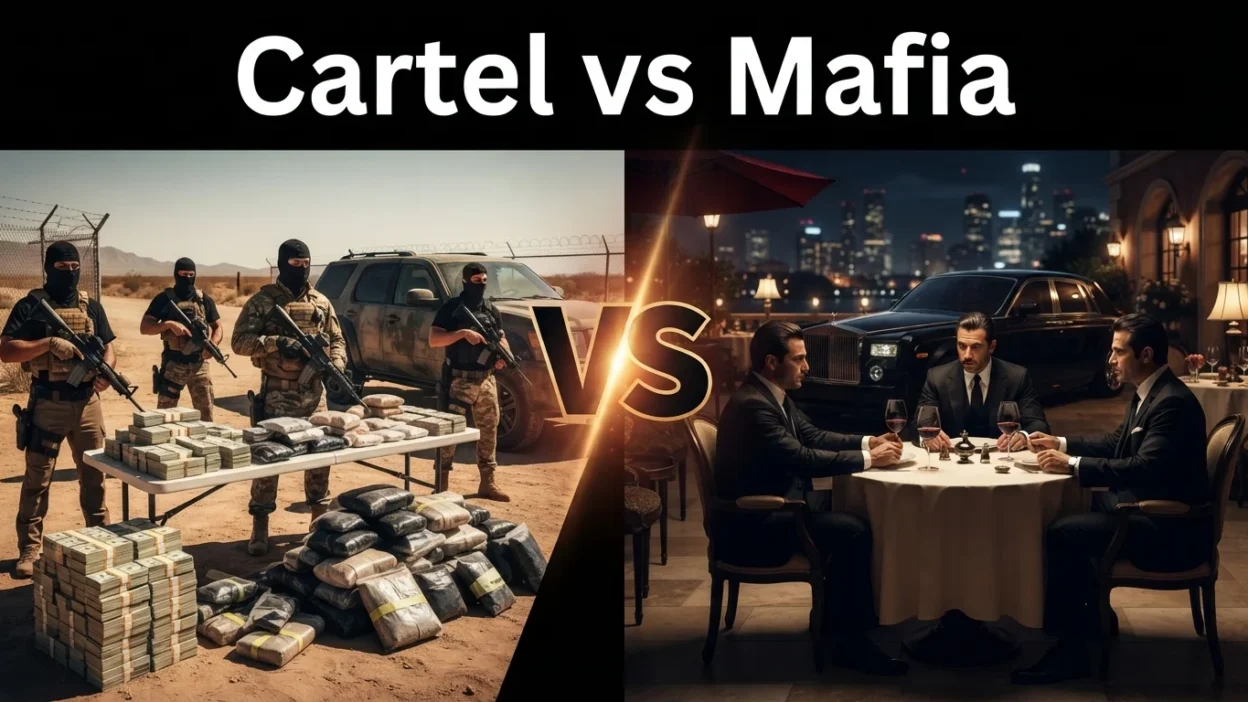
The debate over cartel vs mafia often comes up in news reports, movies, books, and everyday conversations.
While many people use these terms interchangeably, they do not mean the same thing.
Understanding the cartel vs mafia difference helps you use the correct word when discussing organized crime, history, or current events.
A cartel is usually an organized group focused on controlling illegal markets, especially drug trafficking, while a mafia is a broader criminal organization with deep roots in family structure, extortion, corruption, and various illegal businesses.
This guide explains the cartel vs mafia meaning, differences, examples, and proper usage in simple English.
Quick Answer
A cartel is an organized criminal group mainly involved in controlling illegal markets, especially drugs.
A mafia is a structured criminal organization that operates through family ties, extortion, racketeering, corruption, and multiple illegal activities. Every cartel is organized crime, but not every mafia is a cartel.
What Does “Cartel” Mean?
A cartel is an organized group that works together to control a market. The word can have both legal and illegal meanings.
In economics, a cartel refers to businesses cooperating to reduce competition.
In crime, a cartel is a powerful criminal organization that controls the production, transportation, and sale of illegal goods such as narcotics.
Examples
- The drug cartel controlled trafficking routes.
- Authorities arrested several cartel members.
- The cartel expanded into neighboring regions.
What Does “Mafia” Mean?
A mafia is a highly organized criminal society that often follows a hierarchy and family-based structure. Mafias may engage in extortion, money laundering, gambling, loan sharking, smuggling, and corruption.
Historically, the term “Mafia” referred to organized crime groups originating in Sicily, although today it is also used more broadly.
Examples
- The mafia controlled local businesses through intimidation.
- Police investigated mafia-related corruption.
- The mafia operated illegal gambling networks.
Cartel vs Mafia: Main Differences
| Feature | Cartel | Mafia |
|---|---|---|
| Primary goal | Control illegal markets | Operate diverse criminal enterprises |
| Structure | Business-like criminal organization | Family or clan-based hierarchy |
| Main activities | Drug trafficking, smuggling | Extortion, gambling, corruption, racketeering |
| Geographic focus | Often international | Can be local, national, or international |
| Leadership | Centralized leadership | Bosses, underbosses, captains, soldiers |
| Origin | Economic term adapted to crime | Sicilian organized crime tradition |
Cartel vs Mafia Comparison Table
| Category | Cartel | Mafia |
|---|---|---|
| Meaning | Criminal organization controlling illegal markets | Organized criminal society |
| Common industries | Drugs, weapons, smuggling | Extortion, gambling, fraud, corruption |
| Organization | Business-focused | Family-focused |
| Recruitment | Criminal associates | Often family or trusted members |
| Public image | Drug trafficking | Traditional organized crime |
Origin of the Terms
Cartel
The word cartel comes from European languages referring to agreements between groups. Economists still use the word to describe companies that cooperate to reduce competition.
Mafia
The word mafia originated in Sicily during the 19th century and became associated with organized criminal families that exercised influence through violence and intimidation.
Real-Life Examples
| Situation | Cartel Example | Mafia Example |
|---|---|---|
| News | Drug trafficking organization | Extortion ring |
| Movies | Drug smuggling network | Crime family |
| Law enforcement | Cross-border narcotics investigation | Organized crime investigation |
| History | Cocaine trafficking groups | Sicilian crime organizations |
Cartel vs Mafia in Different Contexts
Business
A cartel may legally refer to companies fixing prices, although such agreements are illegal in many countries.
The word mafia is rarely used literally in business, though people sometimes use it metaphorically, such as “parking mafia.”
Education
Students learn about cartels in economics and organized crime studies.
Mafia appears in history, sociology, and criminology courses.
Media
Films often portray both cartels and mafias, but they emphasize different criminal activities.
Law Enforcement
Police and investigators distinguish between cartels and mafias because their structures and operations differ significantly.
Industry Usage Table
| Industry | Cartel Usage | Mafia Usage |
|---|---|---|
| Economics | Market control agreements | Rare |
| Journalism | Drug trafficking organizations | Organized crime groups |
| Law | Criminal enterprises | Criminal organizations |
| Education | Economic and crime studies | Historical crime studies |
| Entertainment | Drug crime stories | Crime family stories |
Why Do People Confuse Cartel and Mafia?
Several reasons explain the confusion:
- Both are forms of organized crime.
- Movies often blur the differences.
- News reports sometimes use the terms loosely.
- Both involve violence and illegal businesses.
- Both operate with organized leadership.
Usage Examples
Cartel
- The cartel controlled drug distribution.
- Officials targeted the cartel’s financial network.
- Intelligence agencies tracked cartel operations.
Mafia
- The mafia demanded protection payments.
- Prosecutors charged several mafia members.
- The mafia influenced local politics through corruption.
Common Mistakes
| Incorrect Sentence | Correct Sentence |
|---|---|
| Every mafia is a cartel. | Not every mafia is a cartel. |
| A cartel only means a criminal group. | A cartel can also mean companies cooperating in economics. |
| Mafia always means drug traffickers. | Mafia groups may engage in many criminal activities beyond drugs. |
| Cartel and mafia always mean the same thing. | They are related but different types of organized crime. |
Correct vs Incorrect Usage
Correct
- The drug cartel expanded internationally.
- The mafia controlled illegal gambling.
- Economists discussed an oil cartel.
Incorrect
- The mafia is an economics term.
- Every cartel is family-based.
- A cartel always refers to the Sicilian Mafia.
Memory Trick
Remember this simple rule:
Cartel = Controls a market
Think of Control and Cartel starting with the letter C.
Mafia = Family organization
Think of mafia stories involving crime families and long-term criminal networks.
Grammar Forms Table
| Word | Part of Speech | Example |
|---|---|---|
| Cartel | Noun | The cartel expanded rapidly. |
| Cartels | Plural noun | Several cartels competed. |
| Mafia | Noun | The mafia controlled the region. |
| Mafias | Plural noun | Different mafias operated worldwide. |
| Mafioso | Noun | The mafioso was arrested. |
| Mafioso | Adjective | Mafioso culture influenced the film. |
How Law Enforcement Distinguishes Them
| Investigation Focus | Cartel | Mafia |
|---|---|---|
| Drug trafficking | High priority | Possible involvement |
| Extortion | Less common | Major activity |
| Family hierarchy | Sometimes | Core feature |
| International smuggling | Common | Possible |
| Racketeering | Less common | Common |
People Also Ask
Is a cartel the same as a mafia?
No. A cartel mainly controls illegal markets, while a mafia operates broader criminal organizations with structured hierarchies.
Which is older, the cartel or the mafia?
The modern concept of the Sicilian Mafia predates most modern criminal cartels.
Can a mafia run a cartel?
Yes. A mafia organization may participate in cartel-like activities if it controls illegal markets.
Is cartel only used for crime?
No. Economists also use the word cartel for companies cooperating to limit competition.
Why are drug organizations called cartels?
Because they often cooperate to control supply, prices, transportation, and territory within illegal markets.
Conclusion
Understanding cartel vs mafia helps you choose the correct term in conversation, writing, and academic work. A cartel primarily focuses on controlling illegal markets such as drug trafficking, while a mafia is a broader organized crime network often built around family structures, extortion, corruption, and multiple criminal enterprises.
Although both belong to organized crime, they differ in origin, structure, activities, and usage. Remember this simple rule: cartel controls markets, while mafia controls criminal organizations.