When comparing polite vs courteous, many English learners wonder whether these two words mean exactly the same thing.
Both describe respectful and considerate behavior, and in everyday English, they can often be used interchangeably.
However, there is a slight difference in emphasis that can make one word more suitable than the other in certain situations.
The word polite generally describes good manners, appropriate behavior, and respectful language.
Courteous, on the other hand, often emphasizes consideration, respect, and thoughtfulness toward other people.
Understanding polite vs courteous can help you choose the most natural word when writing emails, speaking professionally, interacting with customers, or describing someone’s behavior.
Quick Answer: Polite vs Courteous
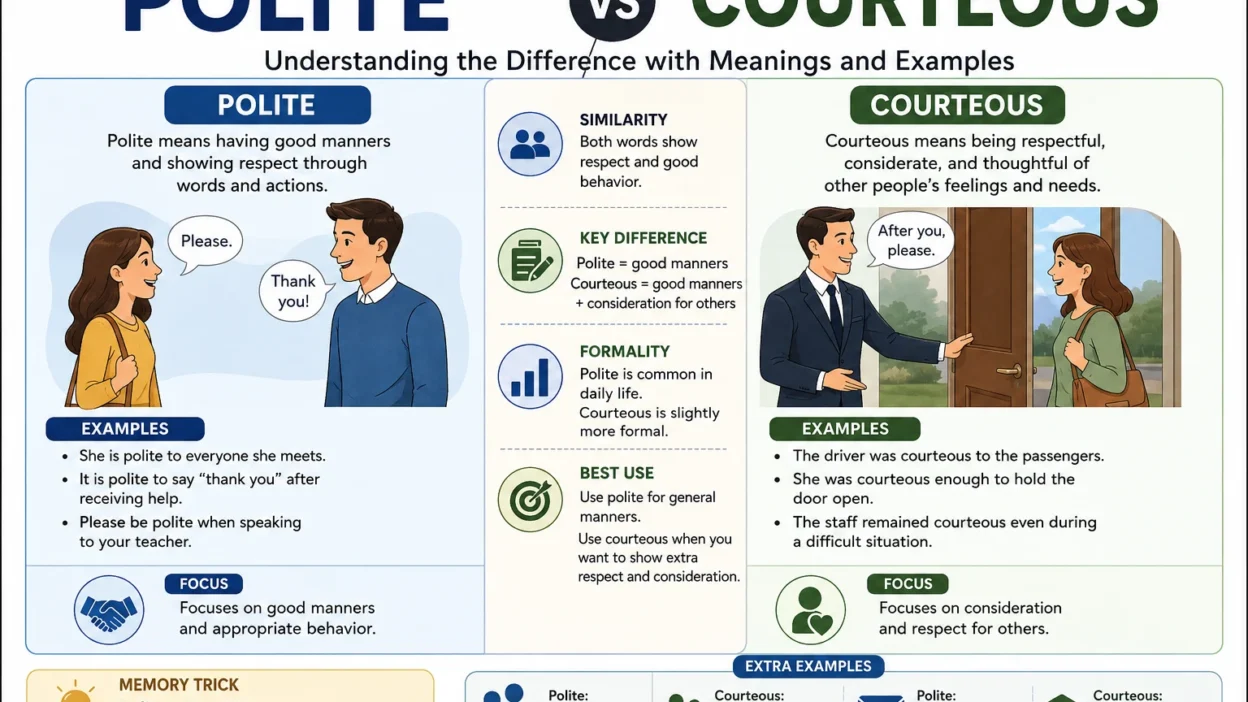
Polite means showing good manners and using respectful language or behavior.
Courteous means being respectful, considerate, and thoughtful toward others.
The two words are very similar, but courteous often emphasizes consideration for other people’s comfort or feelings.
What Does “Polite” Mean?
Polite is an adjective used to describe someone who has good manners and behaves respectfully toward others.
It can refer to words, actions, tone, or social behavior. Saying “please” and “thank you,” listening without interrupting, and speaking respectfully are common examples of being polite.
Polite Meaning
The basic meaning of polite is:
Showing good manners and respect for other people.
Examples of “Polite”
- She was polite to everyone at the meeting.
- Please be polite when speaking to your teacher.
- He gave a polite response to the question.
- It is polite to say “thank you” after receiving help.
- The receptionist was friendly and polite.
What Does “Courteous” Mean?
Courteous is also an adjective, but it places slightly more emphasis on being considerate, respectful, and thoughtful toward others.
A courteous person does not simply follow social rules. They often make an effort to make other people feel respected and comfortable.
Courteous Meaning
The basic meaning of courteous is:
Showing respect, consideration, and good manners toward others.
Examples of “Courteous”
- The driver was courteous to pedestrians.
- Please be courteous to other passengers.
- The customer-service representative was extremely courteous.
- He was courteous enough to hold the door open.
- The staff remained courteous despite the difficult situation.
Polite vs Courteous: Main Difference
The difference between polite vs courteous is subtle because both words describe respectful behavior.
Polite is generally associated with good manners and socially appropriate language or behavior. Courteous often suggests active consideration for another person’s comfort, needs, or feelings.
| Feature | Polite | Courteous |
|---|---|---|
| Part of speech | Adjective | Adjective |
| Basic meaning | Showing good manners | Showing respect and consideration |
| Main emphasis | Manners and social behavior | Consideration and respect |
| Tone | Neutral and very common | Slightly more formal |
| Everyday use | Very common | Common but more formal |
| Professional use | Very common | Especially common |
| Can describe speech? | Yes | Yes |
| Can describe behavior? | Yes | Yes |
| Can describe a person? | Yes | Yes |
Polite vs Courteous in Simple English
A simple way to understand the difference is:
Polite = having good manners.
Courteous = having good manners while showing consideration for others.
For example:
“Please close the door.”
This can be a polite request.
If you quietly close the door because you notice someone is working nearby, that behavior can be described as courteous because you are considering another person’s situation.
The distinction is not absolute. Native speakers frequently use the two words in similar contexts.
Are Polite and Courteous Synonyms?
Yes. Polite and courteous are close synonyms.
In many sentences, either word can be used without significantly changing the meaning.
| Sentence | Alternative | Difference |
|---|---|---|
| She was polite to the guests. | She was courteous to the guests. | Very small |
| He gave a polite reply. | He gave a courteous reply. | Courteous sounds more formal |
| The staff was polite. | The staff was courteous. | Courteous emphasizes respectful treatment |
| Please be polite. | Please be courteous. | Courteous sounds slightly more formal |
| He was polite to everyone. | He was courteous to everyone. | Both are natural |
When Should You Use “Polite”?
Use polite when talking about everyday manners, respectful language, or socially appropriate behavior.
It is usually the safer and more natural choice in casual conversation.
Examples
At school:
Students should be polite to their teachers and classmates.
At home:
It is polite to ask before taking someone else’s belongings.
In conversation:
She politely declined the invitation.
In public:
Please be polite to the people around you.
In an email:
He wrote a polite response to the customer.
When Should You Use “Courteous”?
Use courteous when you want to emphasize respect, consideration, or thoughtful treatment of another person.
It is particularly natural in professional, customer-service, transportation, and formal contexts.
Examples
Customer service:
The representative was courteous and helpful.
Business:
The manager gave the client a courteous response.
Driving:
Courteous drivers allow pedestrians to cross safely.
Public spaces:
Please be courteous to other passengers.
Professional communication:
She remained courteous even during the disagreement.
Polite vs Courteous in Professional English
Both words are useful in professional communication, but courteous can sound slightly more formal.
For example:
Thank you for your polite response.
This is natural and professional.
You could also say:
Thank you for your courteous response.
This sounds somewhat more formal and emphasizes the respectful nature of the response.
Professional Usage Table
| Situation | More Natural Choice | Example |
|---|---|---|
| Casual conversation | Polite | He was polite to me. |
| Formal letter | Courteous | Thank you for your courteous reply. |
| Customer service | Courteous | The agent was courteous and professional. |
| Classroom | Polite | Please be polite to your classmates. |
| Workplace | Both | She was polite/courteous to her colleagues. |
| Public transportation | Courteous | Please be courteous to other passengers. |
| Everyday manners | Polite | It is polite to say thank you. |
Polite vs Courteous in Business
In business English, both words are useful, but courteous frequently appears when describing professional conduct.
Companies often expect employees to be courteous toward customers, clients, coworkers, and visitors.
Business Examples
- The employee was polite when answering the phone.
- The receptionist was courteous to every visitor.
- Please maintain a polite tone in your emails.
- Customer-service representatives should remain courteous at all times.
- He gave the client a courteous explanation.
A useful rule is that polite works well for general professional manners, while courteous can sound especially appropriate when describing respectful treatment of another person.
Polite vs Courteous in Education
Teachers commonly encourage students to be polite because classroom behavior depends on good manners and respectful communication.
Examples
- Please be polite when asking questions.
- Students should be courteous to their classmates.
- It is polite to wait until someone finishes speaking.
- A courteous student listens carefully to others.
In everyday educational contexts, polite is probably more common.
Polite vs Courteous in Science and Technical Writing
Neither word is a technical scientific term. However, both may appear when describing human behavior, communication, or professional interactions.
For example:
The researchers remained courteous during the discussion.
Or:
Participants were asked to be polite when discussing opposing opinions.
In scientific writing, the choice depends on the context rather than on a technical grammatical rule.
Polite vs Courteous in Customer Service
Customer service is one area where courteous is especially common.
Businesses often describe good customer treatment as courteous service.
Examples
- The hotel staff provided courteous service.
- The representative was polite and patient.
- Employees should remain courteous when handling complaints.
- She gave the customer a polite explanation.
The word courteous works particularly well because it highlights respectful and considerate treatment.
Grammar Forms of Polite and Courteous
Both words are adjectives, but they have related grammatical forms.
| Word | Adjective | Adverb | Noun | Comparative |
|---|---|---|---|---|
| Polite | polite | politely | politeness | more polite |
| Courteous | courteous | courteously | courtesy | more courteous |
Examples
Polite:
- She is polite.
- He spoke politely.
- Her politeness impressed everyone.
- She was more polite than before.
Courteous:
- He is courteous.
- She responded courteously.
- His courtesy was appreciated.
- The staff was more courteous than expected.
Common Expressions With “Polite”
Here are some common phrases using polite:
| Expression | Example |
|---|---|
| Polite person | She is a very polite person. |
| Polite request | He made a polite request. |
| Polite response | I received a polite response. |
| Polite conversation | They had a polite conversation. |
| Polite manner | She answered in a polite manner. |
| Polite behavior | Polite behavior is appreciated. |
| Politely ask | You should politely ask first. |
| Politely decline | He politely declined the offer. |
Common Expressions With “Courteous”
Here are common expressions using courteous:
| Expression | Example |
|---|---|
| Courteous person | He is a courteous person. |
| Courteous response | She gave a courteous response. |
| Courteous behavior | Courteous behavior makes communication easier. |
| Courteous service | The hotel provides courteous service. |
| Courteous manner | He spoke in a courteous manner. |
| Courteous treatment | Customers deserve courteous treatment. |
| Courteous reply | Thank you for your courteous reply. |
| Courteous driver | A courteous driver gives pedestrians space. |
Real-Life Examples of Polite vs Courteous
Understanding the words through real situations makes the polite vs courteous difference easier to remember.
Example 1: Holding a Door
Sarah held the door open for an elderly man.
This can be described as courteous because Sarah considered another person’s needs.
Example 2: Saying “Thank You”
Tom said “thank you” after receiving a gift.
This is clearly polite behavior.
Example 3: Customer Complaint
The employee listened carefully and responded respectfully to an angry customer.
This is courteous behavior because the employee showed consideration despite a difficult situation.
Example 4: Classroom
The student waited for the teacher to finish speaking before asking a question.
This is polite behavior.
Example 5: Workplace
The manager thanked an employee for raising a concern and responded respectfully.
The manager’s behavior can be described as courteous and professional.
Common Mistakes With Polite and Courteous
Because the two words are very similar, people do not usually make serious grammatical mistakes with them. The more common problem is choosing an unnatural phrase or misunderstanding their tone.
| Incorrect or Less Natural | Better | Why |
|---|---|---|
| He courteous asked me. | He courteously asked me. | Courteous is an adjective; courteously is the adverb. |
| She politely person helped us. | The polite person helped us. | Use the adjective before a noun. |
| He was courtesy to everyone. | He was courteous to everyone. | Courtesy is a noun; courteous is an adjective. |
| She responded courteous. | She responded courteously. | An adverb modifies “responded.” |
| His polite was appreciated. | His politeness was appreciated. | Politeness is the noun form. |
| Thank you for your courteously reply. | Thank you for your courteous reply. | Courteous modifies the noun “reply.” |
Why Do People Confuse Polite and Courteous?
People confuse polite vs courteous because both words describe respectful behavior and are frequently interchangeable.
There is also considerable overlap between their meanings.
For example:
He was polite to the waiter.
and
He was courteous to the waiter.
Both sentences are grammatically correct and communicate a similar idea.
The main distinction is one of emphasis and tone, not a strict grammatical rule.
A Simple Memory Trick
Remember:
Polite = good manners.
Courteous = good manners + consideration.
Think of courteous as going one small step beyond simply following manners.
For example:
Saying “excuse me” is polite.
Moving aside so someone can pass is courteous.
This is not a rigid rule, but it is a useful memory trick for understanding the difference.
Polite vs Courteous: Step-by-Step Usage Guide
When deciding which word to use, follow these steps:
| Step | Question | Choice |
|---|---|---|
| 1 | Are you talking about general manners? | Polite |
| 2 | Are you emphasizing consideration? | Courteous |
| 3 | Is the context casual? | Polite often sounds more natural |
| 4 | Is the context formal or professional? | Courteous may sound better |
| 5 | Could either word work? | Usually choose based on tone |
For example, if you are describing someone saying “please,” polite is an obvious choice.
If you are describing someone making an effort to accommodate another person’s needs, courteous may be more precise.
Polite vs Courteous Comparison Table
| Category | Polite | Courteous |
|---|---|---|
| Meaning | Having good manners | Showing respect and consideration |
| Similarity | Very high | Very high |
| Formality | Neutral | Slightly formal |
| Everyday conversations | Excellent | Good |
| Business English | Excellent | Excellent |
| Customer service | Excellent | Especially common |
| Describes behavior | Yes | Yes |
| Describes speech | Yes | Yes |
| Describes a person | Yes | Yes |
| Adverb | Politely | Courteously |
| Noun | Politeness | Courtesy |
| Best memory clue | Good manners | Considerate manners |
Polite vs Courteous: Which Is More Formal?
Courteous generally sounds more formal than polite.
For example:
She was polite to the guests.
This sounds natural in everyday English.
She was courteous to the guests.
This sounds slightly more formal and may fit professional or formal writing better.
However, polite is not informal. It is completely appropriate in professional communication.
Can Polite and Courteous Be Used Interchangeably?
Often, yes.
You can say:
The receptionist was polite.
or:
The receptionist was courteous.
Both are correct.
The second sentence may place slightly more emphasis on respectful treatment of visitors, while the first simply describes good manners.
The exact difference depends on context and speaker intention.
Related Words: Polite, Courteous, Civil, Respectful, Considerate
Several English words are related to polite and courteous, but they are not always identical.
| Word | Main Idea |
|---|---|
| Polite | Good manners |
| Courteous | Respectful and considerate behavior |
| Respectful | Showing respect |
| Considerate | Thinking about other people’s needs and feelings |
| Civil | Calm and reasonably respectful, especially during disagreement |
| Well-mannered | Having socially acceptable manners |
For everyday usage, polite is usually the simplest choice.
For formal or professional situations, courteous can provide a slightly more refined tone.
Frequently Asked Questions About Polite vs Courteous
Is courteous the same as polite?
Almost. Both mean showing good manners and respect. Courteous often adds a stronger sense of consideration for other people.
Is courteous more formal than polite?
Generally, yes. Courteous can sound slightly more formal or professional, although both words are appropriate in formal situations.
Which is better: polite or courteous?
Neither is universally better. Use polite for general manners and courteous when you want to emphasize respectful, considerate treatment.
Can I use polite and courteous interchangeably?
In many sentences, yes. They are close synonyms, and replacing one with the other usually does not dramatically change the meaning.
What is the noun form of polite?
The noun form is politeness.
Example:
Her politeness made everyone feel comfortable.
What is the noun form of courteous?
The noun form is courtesy.
Example:
His courtesy toward the guests was appreciated.
Conclusion: Polite vs Courteous
The key difference in polite vs courteous is subtle. Polite generally means having good manners and behaving appropriately toward others, while courteous emphasizes respectful and considerate treatment.
Use polite when talking about everyday manners, respectful language, or socially appropriate behavior.
Use courteous when you want to highlight thoughtfulness, consideration, or professional respect. In many situations, however, both words are correct.
A simple rule to remember is: polite means showing good manners, while courteous means showing good manners with consideration for other