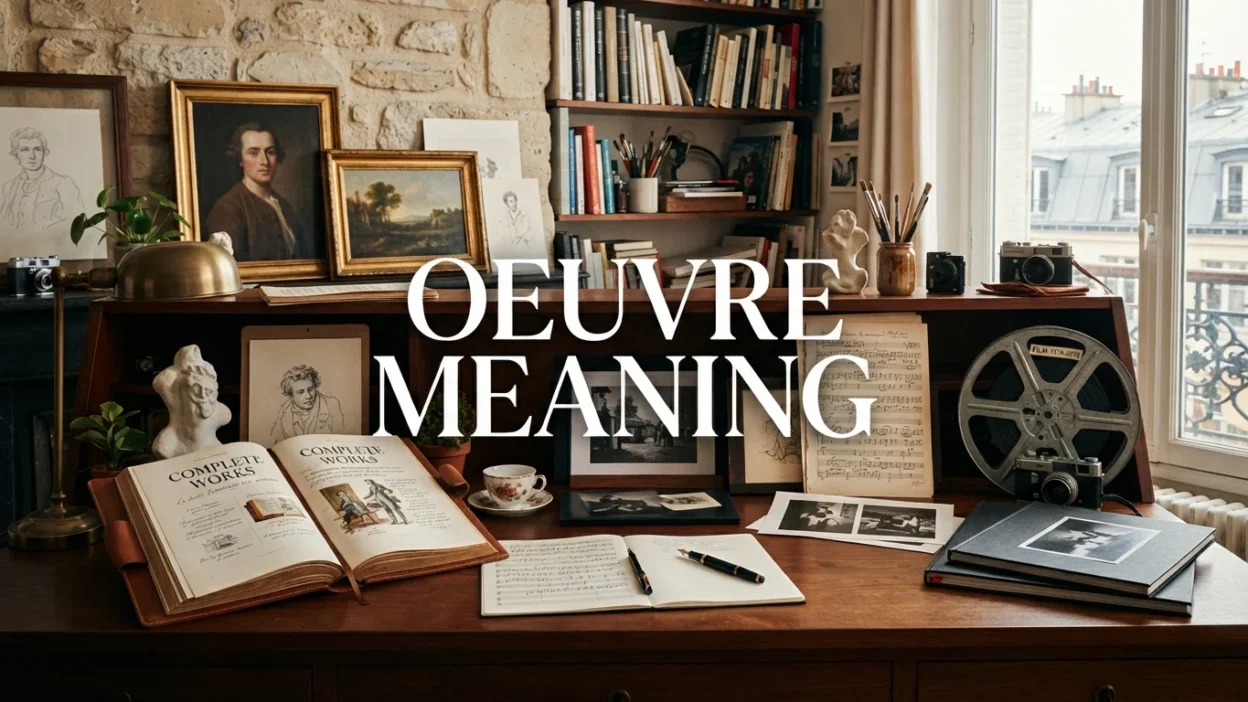
If you have ever read a book review, visited an art exhibition, or explored a film discussion, you may have come across the French word oeuvre.
At first glance, its spelling and pronunciation can seem unfamiliar, leaving many English learners wondering about the exact oeuvre meaning.
The word is commonly used when discussing the complete body of creative work produced by an artist, writer, composer, filmmaker, or other creator.
Understanding the oeuvre meaning can make your English vocabulary stronger, especially when reading literature, art criticism, music reviews, academic writing, or cultural commentary.
Although the word comes from French, oeuvre is now established in English and is frequently used in discussions about creative achievement.
This guide explains its meaning, pronunciation, grammar, usage, examples, common mistakes, professional contexts, and easy ways to remember it.
Quick Answer: What Does Oeuvre Mean?
Oeuvre means the complete body or collection of creative work produced by an artist, writer, composer, filmmaker, or other creator.
It is commonly used in art, literature, music, cinema, and academic criticism.
Simple example: “Her oeuvre includes six novels and several collections of poetry.”
What Is the Oeuvre Meaning?
The basic oeuvre meaning is the entire body of work created by a particular person.
The word is especially useful when talking about creative achievements over an artist’s or creator’s career.
For example:
“The director’s oeuvre spans more than four decades.”
This means that the director’s complete collection of films covers more than 40 years of creative work.
An oeuvre does not usually mean just one individual work. Instead, it focuses on the collection as a whole.
Where Does the Word Oeuvre Come From?
Oeuvre is a French word that literally relates to “work.” English adopted the term because it provides a precise way to describe a creator’s complete body of work.
The French spelling is œuvre, using the ligature œ. In English writing, it is also commonly written as oeuvre.
| Form | Language/Style | Meaning |
|---|---|---|
| œuvre | French spelling | Body of work |
| oeuvre | Common English spelling | Body of work |
| oeuvre | English literary/art usage | Complete creative output |
The word is now familiar in English-language criticism and does not need to be translated every time it appears.
How Do You Pronounce Oeuvre?
The pronunciation of oeuvre can be challenging because its spelling follows French conventions.
In English, it is commonly pronounced approximately:
UH-vruh or ER-vruh
The exact pronunciation may vary slightly by speaker and accent.
| Word | Approximate Pronunciation | Meaning |
|---|---|---|
| Oeuvre | UH-vruh | Complete body of creative work |
| Artist | AR-tist | Person who creates art |
| Portfolio | port-FOH-lee-oh | Collection of selected work |
| Catalogue | CAT-uh-log | Organized collection or record |
If you are learning English, do not worry about producing a perfect French accent. Understanding the meaning and using the word naturally are more important.
Oeuvre vs One Work: What Is the Difference?
One of the most important points about oeuvre meaning is that it generally refers to a creator’s overall body of work, rather than a single creation.
Compare these examples:
“This painting is one of her greatest works.”
This refers to one painting.
“This painting is an important part of her oeuvre.”
This places the painting within her larger body of artistic work.
| Term | Meaning | Example |
|---|---|---|
| Work | One creative piece or a piece in general | “This is his finest work.” |
| Oeuvre | Complete body of creative work | “This novel is part of his oeuvre.” |
| Portfolio | Selected collection of work | “Her design portfolio is impressive.” |
| Catalogue | Organized list or collection | “The museum published a catalogue.” |
Oeuvre as a Noun
Oeuvre is a noun. It is not normally used as a verb or adjective.
Examples:
- “His oeuvre is highly influential.”
- “The artist’s oeuvre includes hundreds of paintings.”
- “Her later novels form an important part of her oeuvre.”
- “The filmmaker’s oeuvre explores identity and memory.”
The word often appears with possessive nouns such as:
- the artist’s oeuvre
- the author’s oeuvre
- the director’s oeuvre
- the composer’s oeuvre
- the painter’s oeuvre
Grammar Forms and Common Structures
Because oeuvre is a noun, its grammatical usage is relatively straightforward.
| Form | Usage | Example |
|---|---|---|
| oeuvre | Singular noun | “His oeuvre is impressive.” |
| oeuvres | Plural form, less common | “Several artists’ oeuvres were discussed.” |
| artist’s oeuvre | Possessive structure | “The artist’s oeuvre spans 30 years.” |
| part of an oeuvre | Describes one contribution | “The film is part of her oeuvre.” |
| entire oeuvre | Complete body of work | “Researchers examined his entire oeuvre.” |
In everyday English, writers often avoid the plural oeuvres because the singular form is more common and the plural idea can be expressed in other ways.
Oeuvre in Literature
Literary critics frequently use oeuvre to discuss an author’s complete collection of writing.
For example:
“The author’s oeuvre explores themes of identity, migration, and belonging.”
This means the writer’s body of literary work repeatedly addresses those themes.
The word can apply to:
- novels
- poems
- short stories
- essays
- plays
- nonfiction
- literary criticism
Example
“Her early novels differ in style from the later works in her oeuvre.”
Here, the word helps connect individual books to the author’s larger creative development.
Oeuvre in Art
In art criticism, oeuvre is especially useful because an artist may create hundreds or thousands of individual works.
A critic might examine how an artist’s style changes throughout their career.
For example:
“The exhibition examines the painter’s oeuvre from his early experiments to his mature period.”
The statement refers to the artist’s overall artistic production rather than one painting.
Oeuvre in Music
The oeuvre meaning also applies to composers and musicians.
A composer’s oeuvre can include:
- symphonies
- concertos
- operas
- sonatas
- chamber music
- songs
- experimental compositions
For example:
“The composer’s oeuvre combines traditional forms with modern harmonies.”
This means the composer’s entire body of musical work demonstrates those characteristics.
Oeuvre in Film and Cinema
Film critics often use oeuvre when discussing a director’s complete filmography as a connected body of creative work.
For example:
“The director’s oeuvre frequently explores loneliness and human relationships.”
This does not necessarily mean every movie has exactly the same theme. It suggests that these ideas appear repeatedly across the director’s career.
| Creative Field | Example of an Oeuvre |
|---|---|
| Literature | Novels, poems, essays, plays |
| Painting | Paintings, drawings, installations |
| Music | Compositions, songs, operas |
| Film | Movies and related creative projects |
| Photography | Photographs and visual series |
| Architecture | Buildings and design projects |
| Sculpture | Sculptures and installations |
Oeuvre in Academic Writing
The word is common in academic and critical writing, particularly in the humanities.
Researchers may use it when studying the development of a particular creator’s ideas, style, themes, or techniques.
Example:
“The study examines recurring themes across the novelist’s oeuvre.”
This sounds more precise than repeatedly saying:
“The study examines recurring themes across all the novelist’s books.”
However, oeuvre can sound sophisticated or specialized. In simple writing, “body of work” is often easier for a general audience.
Oeuvre in Business and Professional Contexts
Although oeuvre is mainly associated with creative fields, it can occasionally appear in professional discussions involving a person’s overall creative or intellectual contributions.
For example:
“Her consulting reports form a significant part of her professional oeuvre.”
This usage is possible but more literary than ordinary business English.
In most workplace documents, simpler expressions such as body of work, portfolio, or professional achievements are clearer.
| Context | Recommended Term |
|---|---|
| Art criticism | Oeuvre |
| Literary criticism | Oeuvre |
| Film criticism | Oeuvre |
| Music criticism | Oeuvre |
| Academic humanities | Oeuvre |
| Business report | Body of work |
| Resume | Portfolio / experience |
| Casual conversation | Body of work |
Oeuvre vs Portfolio
These words are related but not identical.
An oeuvre refers to the complete body of creative work produced by someone.
A portfolio is usually a selected collection of work presented to demonstrate someone’s skills or achievements.
For example, a designer might have created 100 projects during a career but include only 15 in a portfolio.
| Oeuvre | Portfolio |
|---|---|
| Complete body of work | Selected body of work |
| Often discussed by critics | Often used for professional presentation |
| Covers a career or major period | Usually highlights strongest examples |
| Common in art and literature | Common in design, photography, business |
Oeuvre vs Catalogue
A catalogue is an organized list or record of items. An oeuvre is the actual body of creative work.
For example:
“The museum published a catalogue of the painter’s works.”
The catalogue records or organizes the works.
“The painter’s oeuvre includes portraits, landscapes, and still lifes.”
The oeuvre refers to the body of creative production itself.
Oeuvre vs Body of Work
In many situations, body of work is the simplest English equivalent of oeuvre.
The main difference is tone.
Oeuvre sounds more literary, artistic, academic, or sophisticated.
Body of work is more natural in everyday English.
| Expression | Tone | Best Use |
|---|---|---|
| Oeuvre | Literary / academic | Art and cultural criticism |
| Body of work | Neutral | General writing |
| Portfolio | Professional | Job and client presentations |
| Collection | General | Selected works |
| Filmography | Specific | Films |
| Bibliography | Specific | Written sources |
Real-World Example Sentences
Here are practical examples showing how the word works naturally.
Literature
“The novel occupies an unusual position within the author’s oeuvre.”
Painting
“The exhibition brings together key pieces from the painter’s oeuvre.”
Music
“The composer’s early oeuvre shows strong classical influences.”
Film
“This movie is considered one of the director’s most ambitious works.”
“The film is an important part of the director’s oeuvre.”
Academic Research
“Scholars have identified recurring symbols throughout the writer’s oeuvre.”
Photography
“Her photographic oeuvre documents changing urban landscapes.”
Architecture
“The building reflects themes found throughout the architect’s oeuvre.”
How to Use Oeuvre Correctly: Simple Process
If you are unsure whether oeuvre is appropriate, follow these steps.
| Step | Question | What to Do |
|---|---|---|
| 1 | Are you discussing a creator? | Identify the artist, writer, composer, etc. |
| 2 | Are you discussing multiple works? | Consider using “oeuvre.” |
| 3 | Is the context artistic or academic? | “Oeuvre” may be a strong choice. |
| 4 | Is the audience general? | Consider “body of work.” |
| 5 | Are you discussing selected works? | “Portfolio” may be more accurate. |
Common Mistakes With Oeuvre
Although oeuvre is useful, learners sometimes use it incorrectly.
Mistake 1: Using It for One Completely Unrelated Object
Incorrect:
“This single painting is an oeuvre.”
Better:
“This painting is part of the artist’s oeuvre.”
The second sentence makes it clear that the painting belongs to the artist’s larger body of work.
Mistake 2: Treating It as a Verb
Incorrect:
“She oeuvred several paintings.”
Correct:
“Several paintings form part of her oeuvre.”
Oeuvre is a noun, not a regular English verb.
Mistake 3: Using It in Every Situation
The word can sound overly formal if used unnecessarily.
Instead of:
“His business reports are part of his oeuvre.”
A more natural sentence may be:
“His business reports form an important part of his professional body of work.”
Why Do People Find Oeuvre Confusing?
There are several reasons learners may struggle with this word.
First, its spelling is unusual because it comes from French. The oe combination is not common in many everyday English words.
Second, its pronunciation does not seem obvious from its spelling.
Third, the word has a specialized meaning. It does not simply mean “a work.” It usually describes a complete or substantial body of creative work.
Finally, English already has simpler alternatives such as “body of work,” making it less common in everyday conversation.
Memory Trick for Oeuvre
A simple way to remember the oeuvre meaning is:
Oeuvre = Overall work
Both begin with the idea of O:
Oeuvre → Overall creative work
Think about everything an artist, author, musician, or filmmaker creates across a career. That collection is their oeuvre.
Another memory clue is:
Oeuvre = an artist’s entire creative world.
When Should You Use Oeuvre?
Use oeuvre when you want to discuss the creative output of a person as a whole.
It works particularly well when talking about:
- artistic development
- recurring themes
- creative style
- career achievements
- literary analysis
- film criticism
- music criticism
- art history
- academic research
Avoid forcing the word into very casual or highly technical contexts when a simpler term would communicate the idea more clearly.
Oeuvre Usage by Industry
| Industry | Frequency | Typical Example |
|---|---|---|
| Art | High | “The artist’s oeuvre spans several periods.” |
| Literature | High | “Themes recur throughout her oeuvre.” |
| Film | High | “The film is part of his oeuvre.” |
| Music | High | “His oeuvre includes numerous compositions.” |
| Photography | Moderate | “Her oeuvre focuses on nature.” |
| Architecture | Moderate | “The structure reflects his oeuvre.” |
| Education | Moderate | “Students studied the author’s oeuvre.” |
| Business | Low | “His professional body of work” is usually preferred. |
| Science | Low | “Research output” is usually more appropriate. |
Oeuvre vs Similar Words
Several English words are related to oeuvre, but they are not always interchangeable.
| Word | Meaning | Difference From Oeuvre |
|---|---|---|
| Work | A creation or task | Can mean one piece |
| Works | Multiple creations | Broader and more common |
| Collection | Group of things | Does not necessarily imply one creator |
| Portfolio | Selected professional works | Usually not complete |
| Catalogue | Organized record | Describes a list or record |
| Filmography | List of films | Specific to filmmaking |
| Bibliography | List of written sources | Usually refers to sources, not an author’s full creative output |
| Body of work | Complete creative output | Closest everyday synonym |
Is Oeuvre Singular or Plural?
In normal English usage, oeuvre is treated as a singular noun when referring to one creator’s body of work.
For example:
“Her oeuvre is highly influential.”
The verb is agrees with the singular noun.
The plural form oeuvres is possible when discussing multiple creators:
“The exhibition compares the oeuvres of several contemporary artists.”
However, many writers simply restructure the sentence to avoid the plural.
Oeuvre in a Sentence: Easy Templates
These sentence patterns can help you use the word naturally.
Template 1
“The artist’s oeuvre includes ______.”
Example:
“The artist’s oeuvre includes paintings, sculptures, and drawings.”
Template 2
“The work is part of ______’s oeuvre.”
Example:
“The novel is part of the author’s later oeuvre.”
Template 3
“Throughout his oeuvre, ______.”
Example:
“Throughout his oeuvre, the filmmaker explores questions of identity.”
Template 4
“Her oeuvre reflects ______.”
Example:
“Her oeuvre reflects a lifelong interest in nature.”
Frequently Asked Questions
1. What is the simple meaning of oeuvre?
Oeuvre means the complete body of creative work produced by an artist, writer, musician, filmmaker, or another creator.
2. Is oeuvre an English word?
Yes. Oeuvre comes from French, but it is widely used as an English loanword, especially in art, literature, music, film, and academic criticism.
3. What is an example of oeuvre?
“The director’s oeuvre includes more than 20 films.” Here, oeuvre means the director’s complete body of creative work.
4. What is the synonym of oeuvre?
The closest simple synonym is body of work. Depending on context, portfolio, works, collection, or creative output may also work.
5. Is oeuvre formal?
Yes, oeuvre generally sounds more formal, literary, or academic than “body of work.” It is especially common in critical discussions of artists and creators.
6. What is the plural of oeuvre?
The plural can be oeuvres, especially when discussing the bodies of work of multiple creators. However, writers often use “bodies of work” instead.
Final Thoughts
The oeuvre meaning is simple once you understand the central idea: it refers to the complete body of creative work produced by a particular person. It is especially common when discussing artists, authors, composers, filmmakers, photographers, architects, and other creative professionals.
Remember that an oeuvre is bigger than one individual work. A painting, novel, song, or film can be part of someone’s oeuvre, but the oeuvre represents the broader collection of their creative output. For everyday English, “body of work” is often the easiest alternative. In literary, artistic, and academic writing, however, oeuvre can provide a precise and sophisticated way to describe a creator’s overall achievements.