Have you ever wondered whether you should use in vs within in a sentence? These two words often seem interchangeable, but they are not always used in the same way.
Understanding the difference between in vs within helps you write more naturally and avoid common grammar mistakes.
Both words relate to place, time, or limits, but each has a slightly different meaning and emphasis.
In this guide, you’ll learn the meaning, usage, grammar rules, examples, and practical differences between in vs within, making it easier to choose the correct word in every situation.
Quick Answer
The difference between in vs within is simple:
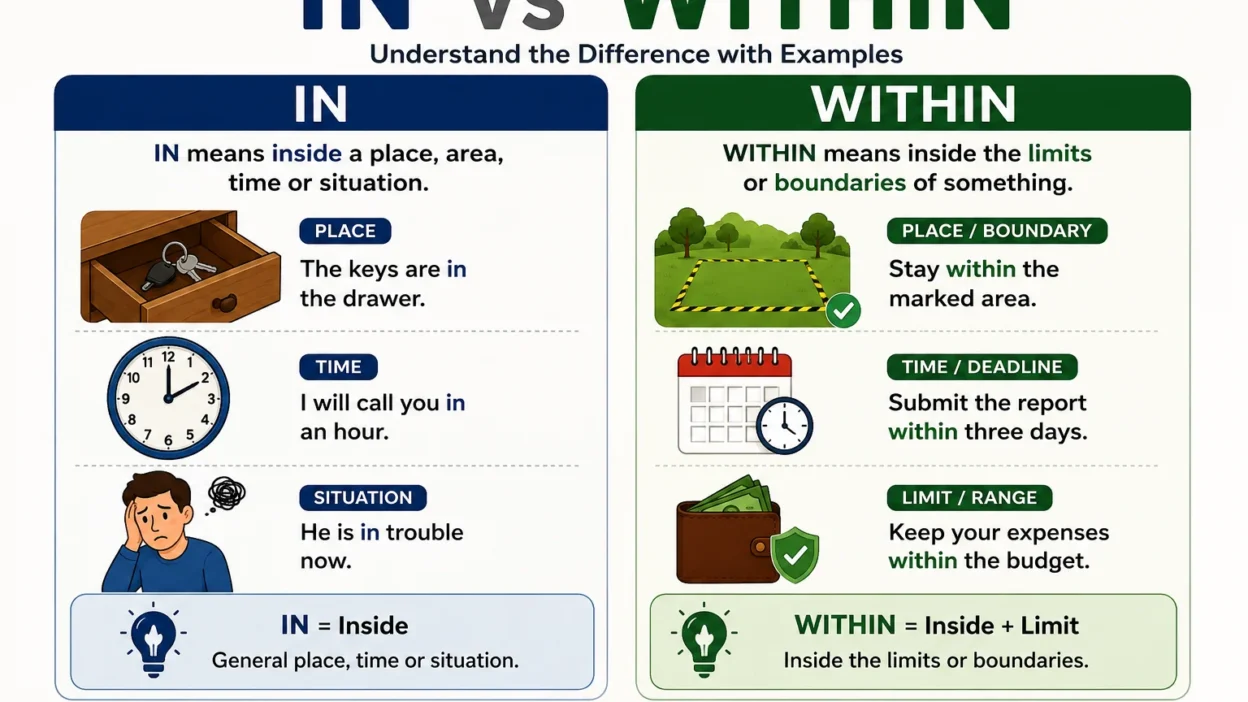
- In means inside a place, period of time, or situation.
- Within means inside the limits or boundaries of something, often emphasizing a specific limit of time, space, or scope.
In vs Within Comparison Table
| Feature | In | Within |
|---|---|---|
| Basic Meaning | Inside something | Inside the limits or boundaries |
| Common Usage | Place, time, situations | Time limits, physical boundaries, scope |
| Formality | Common in everyday English | Slightly more formal |
| Time Example | In two days | Within two days |
| Place Example | In the room | Within the room |
| Focus | Location or period | Boundary or limit |
What Does “In” Mean?
The word in is one of the most common English prepositions. It usually means inside a place, period, or condition.
Examples
- She is in the classroom.
- We live in Canada.
- I’ll finish the report in a week.
- He is in trouble.
Here, in simply tells us where something is or when something happens.
What Does “Within” Mean?
Within means inside the limits, boundaries, or range of something. It often emphasizes a maximum limit.
Examples
- Submit your assignment within three days.
- Stay within the marked area.
- The solution is within reach.
- Expenses must remain within budget.
Unlike in, within highlights boundaries or restrictions.
Key Differences Between In vs Within
| In | Within |
|---|---|
| Refers to being inside | Refers to staying inside limits |
| Used more frequently | Used for emphasis on boundaries |
| Sounds more conversational | Sounds slightly more formal |
| General location or time | Specific limits of time or space |
| Doesn’t always imply restriction | Usually implies a limit |
In vs Within for Time
This is where many learners become confused.
Use “In”
Use in when referring to the amount of time before something happens.
Examples:
- I’ll call you in ten minutes.
- The package will arrive in two days.
- She graduated in 2024.
Use “Within”
Use within when referring to a deadline or maximum period.
Examples:
- Complete the form within ten minutes.
- Respond within seven days.
- Payment must be made within one month.
Time Comparison Table
| Sentence | Correct Word | Reason |
|---|---|---|
| I’ll be back ___ an hour. | In | After one hour |
| Finish the task ___ an hour. | Within | Before one hour ends |
| The train arrives ___ five minutes. | In | Time until arrival |
| Reply ___ 48 hours. | Within | Deadline |
In vs Within for Place
Both words can describe location, but their meanings differ slightly.
In
Simply means inside.
Examples:
- The keys are in my bag.
- She’s in the office.
Within
Emphasizes boundaries.
Examples:
- Stay within the fence.
- The treasure lies within the cave.
- Everything happened within the city limits.
Real-Life Examples of In vs Within
Business
| Situation | Correct Sentence |
|---|---|
| Office location | Our headquarters is in London. |
| Project deadline | Finish the project within two weeks. |
Education
| Situation | Correct Sentence |
|---|---|
| Classroom | Students are in the classroom. |
| Assignment | Submit homework within five days. |
Science
| Situation | Correct Sentence |
|---|---|
| Cell structure | DNA is in the nucleus. |
| Safe limits | Radiation remained within acceptable levels. |
Healthcare
| Situation | Correct Sentence |
|---|---|
| Hospital | The patient is in the hospital. |
| Blood pressure | Values stayed within the normal range. |
Grammar Forms and Usage Table
| Usage | In | Within |
|---|---|---|
| Place | ✔ | ✔ |
| Time period | ✔ | ✔ |
| Deadline | Sometimes | ✔ |
| Physical boundary | Sometimes | ✔ |
| Abstract limit | Rarely | ✔ |
| Common speech | ✔ | ✔ |
When Can In and Within Mean Nearly the Same Thing?
Sometimes both words are grammatically correct.
Example:
- The answer is in the document.
- The answer is within the document.
Difference:
- In simply states location.
- Within emphasizes that the answer exists somewhere inside the document.
Another example:
- The treasure is in the cave.
- The treasure is within the cave.
The second sentence gives slightly more emphasis to the interior of the cave.
Why Do People Confuse In vs Within?
Several reasons explain the confusion.
- Both describe something inside another thing.
- Both can refer to time.
- Both can describe location.
- Dictionaries often give similar definitions.
- Many translations treat them as identical.
The biggest difference is that within usually highlights a boundary or limit, while in simply indicates location or time.
Common Mistakes and Corrections
| Incorrect | Correct |
|---|---|
| Submit it in seven days. (when a deadline is meant) | Submit it within seven days. |
| Stay in the marked boundary. | Stay within the marked boundary. |
| She is within the kitchen. | She is in the kitchen. |
| I arrived within five minutes. (meaning after five minutes) | I arrived in five minutes. |
Correct vs Incorrect Sentences
❌ Finish the exam in one hour. (If one hour is the maximum allowed.)
✅ Finish the exam within one hour.
❌ Stay in the speed limit.
✅ Stay within the speed limit.
❌ The children are within the classroom.
✅ The children are in the classroom.
Memory Trick to Remember the Difference
Here’s an easy trick:
- In = Inside
- Within = Inside + Limit
If you’re talking about a boundary, deadline, or restriction, choose within.
If you’re simply describing where something is or when something happens, choose in.
Professional and Industry Usage
| Industry | In | Within |
|---|---|---|
| Legal | In court | Within the legal framework |
| Business | In the office | Within budget |
| Education | In class | Within the submission deadline |
| Medicine | In the body | Within normal range |
| Engineering | In the system | Within specifications |
| Government | In the department | Within regulations |
Practice Sentences
Choose the correct word.
- Please reply ___ five business days.
- The books are ___ the cabinet.
- Stay ___ the safety zone.
- I’ll return ___ an hour.
- Keep expenses ___ the approved budget.
Answers
- Within
- In
- Within
- In
- Within
When to Use In vs Within
| Situation | Best Choice |
|---|---|
| Talking about location | In |
| Mentioning a deadline | Within |
| Describing boundaries | Within |
| Referring to a country or city | In |
| Discussing limits | Within |
| Everyday conversation | In (most often) |
Frequently Asked Questions
Is “within” more formal than “in”?
Yes. Within often sounds slightly more formal because it emphasizes limits, deadlines, or boundaries.
Can “within” replace “in”?
Sometimes. However, replacing in with within can change the emphasis from simple location to boundaries or limits.
Is “within two days” the same as “in two days”?
Not exactly.
- In two days means after two days.
- Within two days means any time before two days have passed.
Which is more common in everyday English?
In is much more common because it covers many everyday situations involving place and time.
Should I use “within” for deadlines?
Yes. Within is usually the best choice when referring to deadlines or maximum time limits.
Conclusion
Understanding in vs within is easier once you remember their main purpose. Use in when talking about being a place, situation, or period of time.
Use within when emphasizing boundaries, limits, ranges, or deadlines. Although the two words sometimes overlap, within adds the idea of a maximum limit, while in simply indicates location or time.
By practicing these rules and examples, you’ll confidently choose the right word in both everyday conversations and professional writing.