Have you ever received a message that simply says “Hi there” and wondered what it really means?
The hi there meaning is generally friendly, warm, and informal, but its tone can vary depending on the situation and the relationship between the people communicating.
Understanding the hi there meaning helps you use this greeting naturally in emails, chats, social media, customer service, and everyday conversations.
In this guide, you’ll learn its definition, usage, examples, common mistakes, grammar tips, and when it’s the best greeting to choose.
Quick Answer
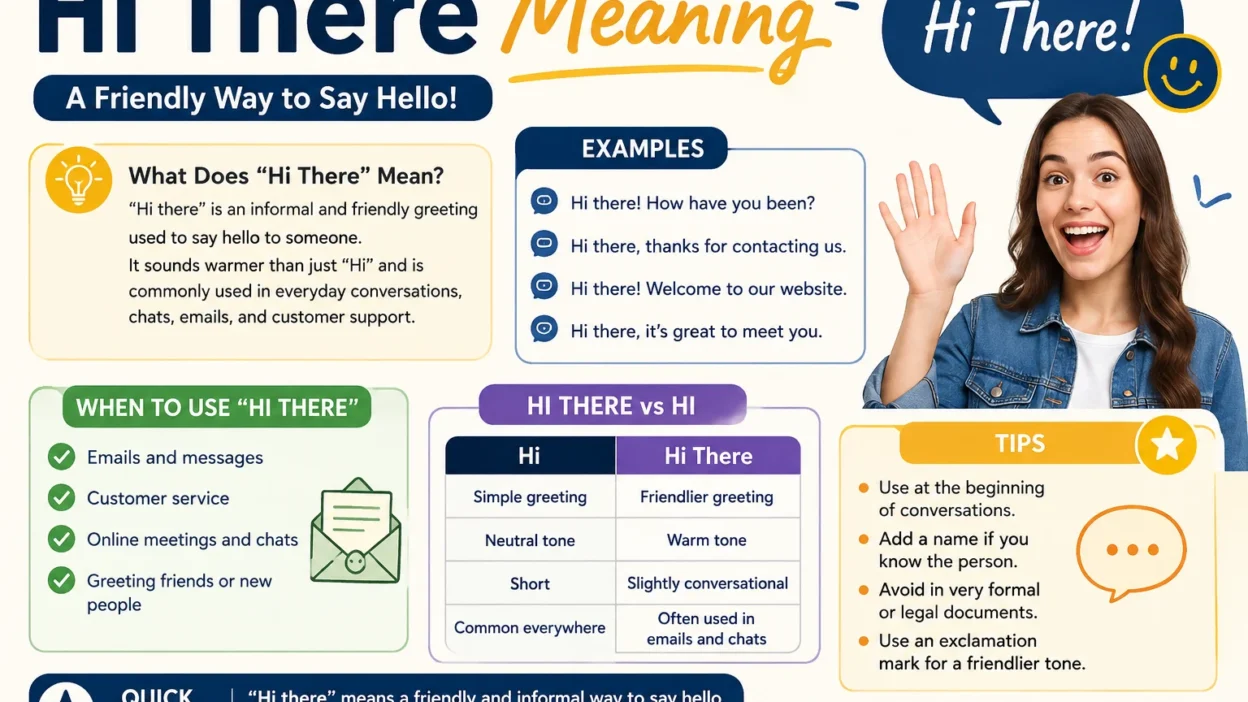
“Hi there” is a friendly and informal greeting used to say hello to someone. It sounds warmer than simply saying “Hi” but is still casual enough for everyday conversations, emails, and online messaging.
What Does “Hi There” Mean?
The phrase “Hi there” is an informal greeting used to welcome or acknowledge someone in a cheerful and friendly way.
Unlike a plain “Hi,” adding “there” makes the greeting sound slightly warmer and more conversational.
Examples
- Hi there! How have you been?
- Hi there, thanks for contacting us.
- Hi there! Welcome to our website.
- Hi there, it’s great to meet you.
Main Comparison Table
| Greeting | Meaning | Formality | Best Used For |
|---|---|---|---|
| Hi | Simple greeting | Casual | Friends, coworkers |
| Hi there | Friendly greeting | Casual to semi-formal | Emails, chats, customer support |
| Hello | Standard greeting | Neutral | Professional communication |
| Hey | Very casual greeting | Informal | Friends and family |
| Good morning | Time-based greeting | Formal | Business meetings |
Why Do People Say “Hi There”?
People often use “Hi there” because it sounds:
- Friendly
- Welcoming
- Less formal than “Hello”
- More personal than just “Hi”
Businesses also use it because it creates a warm first impression.
Examples:
Customer Support:
Hi there! How can I help you today?
Teacher:
Hi there, class! Let’s begin today’s lesson.
Friend:
Hi there! Long time no see.
When Should You Use “Hi There”?
The greeting works well in many situations.
| Situation | Appropriate? | Example |
|---|---|---|
| Email to customer | Yes | Hi there, thanks for reaching out. |
| Chat message | Yes | Hi there! |
| Online meeting | Yes | Hi there, everyone! |
| Speaking to friends | Yes | Hi there, Alex! |
| Formal legal document | No | Use Dear Sir or Madam instead. |
Hi There vs Hi
Many learners wonder whether these greetings have different meanings.
| Hi | Hi There |
|---|---|
| Simple greeting | Friendlier greeting |
| Neutral tone | Warm tone |
| Short | Slightly conversational |
| Common everywhere | Often used in emails and chats |
Examples:
Hi, Sarah.
Hi there, Sarah!
Both are correct, but the second sounds a little warmer.
Grammar of “Hi There”
“Hi there” is an interjection used as a greeting.
Grammar Table
| Feature | Details |
|---|---|
| Part of speech | Greeting (Interjection) |
| Formality | Informal to semi-formal |
| Sentence position | Beginning of conversation |
| Punctuation | Usually followed by comma or exclamation mark |
Examples
✓ Hi there, everyone!
✓ Hi there!
✓ Hi there, John.
Real-Life Examples
Business
Hi there! Thank you for choosing our company.
Education
Hi there, students. Today we’ll learn grammar.
Customer Service
Hi there! How may I assist you today?
Healthcare
Hi there. Please have a seat.
Social Media
Hi there! Thanks for following our page.
Online Gaming
Hi there! Ready for another match?
Industry Usage Table
| Industry | Example |
|---|---|
| Customer Support | Hi there! How can we help? |
| Education | Hi there, class! |
| Marketing | Hi there! Check out our latest offer. |
| Healthcare | Hi there. How are you feeling today? |
| Retail | Hi there! Welcome to our store. |
| Technology | Hi there! Need technical support? |
Common Situations Where “Hi There” Works Best
| Situation | Recommended |
|---|---|
| Starting an email | Yes |
| Greeting customers | Yes |
| Beginning a chat | Yes |
| Welcoming visitors | Yes |
| Official government letter | No |
Common Mistakes
Many English learners misuse this greeting.
| Incorrect | Correct |
|---|---|
| Hi there sir madam | Hi there! |
| Hi there dear respected | Hello, Dear Sir or Madam |
| Hi there in formal contract | Dear Mr. Smith |
| Hi there professor in academic paper | Dear Professor Brown |
Correct Sentences
✓ Hi there! Nice to meet you.
✓ Hi there, thanks for your email.
✓ Hi there! Welcome aboard.
Incorrect Sentences
✗ Hi there respected manager.
✗ Hi there honorable judge.
Why People Get Confused About the Hi There Meaning
There are several reasons why learners misunderstand this greeting.
- They think “there” refers to a location.
- They assume it’s more formal than “Hello.”
- They believe it’s only used online.
- They confuse it with “Hey there.”
In reality, “there” doesn’t point to a place. It simply makes the greeting sound friendlier.
Memory Trick
A simple way to remember the hi there meaning is:
Hi + there = Friendly hello
Think of “there” as adding warmth rather than location.
Whenever you want to sound welcoming without being too formal, “Hi there” is a great choice.
Examples in Different Contexts
Office
Hi there! Could you send today’s report?
School
Hi there, everyone. Please open your books.
Restaurant
Hi there! Welcome to our restaurant.
Airport
Hi there! May I see your boarding pass?
Phone Conversation
Hi there! Is this Emma speaking?
Online Store
Hi there! Your order has been shipped.
Tips for Using “Hi There” Naturally
- Use it at the beginning of conversations.
- Pair it with a smile in face-to-face communication.
- Add a name if you know the person.
- Avoid it in very formal legal or official documents.
- Use an exclamation mark for a friendlier tone.
People Also Ask
Is “Hi there” polite?
Yes. It is polite, friendly, and suitable for most casual and semi-formal conversations.
Is “Hi there” formal?
No. It is generally informal but acceptable in many professional emails.
Can I use “Hi there” in an email?
Yes. It is common in customer service, workplace emails, and friendly business communication.
What is the difference between “Hi” and “Hi there”?
“Hi there” sounds warmer and slightly more welcoming than simply saying “Hi.”
Is “Hi there” professional?
Yes, in many modern workplaces. However, highly formal situations may require “Hello” or “Dear.”
Frequently Asked Questions
What does “Hi there” literally mean?
It simply means “Hello.” The word “there” adds friendliness rather than referring to a place.
Is “Hi there” appropriate for customers?
Yes. Many businesses use it because it sounds welcoming and approachable.
Can I say “Hi there” to someone I don’t know?
Yes. It is a common and polite greeting for strangers in casual and professional settings.
Is “Hi there” better than “Hello”?
Neither is better. “Hi there” is warmer, while “Hello” is more neutral and slightly more formal.
Can I reply with “Hi there”?
Absolutely. Replying with “Hi there!” is perfectly natural.
Conclusion
Understanding the hi there meaning makes it easier to greet people naturally and confidently.
The phrase is a warm, friendly, and informal way of saying hello, making it suitable for emails, chats, customer service, workplaces, and everyday conversations.
While it is more welcoming than a simple “Hi,” it is still less formal than greetings like “Dear” or “Good morning.”
Choosing the right greeting depends on your audience and the situation, but “Hi there” remains one of the most versatile and approachable expressions in modern English.