
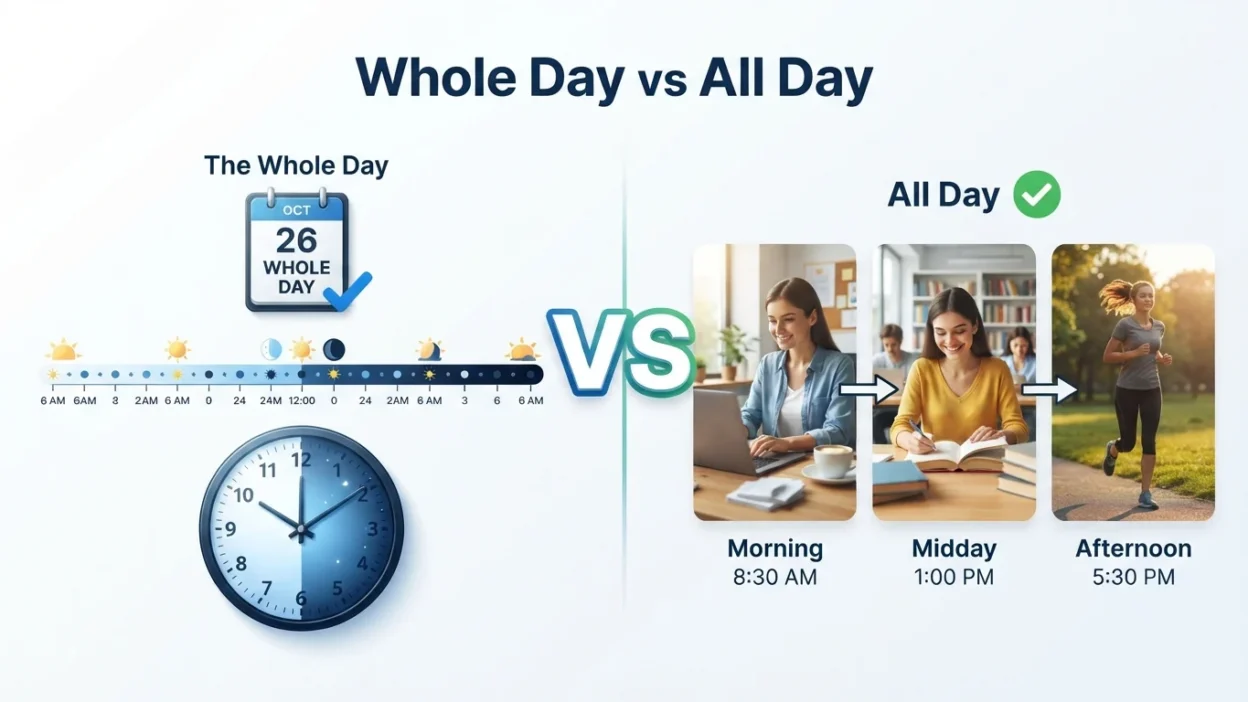
The whole day vs all day comparison often confuses English learners because both expressions refer to an entire day.
Although they are closely related, whole day and all day are not always used in the same way.
Choosing the right phrase depends on the sentence structure and the meaning you want to express.
Understanding whole day vs all day will help you sound more natural in conversations, emails, academic writing, and professional communication.
In this guide, you’ll learn the meaning of each phrase, their differences, grammar rules, real life examples, common mistakes, memory tricks, and professional usage so you can use them correctly every time.
Quick Answer
All day means throughout the entire day and is the more common expression.
Whole day means the complete day but usually appears with the article the, as in the whole day.
In most situations, all day sounds more natural.
Whole Day vs All Day Comparison Table
| Feature | Whole Day | All Day |
|---|---|---|
| Meaning | The complete day | Throughout the entire day |
| Common Usage | Less common | Very common |
| Natural Expression | Usually “the whole day” | Usually “all day” |
| Sounds More Natural | Sometimes | Yes |
| Part of Speech | Noun phrase | Adverbial phrase |
What Does “Whole Day” Mean?
Whole day refers to the complete duration of a day.
In natural English, it is usually written as the whole day rather than simply whole day.
Examples
- I spent the whole day cleaning the house.
- She was busy the whole day.
- It rained the whole day yesterday.
- We traveled the whole day.
What Does “All Day” Mean?
All day means during the entire day from beginning to end.
It emphasizes continuous activity throughout the day.
Examples
- I worked all day.
- The children played all day.
- It snowed all day.
- We waited all day for the package.
Main Difference Between Whole Day and All Day
| Point | Whole Day | All Day |
|---|---|---|
| Focus | Entire day as one unit | Activity lasting throughout the day |
| Naturalness | Less common | More common |
| Usually Includes “The” | Yes | No |
| Everyday Conversation | Sometimes | Frequently |
| Formal Writing | Acceptable | Very common |
A simple rule:
All day = Throughout the day
The whole day = The entire day
When Should You Use “Whole Day”?
Use the whole day when emphasizing the day as a complete period.
Examples
- We spent the whole day at the beach.
- She stayed home the whole day.
- They discussed the project the whole day.
- The whole day was exciting.
Notice that the usually comes before whole day.
When Should You Use “All Day”?
Use all day when talking about something happening continuously from morning until evening.
Examples
- I’ve been studying all day.
- The baby slept all day.
- It rained all day.
- He worked all day without taking a break.
This is the more natural choice in everyday English.
Grammar Forms
| Expression | Correct Form |
|---|---|
| Whole Day | The whole day |
| All Day | All day |
| Entire Day | The entire day |
| Full Day | A full day |
| Throughout the Day | Throughout the day |
All of these expressions are grammatically correct, but all day is the most commonly used.
Real-Life Examples
Business
| Situation | Preferred Expression |
|---|---|
| Employee worked continuously | All day |
| Meeting lasted the entire day | The whole day |
Example:
The conference continued all day.
Education
Students may study all day before exams.
Example:
She revised her notes all day.
Science
Researchers may conduct experiments throughout an entire day.
Example:
The equipment recorded data all day.
Travel
Example:
We drove all day to reach the destination.
Everyday Life
Example:
I watched movies all day because it was raining.
Professional Usage Table
| Industry | Common Expression |
|---|---|
| Business | All day meeting |
| Education | Studied all day |
| Healthcare | Worked all day |
| Hospitality | Open all day |
| Customer Service | Available all day |
| Manufacturing | Machines operated all day |
Why Do People Confuse Whole Day and All Day?
The confusion happens because:
- Both refer to an entire day.
- Both can describe the same event.
- They often appear in similar contexts.
- Many languages translate both expressions the same way.
- Learners don’t know that all day is more natural in modern English.
Memory Trick
| Phrase | Memory Trick |
|---|---|
| All Day | Think “from morning until night.” |
| The Whole Day | Think “the entire day as one complete period.” |
Easy shortcut:
Continuous activity → All day
Complete time period → The whole day
Common Mistakes
| Incorrect Sentence | Correct Sentence |
|---|---|
| I worked whole day. | I worked all day. |
| I stayed whole day at home. | I stayed home the whole day. |
| She studied whole day. | She studied all day. |
| We waited whole day. | We waited the whole day. |
| He slept the all day. | He slept all day. |
Process for Choosing the Correct Expression
| Question | Choose |
|---|---|
| Is the activity continuous throughout the day? | All day |
| Are you emphasizing the complete day? | The whole day |
| Writing casual conversation? | All day |
| Referring to the day as a unit? | The whole day |
| Unsure? | All day usually sounds more natural |
Sentence Examples Comparing Both Expressions
| Situation | Example |
|---|---|
| Office work | I worked all day. |
| Vacation | We spent the whole day sightseeing. |
| Rain | It rained all day. |
| Family outing | We enjoyed the whole day together. |
| Exam preparation | She studied all day. |
| Festival | The whole day was filled with celebrations. |
Tips to Avoid Mistakes
- Use all day for ongoing actions.
- Use the whole day when emphasizing the entire time period.
- Remember that whole day usually needs the.
- In casual speech, all day is almost always the better choice.
- Read your sentence aloud to see which sounds more natural.
Frequently Asked Questions
Which is more common: whole day or all day?
All day is much more common in everyday English.
Is “whole day” grammatically correct?
Yes, but it is usually written as the whole day.
Can I say “I worked whole day”?
No. The natural forms are I worked all day or I worked the whole day.
Is “all day” more natural?
Yes. Native speakers generally prefer all day for continuous actions.
Can both expressions mean the same thing?
Yes. In many situations, they express a similar idea, but all day is usually more idiomatic.
Which phrase should I use in professional writing?
Both are correct, but all day is more common unless you specifically want to emphasize the whole day as a complete period.
Conclusion
The whole day vs all day comparison comes down to natural usage and emphasis. All day is the preferred expression for describing an activity that continues throughout the day, while the whole day emphasizes the entire day as a complete period. Although both phrases can often express similar ideas, all day is more common in everyday conversation and professional writing. Remember the simple rule: use “all day” for ongoing actions and “the whole day” when focusing on the entire day’s duration.