Have you ever seen the words minuet vs minute and wondered whether they are related?
At first glance, they look very similar, but their meanings, pronunciation, and usage are completely different.
This similarity often causes confusion for students, writers, and English learners.
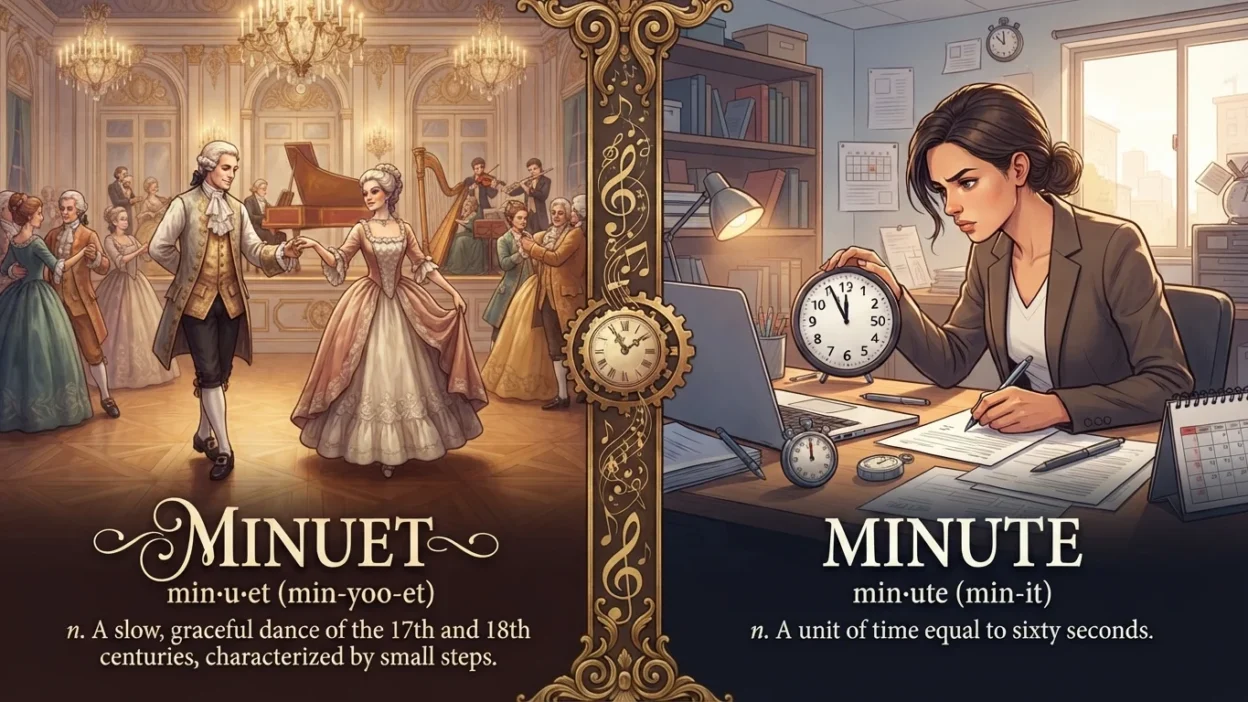
Understanding minuet vs minute is important because one word refers to a graceful dance from history, while the other commonly refers to a unit of time or something extremely small.
Learning the difference between minuet vs minute will help you avoid spelling mistakes, pronunciation errors, and misunderstandings in both writing and conversation.
Quick Answer
A minuet is a slow, elegant dance and a style of classical music.
A minute usually means 60 seconds, but it can also mean very small or tiny when pronounced differently.
Although the spellings are similar, minuet and minute have different meanings, pronunciations, and uses.
Minuet vs Minute: Comparison Table
| Feature | Minuet | Minute |
|---|---|---|
| Part of Speech | Noun | Noun or adjective |
| Primary Meaning | A formal dance and musical composition | A unit of time or extremely small |
| Pronunciation | min-yoo-ET | MIN-it (time) / my-NOOT (tiny) |
| Common Context | Music, history, dance | Time, meetings, measurements, science |
| Modern Usage | Less common | Extremely common |
| Example | The orchestra performed a minuet. | Please wait one minute. |
What Does Minuet Mean?
A minuet is a slow and elegant dance that became popular in France during the 17th and 18th centuries. It was often performed in royal courts and high-society gatherings.
The word can also refer to the music written specifically for that dance. Many classical composers included minuets in their symphonies and other works.
Examples of Minuet
- The dancers performed a beautiful minuet during the historical event.
- Mozart composed several famous minuets.
- Students learned the steps of a traditional minuet in music class.
What Does Minute Mean?
The word minute has two different meanings and pronunciations.
As a noun, it means 60 seconds, which is a unit of time.
As an adjective, it means extremely small or tiny.
Examples of Minute (Time)
- I will be there in one minute.
- The meeting lasted only ten minutes.
- Please wait a few minutes before entering.
Examples of Minute (Tiny)
- Scientists observed minute particles under the microscope.
- The difference was so minute that nobody noticed it.
- Engineers measured even minute changes in temperature.
Pronunciation Differences Between Minuet and Minute
One major reason people confuse these words is pronunciation.
| Word | Pronunciation | Meaning |
|---|---|---|
| Minuet | min-yoo-ET | Dance or music |
| Minute (time) | MIN-it | 60 seconds |
| Minute (tiny) | my-NOOT | Extremely small |
Even though minuet and minute look alike, they do not sound the same.
Minuet vs Minute: Key Differences
| Category | Minuet | Minute |
|---|---|---|
| Origin | French dance tradition | Latin word related to small divisions |
| Subject Area | Music and dance | Time, measurements, science |
| Frequency of Use | Rare | Very common |
| Number of Meanings | One primary meaning | Multiple meanings |
| Pronunciation Complexity | Single pronunciation | Two pronunciations |
The easiest way to remember the difference is that minute is everyday vocabulary, while minuet is mainly used in music and history.
Why Do People Confuse Minuet and Minute?
People often mix up these words because:
- Their spellings are very similar.
- Both words come from French and Latin roots related to “small.”
- English learners may not know the different pronunciations.
- Spell-check tools do not always catch the mistake.
- The words are rarely taught together.
Minuet vs Minute in Real-Life Examples
In Education
- Music students may study a minuet by Bach.
- Math students may solve problems involving minutes.
In History
- European nobles danced the minuet at royal events.
- Historians may record events by the exact minute they occurred.
In Science
- Researchers examine minute particles under microscopes.
- The word minuet is rarely used in science.
In Everyday Conversation
- “Give me a minute.”
- You are unlikely to use minuet unless discussing music or dance.
Industry Usage Table
| Industry | Minuet | Minute |
|---|---|---|
| Music | Common | Rare |
| Dance | Common | Rare |
| Education | Moderate | Common |
| Business | Rare | Very common |
| Science | Rare | Very common |
| Journalism | Rare | Common |
| History | Common | Moderate |
Grammar Forms of Minuet and Minute
| Word | Singular | Plural | Adjective Form | Verb Form |
|---|---|---|---|---|
| Minuet | minuet | minuets | None commonly used | None |
| Minute (time) | minute | minutes | minute (tiny) | None |
| Minute (tiny) | minute | N/A | minute | None |
Minuet vs Minute in Sentences
Minuet Sentences
- The orchestra ended the concert with a minuet.
- The dancers practiced the minuet for weeks.
- The composer wrote an elegant minuet.
Minute Sentences
- The train leaves in one minute.
- We discussed the issue for several minutes.
- Scientists found minute traces of the chemical.
Common Mistakes with Minuet and Minute
Many writers accidentally use one word when they mean the other.
| Incorrect Sentence | Correct Sentence |
|---|---|
| Please wait one minuet. | Please wait one minute. |
| Mozart wrote many minutes. | Mozart wrote many minuets. |
| The dance lasted five minuets. | The dance lasted five minutes. |
| The orchestra played a minute by Mozart. | The orchestra played a minuet by Mozart. |
Correct vs Incorrect Usage Examples
Correct
✔ We have one minute left.
✔ The musicians performed a minuet.
✔ Scientists detected minute differences.
Incorrect
✘ We have one minuet left.
✘ The orchestra performed a minute by Mozart.
✘ The particles were extremely minuets.
Memory Tricks to Remember the Difference
| Word | Memory Trick |
|---|---|
| Minuet | Think of “duet.” Both are related to music. |
| Minute (time) | A minute equals 60 seconds. |
| Minute (tiny) | Pronounced “my-NOOT,” which sounds different because the meaning is different. |
Another easy trick is:
- Minuet = Music and dance
- Minute = Time or tiny
Historical Background of Minuet
The minuet originated in France during the 1600s. It became one of the most popular court dances in Europe. Composers such as Mozart, Bach, and Beethoven wrote minuets as part of larger musical works.
Today, the minuet is mainly studied in music history, classical performance, and historical dance programs.
When Should You Use Minuet or Minute?
Use minuet when discussing:
- Classical music
- Historical dances
- Ballet or choreography
- European court traditions
Use minute when discussing:
- Time
- Schedules
- Meetings
- Measurements
- Tiny details
People Also Ask
Is minuet another spelling of minute?
No. Minuet and minute are completely different words with different meanings and pronunciations.
Is a minuet a dance?
Yes. A minuet is a traditional French dance and also a style of classical music.
Can minute mean tiny?
Yes. When pronounced my-NOOT, minute means extremely small.
Which word is more common: minuet or minute?
Minute is far more common in everyday English.
How do you pronounce minuet?
Minuet is pronounced min-yoo-ET.
FAQs
What is the main difference between minuet and minute?
A minuet is a dance or musical composition, while minute refers to time or something very small.
Is minuet still used today?
Yes, but mostly in classical music, dance studies, and historical discussions.
Can minute be both a noun and an adjective?
Yes. It is a noun when referring to time and an adjective when meaning tiny.
Are minuet and minute pronounced the same?
No. Their pronunciations are different.
Which word should I use for 60 seconds?
Use minute for 60 seconds.
Conclusion
The difference between minuet vs minute is simple once you know their meanings. A minuet is an elegant historical dance and a piece of classical music. A minute usually means 60 seconds, while it can also mean extremely small when used as an adjective.
Remember this rule: use minuet for music and dance, and use minute for time or tiny details. Knowing the correct usage will help you write more accurately and avoid common English mistakes.