The difference between there has been vs there have been is one of the most common grammar questions for English learners and even native speakers.
Although the phrases look almost identical, they follow an important subject-verb agreement rule. Knowing when to use there has been vs there have been makes your writing clearer and more grammatically correct.
If you’ve ever paused before writing “there has been” or “there have been,” you’re not alone.
The confusion comes from the fact that the sentence begins with “there,” while the real subject appears later.
This guide explains the meaning, difference, usage, examples, grammar rules, and common mistakes in simple English.
Quick Answer
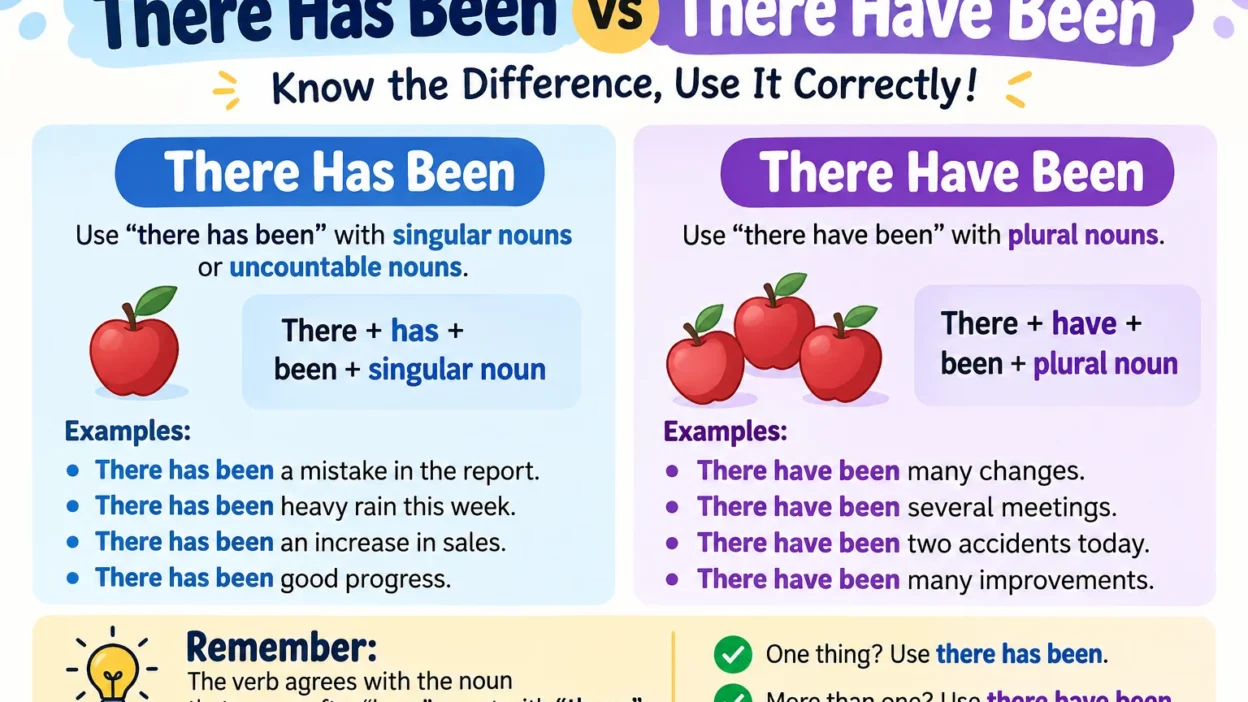
There has been is used with singular nouns or uncountable nouns.
There have been is used with plural nouns.
The verb agrees with the noun that follows—not with the word “there.
What Does “There Has Been” Mean?
There has been is the present perfect form used to show that one person, one thing, or an uncountable noun existed or happened up to now.
Structure
There + has + been + singular noun
Examples
- There has been a mistake in the report.
- There has been heavy rain this week.
- There has been an increase in sales.
- There has been good progress on the project.
The focus is on a single event, object, or an uncountable concept.
What Does “There Have Been” Mean?
There have been is used when referring to more than one person, object, or event that has existed or happened before now.
Structure
There + have + been + plural noun
Examples
- There have been many changes.
- There have been several meetings.
- There have been two accidents today.
- There have been many improvements in technology.
The phrase always introduces plural nouns.
There Has Been vs There Have Been: Main Difference
| Feature | There Has Been | There Have Been |
|---|---|---|
| Verb | Has | Have |
| Noun | Singular | Plural |
| Tense | Present Perfect | Present Perfect |
| Agreement | Singular subject | Plural subject |
| Example | There has been a delay. | There have been delays. |
The key difference is subject-verb agreement.
Grammar Rule Explained
Many learners mistakenly think that the verb agrees with there.
Actually, there is never the subject.
The noun after been determines whether you use has or have.
| Sentence | Correct? | Reason |
|---|---|---|
| There has been a problem. | ✅ | Singular noun |
| There have been problems. | ✅ | Plural noun |
| There has been books. | ❌ | Books is plural |
| There have been a book. | ❌ | Book is singular |
Grammar Forms Table
| Tense | Singular | Plural |
|---|---|---|
| Present | There is | There are |
| Past | There was | There were |
| Present Perfect | There has been | There have been |
| Past Perfect | There had been | There had been |
| Future | There will be | There will be |
Notice that past perfect and future use the same form regardless of number.
When to Use There Has Been
Choose there has been when talking about:
- One person
- One object
- One event
- Uncountable nouns
Examples
- There has been a power outage.
- There has been confusion about the schedule.
- There has been significant progress.
- There has been one complaint.
When to Use There Have Been
Use there have been with plural nouns.
Examples
- There have been many complaints.
- There have been five new employees.
- There have been several updates.
- There have been multiple discoveries.
Real-Life Examples
Business
- There has been a change in company policy.
- There have been several customer complaints.
Education
- There has been an improvement in attendance.
- There have been many classroom activities.
Science
- There has been remarkable progress in cancer research.
- There have been numerous scientific discoveries.
Healthcare
- There has been an increase in awareness.
- There have been several new treatments introduced.
Technology
- There has been rapid innovation.
- There have been many software updates.
Industry Usage Table
| Industry | Singular Example | Plural Example |
|---|---|---|
| Business | There has been a policy update. | There have been multiple meetings. |
| Education | There has been progress. | There have been several exams. |
| Healthcare | There has been improvement. | There have been many patients. |
| Science | There has been a breakthrough. | There have been numerous experiments. |
| Technology | There has been one security issue. | There have been several software releases. |
Why People Confuse There Has Been vs There Have Been
There are several reasons this grammar point causes confusion.
- The sentence starts with there, not the real subject.
- Speakers often choose the verb before reaching the noun.
- Long phrases separate the verb from the subject.
- Spoken English sometimes ignores grammar rules.
For example:
❌ There has been many reasons.
By the time the speaker reaches “many reasons,” the incorrect verb has already been chosen.
Common Mistakes
| Incorrect | Correct |
|---|---|
| There has been many issues. | There have been many issues. |
| There have been a mistake. | There has been a mistake. |
| There has been several meetings. | There have been several meetings. |
| There have been one accident. | There has been one accident. |
Correct vs Incorrect Sentences
❌ There has been many opportunities.
✅ There have been many opportunities.
❌ There have been a new rule.
✅ There has been a new rule.
❌ There has been several questions.
✅ There have been several questions.
Memory Trick
A simple trick is to look at the noun after “been.”
Ask yourself:
Is it one thing?
Use there has been.
Is it more than one?
Use there have been.
| Noun | Use |
|---|---|
| A problem | There has been |
| One employee | There has been |
| Many employees | There have been |
| Several books | There have been |
| Progress | There has been |
Step-by-Step Process to Choose the Correct Phrase
| Step | Question | Result |
|---|---|---|
| 1 | Find the noun after “been.” | Identify the subject |
| 2 | Is it singular? | Use there has been |
| 3 | Is it plural? | Use there have been |
| 4 | Is it uncountable? | Use there has been |
| 5 | Read the sentence again | Confirm agreement |
Examples in Everyday Conversations
At Work
There has been an important announcement today.
There have been several interviews this week.
At School
There has been a change in the exam schedule.
There have been many assignments this semester.
At Home
There has been a strange noise upstairs.
There have been many visitors today.
News Reports
There has been an earthquake near the coast.
There have been several aftershocks.
People Also Ask
Is “there has been” grammatically correct?
Yes. It is correct when followed by a singular or uncountable noun.
Is “there have been” grammatically correct?
Yes. It is correct when followed by a plural noun.
Can I use “there has been” with plural nouns?
No. Plural nouns require there have been.
Why doesn’t the verb agree with “there”?
Because there is only an introductory word. The verb agrees with the real subject.
FAQs
What is the difference between there has been vs there have been?
The difference is that there has been is used with singular or uncountable nouns, while there have been is used with plural nouns.
Which is more common in formal writing?
Both are equally common. The correct choice depends entirely on whether the noun is singular or plural.
Can uncountable nouns use “there has been”?
Yes. Examples include progress, rain, confusion, information, and growth.
How can I remember the rule?
Ignore the word there and check whether the noun after been is singular or plural.
Are these phrases in the present perfect tense?
Yes. Both are present perfect constructions.
Conclusion
Understanding there has been vs there have been is easier once you remember that the verb agrees with the noun that follows, not with the introductory word there.
Use there has been for singular and uncountable nouns, and use there have been for plural nouns.
By checking the real subject before choosing the verb, you can avoid common grammar mistakes and write with greater confidence.
Mastering this simple rule will improve your speaking, writing, and overall English accuracy.