The difference between homophone vs homograph vs homonym often confuses English learners and even native speakers.
Although these three grammar terms are closely related, they describe different relationships between words.
Understanding homophone vs homograph vs homonym can improve your vocabulary, pronunciation, spelling, and reading comprehension.
If you’ve ever wondered why words like see and sea sound the same, why lead can have different pronunciations, or why bat has multiple meanings, you’re not alone.
This complete guide explains homophone vs homograph vs homonym with simple definitions, comparison tables, real-life examples, common mistakes, memory tricks, and practical usage tips for students, teachers, writers, and professionals.
Quick Answer
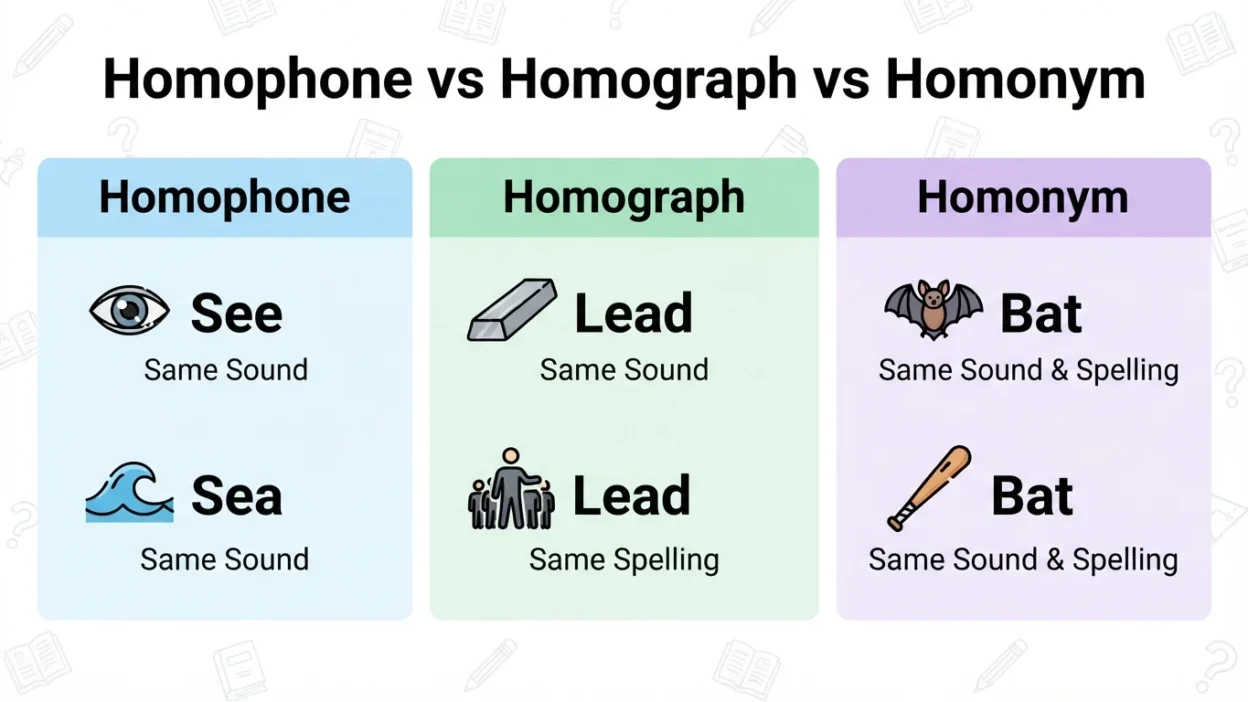
A homophone is a word that sounds the same as another word but has a different meaning and spelling.
A homograph is a word that is spelled the same as another word but has a different meaning and sometimes a different pronunciation.
A homonym is a word that has the same spelling or pronunciation as another word but a different meaning.
Homophone vs Homograph vs Homonym Comparison Table
| Feature | Homophone | Homograph | Homonym |
|---|---|---|---|
| Same Sound | Yes | Sometimes | Yes or Same Spelling |
| Same Spelling | Usually No | Yes | Sometimes |
| Different Meaning | Yes | Yes | Yes |
| Example | Sea – See | Lead (metal) / Lead (guide) | Bat (animal) / Bat (sports equipment) |
| Main Focus | Pronunciation | Spelling | Shared Form |
What Is a Homophone?
A homophone is a pair (or group) of words that sound the same but differ in spelling and meaning.
Common Homophone Examples
| Word 1 | Word 2 | Meaning Difference |
|---|---|---|
| See | Sea | Vision vs Ocean |
| Right | Write | Correct vs Record words |
| Flower | Flour | Plant vs Baking ingredient |
| Son | Sun | Child vs Star |
| Knight | Night | Warrior vs Evening |
Example Sentences
- I can see the ocean.
- The sea is calm today.
- Please write your name.
- You gave the right answer.
What Is a Homograph?
A homograph is a word with the same spelling as another word but a different meaning. Sometimes the pronunciation changes too.
Common Homograph Examples
| Word | Meaning 1 | Meaning 2 |
|---|---|---|
| Lead | To guide | A metal |
| Wind | Moving air | To twist |
| Tear | Rip | Drop from the eye |
| Bow | Front of a ship | Bend forward |
| Row | Line | Argument |
Example Sentences
- She will lead the meeting.
- The pipe is made of lead.
- The strong wind blew all night.
- Please wind the clock.
What Is a Homonym?
A homonym is a word that shares the same spelling, pronunciation, or both with another word but has a different meaning.
Common Homonym Examples
| Word | Meaning 1 | Meaning 2 |
|---|---|---|
| Bat | Flying animal | Baseball bat |
| Bark | Dog sound | Tree covering |
| Match | Competition | Fire starter |
| Ring | Jewelry | Telephone sound |
| Spring | Season | Coil |
Example Sentences
- A bat flew into the cave.
- He hit the ball with a bat.
- The dog began to bark.
- The tree’s bark is rough.
Key Differences Between Homophone, Homograph, and Homonym
| Feature | Homophone | Homograph | Homonym |
|---|---|---|---|
| Same Pronunciation | Yes | Sometimes | Usually |
| Same Spelling | No | Yes | Sometimes |
| Multiple Meanings | Yes | Yes | Yes |
| Reading Challenge | Low | High | Medium |
| Listening Challenge | High | Medium | Medium |
The easiest way to remember is:
- Homophones sound alike.
- Homographs look alike.
- Homonyms share a name or form.
Origin of the Words
| Term | Greek Root | Meaning |
|---|---|---|
| Homo | Same | Same |
| Phone | Sound | Voice or Sound |
| Graph | Writing | Written Form |
| Nym | Name | Name |
Understanding these roots makes the definitions much easier to remember.
Grammar and Language Role
Although these are vocabulary terms rather than verb forms, they play an important role in grammar and communication.
| Language Area | Importance |
|---|---|
| Reading | Improves comprehension |
| Writing | Prevents spelling mistakes |
| Speaking | Improves pronunciation |
| Listening | Helps understand context |
| Vocabulary | Expands word knowledge |
Real-Life Examples
Business
| Type | Example |
|---|---|
| Homophone | Sale – Sail |
| Homograph | Present (gift) / Present (introduce) |
| Homonym | Bill (invoice) / Bill (bird’s beak) |
Education
Teachers often use homophones in spelling quizzes.
Students learn homographs while improving reading comprehension.
Homonyms appear in vocabulary lessons and standardized tests.
Science
Scientists distinguish between words using context.
Example:
- Cell (biology)
- Cell (battery)
Technology
Programmers rely on precise spelling because similar-sounding words can create confusion in documentation.
Everyday Conversation
- Their car is over there.
- They’re coming tomorrow.
- Please accept my compliment.
- The soup is complementary to the meal.
Why People Confuse These Terms
Many learners mix these terms because they all begin with “homo,” meaning same.
Other reasons include:
- Similar terminology
- Overlapping definitions
- English spelling irregularities
- Context-dependent meanings
- Similar classroom explanations
Common Mistakes
| Incorrect Statement | Correct Statement |
|---|---|
| Homophones are spelled the same. | Homophones usually have different spellings. |
| Homographs always sound the same. | Some homographs have different pronunciations. |
| All homonyms are homophones. | Not always. |
| Homophones have the same meaning. | They have different meanings. |
| Homographs always mean the same thing. | They always have different meanings. |
Correct vs Incorrect Sentences
❌ I went to the see yesterday.
✅ I went to the sea yesterday.
❌ He will lead because the metal is heavy.
✅ He will lead the team.
✅ The pipe is made of lead.
❌ Their writing is right.
✅ Their writing is right only if it’s correct.
Memory Tricks
Use these simple tricks to remember the difference.
| Term | Memory Trick |
|---|---|
| Homophone | Phone = Sound |
| Homograph | Graph = Writing |
| Homonym | Name = Same Name |
Another easy reminder:
- Phone = Hear
- Graph = See
- Nym = Name
How to Identify the Correct Category
| Step | Question | Result |
|---|---|---|
| 1 | Do they sound the same? | Homophone |
| 2 | Are they spelled the same? | Homograph |
| 3 | Do they share pronunciation or spelling with different meanings? | Homonym |
| 4 | Does context change the meaning? | Check the sentence carefully |
Professional Usage
| Profession | Why It Matters |
|---|---|
| Teachers | Explain vocabulary accurately |
| Editors | Avoid language mistakes |
| Writers | Improve clarity |
| Translators | Preserve correct meaning |
| Lawyers | Prevent ambiguity |
| Marketers | Write precise copy |
| Journalists | Avoid confusing readers |
Tips to Avoid Confusing Them
- Learn word meanings together.
- Read sentences instead of isolated words.
- Practice pronunciation regularly.
- Pay attention to context.
- Keep a vocabulary notebook.
- Review common examples often.
Frequently Asked Questions
What is the main difference between homophone vs homograph vs homonym?
Homophones share pronunciation, homographs share spelling, and homonyms share pronunciation, spelling, or both while having different meanings.
Is every homograph a homonym?
Many are, but definitions vary slightly depending on grammar references. Homographs always share spelling but may differ in pronunciation.
Can a word be both a homograph and a homonym?
Yes. Words like bat and bark are commonly treated as homonyms because they share spelling and pronunciation while having different meanings.
Why are homophones difficult for learners?
Because they sound identical but have different spellings and meanings, making writing more challenging.
How can I remember these terms?
Remember:
- Phone = Sound
- Graph = Writing
- Nym = Name
Why are these terms important?
They improve reading, writing, pronunciation, spelling, vocabulary, and overall communication skills.
Conclusion
Understanding homophone vs homograph vs homonym helps you communicate more accurately in both spoken and written English.
A homophone shares pronunciation, a homograph shares spelling, and a homonym shares spelling, pronunciation, or both while having different meanings.
By learning the definitions, practicing real world examples, and using simple memory tricks, you’ll confidently recognize each type and avoid common English mistakes.
.