Finding verbs that start with Z can be surprisingly difficult because very few English verbs begin with this letter.
While letters like A, B, or S have hundreds of action words, Z offers only a small collection.
Even so, these verbs are useful in writing, education, science, business, and everyday communication.
This guide explores the most common verbs that start with Z, their meanings, grammar forms, pronunciation, and real world examples.
If you’re improving your vocabulary, preparing for school, playing word games, or writing creatively, this article will help you understand and use these unique verbs correctly.
Quick Answer
Verbs that start with Z are action words beginning with the letter Z. Although they are relatively rare in English,
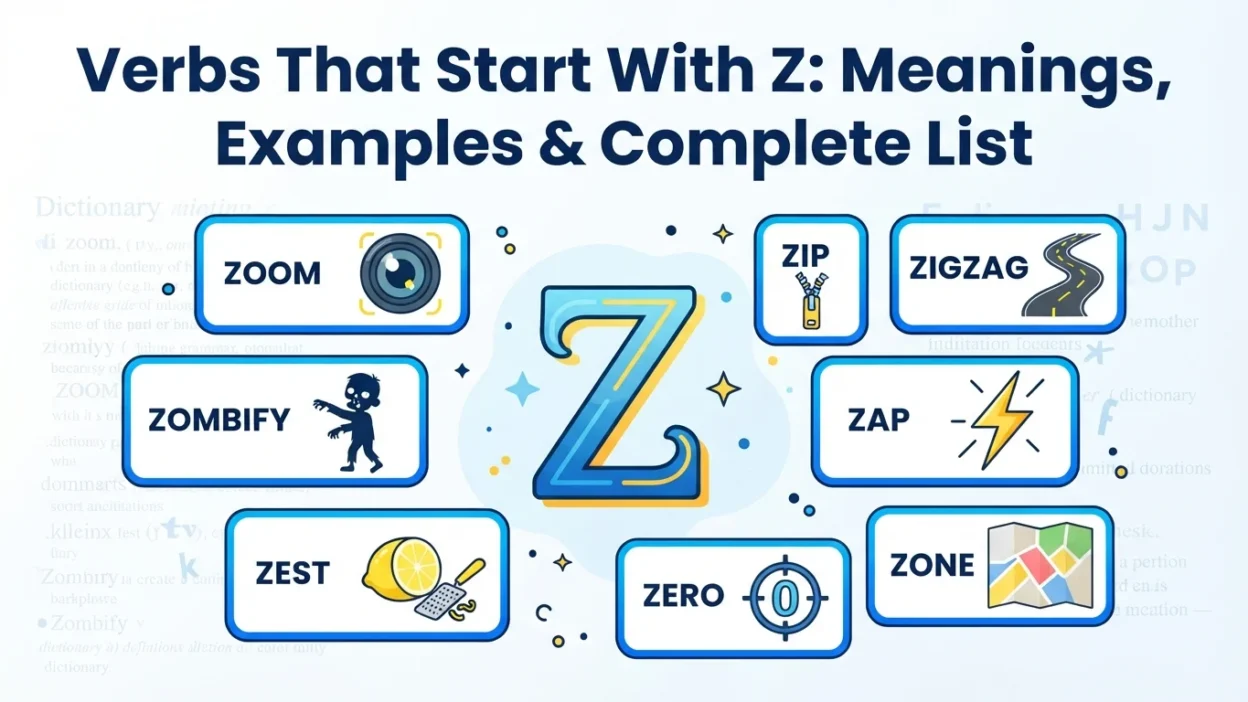
they include useful words like zoom, zip, zigzag, zap, zone, zero, zest, and zombify. Learning them can improve your vocabulary and writing skills.
What Are Verbs That Start With Z?
A verb is a word that expresses an action, occurrence, or state of being. Verbs that start with Z describe actions involving movement, speed, energy, organization, or transformation.
Examples include:
- Zoom
- Zip
- Zigzag
- Zap
- Zone
- Zero
- Zest
- Zombify
These verbs appear in everyday conversations, technology, sports, science, and creative writing.
List of Common Verbs That Start With Z
| Verb | Meaning | Example Sentence |
|---|---|---|
| Zoom | Move quickly or enlarge digitally | The camera zoomed in. |
| Zip | Move quickly or fasten | She zipped her jacket. |
| Zigzag | Move in sharp turns | The rabbit zigzagged across the field. |
| Zap | Destroy or strike suddenly | The laser zapped the target. |
| Zone | Divide into sections | The city zoned the area for housing. |
| Zero | Adjust to zero or focus on | Engineers zeroed the instrument. |
| Zest | Add flavor or enthusiasm | Zest the lemon before baking. |
| Zombify | Turn into a zombie-like state | Long meetings can zombify employees. |
Meanings of Popular Z Verbs
Zoom
Meaning: To move rapidly or enlarge an image.
Examples:
- Birds zoomed across the sky.
- The photographer zoomed in on the mountain.
Zip
Meaning: To close with a zipper or move very quickly.
Examples:
- Zip your backpack.
- The motorcycle zipped past us.
Zigzag
Meaning: To move in alternating directions.
Examples:
- The skier zigzagged downhill.
- Lightning zigzagged across the sky.
Zap
Meaning: To hit with electricity, energy, or force.
Examples:
- The microwave zapped the leftovers.
- The superhero zapped the robot.
Zone
Meaning: To divide or assign areas for specific purposes.
Examples:
- Officials zoned the district for commercial buildings.
- Teachers zoned students into discussion groups.
Zero
Meaning: To adjust precisely or aim accurately.
Examples:
- Soldiers zeroed the equipment.
- Scientists zeroed the measuring device.
Zest
Meaning: To remove citrus peel or add excitement.
Examples:
- Zest the orange carefully.
- She zested the dessert with fresh lemon.
Zombify
Meaning: To make someone tired, emotionless, or zombie-like.
Examples:
- Endless paperwork can zombify workers.
- Watching television all day can zombify children.
Main Comparison Table of Z Verbs
| Verb | Action Type | Common Usage |
|---|---|---|
| Zoom | Movement | Technology, transportation |
| Zip | Fast movement or fastening | Clothing, travel |
| Zigzag | Directional movement | Sports, navigation |
| Zap | Sudden action | Electronics, games |
| Zone | Organization | Business, government |
| Zero | Precision | Science, engineering |
| Zest | Cooking | Food preparation |
| Zombify | Transformation | Entertainment, informal speech |
Grammar Forms of Common Z Verbs
| Base Verb | Past Tense | Past Participle | Present Participle |
|---|---|---|---|
| Zoom | Zoomed | Zoomed | Zooming |
| Zip | Zipped | Zipped | Zipping |
| Zigzag | Zigzagged | Zigzagged | Zigzagging |
| Zap | Zapped | Zapped | Zapping |
| Zone | Zoned | Zoned | Zoning |
| Zero | Zeroed | Zeroed | Zeroing |
| Zest | Zested | Zested | Zesting |
| Zombify | Zombified | Zombified | Zombifying |
How to Use Verbs That Start With Z
Using these verbs correctly depends on the sentence and context.
Examples:
- The drone zoomed over the forest.
- Please zip your suitcase.
- The cyclist zigzagged through traffic.
- The electrician zapped the faulty circuit.
- The council zoned the land for schools.
Real-Life Examples
Business
- Managers zoned the warehouse efficiently.
- Delivery trucks zipped across the city.
Education
- Students zoomed into the online class.
- The teacher zoned learners into teams.
Science
- Researchers zeroed the instruments before testing.
- Scientists zapped bacteria using ultraviolet light.
Technology
- Users zoom images for better visibility.
- The software zapped harmful files.
Cooking
- Always zest lemons before adding juice.
- The chef zested fresh oranges.
Sports
- The player zigzagged around defenders.
- The race car zipped around the track.
Industry Usage Table
| Industry | Common Z Verb | Example |
|---|---|---|
| Technology | Zoom | Zoom the image. |
| Engineering | Zero | Zero the measuring tool. |
| Construction | Zone | Zone the building site. |
| Food Industry | Zest | Zest fresh citrus fruits. |
| Transportation | Zip | Cars zip through tunnels. |
| Gaming | Zap | Zap the enemy character. |
Why Are Verbs That Start With Z So Rare?
The English language has relatively few words beginning with Z because many originated from Greek, Germanic, French, or other languages where Z appeared less frequently.
As a result, only a limited number of common verbs start with Z.
Common Mistakes
Many learners misuse these verbs or spell them incorrectly.
| Incorrect | Correct |
|---|---|
| The car zip yesterday. | The car zipped yesterday. |
| Please zooming the picture. | Please zoom the picture. |
| He zigzag yesterday. | He zigzagged yesterday. |
| They zero the device yesterday. | They zeroed the device yesterday. |
| She zest the lemon. | She zested the lemon. |
Memory Tricks
Remember these simple associations:
| Verb | Memory Trick |
|---|---|
| Zoom | Think of a fast camera. |
| Zip | Think of closing a jacket. |
| Zigzag | Imagine a lightning bolt. |
| Zap | Think of electricity. |
| Zone | Picture a city map. |
| Zero | Think of aiming perfectly. |
| Zest | Imagine peeling a lemon. |
| Zombify | Picture a sleepy zombie. |
Learning Process for Z Verbs
| Step | Action |
|---|---|
| 1 | Learn the meaning of each verb. |
| 2 | Practice pronunciation. |
| 3 | Memorize grammar forms. |
| 4 | Write example sentences. |
| 5 | Use the verbs in conversations. |
| 6 | Review them regularly. |
Tips for Remembering Verbs That Start With Z
- Learn them in small groups.
- Associate each verb with an image.
- Practice writing daily.
- Read books and articles.
- Use flashcards.
- Speak them aloud.
Benefits of Learning Verbs That Start With Z
- Expands vocabulary.
- Improves creative writing.
- Helps in spelling competitions.
- Useful for Scrabble and word games.
- Enhances communication skills.
- Builds confidence in English.
Frequently Asked Questions
How many verbs start with Z?
There are relatively few common English verbs that start with Z, making them among the rarest action words.
What is the most common Z verb?
Zoom is one of the most frequently used verbs beginning with Z.
Is “zest” a verb?
Yes. Zest means to remove the outer peel of citrus fruit or add enthusiasm.
What does “zero” mean as a verb?
It means to adjust something to zero or accurately calibrate an instrument.
Why should I learn verbs that start with Z?
They improve vocabulary, support creative writing, and help in word games and language learning.
Conclusion
Although verbs that start with Z are uncommon, they are valuable additions to your English vocabulary.
Words like zoom, zip, zigzag, zap, zone, zero, zest, and zombify appear in technology, business, education, cooking, sports, and everyday communication.
Learning their meanings, grammar forms, and practical usage will make your writing more precise and engaging.
Practice these verbs regularly, use them in real life sentences, and you’ll quickly become confident using even the rarest action words in English.