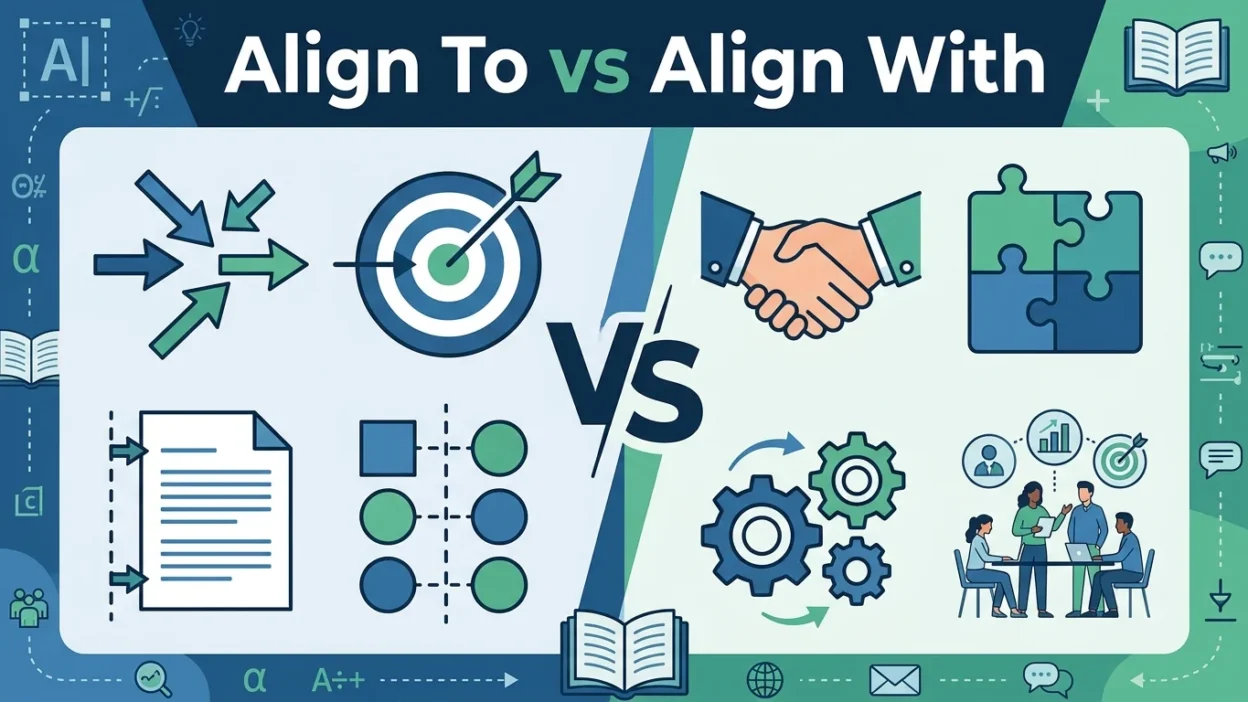
The phrase align to vs align with is a common source of confusion for English learners, professionals, and writers.
Both expressions use the verb align, which means to place something in the correct position or bring it into agreement.
However, the difference between align to vs align with lies in how each phrase is used and the relationship it describes.
Understanding align to vs align with is important in business communication, academic writing, technology, and everyday English.
While the phrases sometimes overlap, native speakers often prefer one over the other depending on the context.
Learning the correct meaning, usage, and examples will help you communicate more naturally and avoid common grammar mistakes.
Quick Answer
Align with is the more common and natural phrase in modern English. It means to agree, match, or be consistent with something.
Align to is usually used when physically positioning something toward a target, standard, or reference point.
Main Comparison Table
| Phrase | Meaning | Common Usage | Example |
|---|---|---|---|
| Align to | Position toward a target or standard | Technical, design, engineering | Align the image to the center. |
| Align with | Match, agree, or be consistent with | Business, communication, everyday English | Our goals align with company values. |
What Does Align Mean?
The verb align means to arrange, position, or bring things into proper agreement.
General Examples
- The mechanic aligned the wheels.
- Our strategy aligns with customer expectations.
- Please align the text to the left margin.
The meaning changes slightly depending on whether it is followed by to or with.
What Does Align To Mean?
Align to typically refers to positioning something according to a reference point, target, standard, or direction.
Examples
- Align the logo to the center of the page.
- The sensor is aligned to the calibration mark.
- The software aligns data to a standard format.
In many cases, align to describes physical or technical positioning.
What Does Align With Mean?
Align with means to agree, match, correspond, or be consistent with something.
Examples
- Our objectives align with the company’s mission.
- Her views align with scientific evidence.
- The project aligns with industry standards.
This phrase is extremely common in business and professional communication.
Align To vs Align With: Key Difference
The main difference is the relationship being expressed.
| Feature | Align To | Align With |
|---|---|---|
| Focus | Positioning toward a target | Agreement or consistency |
| Common Context | Technical, engineering, formatting | Business, communication, strategy |
| Frequency | Less common | More common |
| Sounds Natural in Business | Sometimes | Usually |
Simple Rule
- Use align to for positioning.
- Use align with for agreement or compatibility.
Grammar Structure of Align To and Align With
Both phrases use the verb align followed by a preposition.
Grammar Forms Table
| Structure | Example |
|---|---|
| Align to + target | Align the image to the center. |
| Align to + standard | Align measurements to the reference point. |
| Align with + person | My opinion aligns with hers. |
| Align with + goal | Our strategy aligns with our objectives. |
Real-Life Business Examples
In business communication, align with is far more common.
Examples
- Our marketing strategy aligns with customer needs.
- The budget aligns with corporate priorities.
- Employee goals should align with organizational objectives.
Business Usage Table
| Situation | Preferred Phrase |
|---|---|
| Company values | Align with |
| Business goals | Align with |
| Team objectives | Align with |
| Document formatting | Align to |
| Technical standards | Align to |
Education Examples
Teachers and students often use both phrases depending on the context.
Align To
- Align the chart to the left side of the page.
- The curriculum aligns to state standards.
Align With
- The lesson aligns with learning objectives.
- Student projects align with course requirements.
Science and Technology Examples
Scientific and technical fields frequently use both expressions.
Align To Examples
- Align the telescope to the target star.
- The device aligns to the calibration point.
Align With Examples
- The results align with previous research.
- The findings align with scientific theory.
Industry Usage Table
| Industry | Align To | Align With |
|---|---|---|
| Engineering | Very Common | Sometimes |
| Technology | Common | Common |
| Business | Less Common | Very Common |
| Education | Common | Common |
| Science | Common | Very Common |
Why People Confuse Align To and Align With
Several factors create confusion:
- Both phrases use the same verb.
- Their meanings sometimes overlap.
- Different industries prefer different forms.
- Business jargon often uses align with extensively.
- Some style guides treat them differently.
Because of these similarities, learners often use them interchangeably.
Common Mistakes and Corrections
Many writers choose the wrong preposition.
Correct vs Incorrect Sentences
| Incorrect | Correct |
|---|---|
| Our goals align to the company vision. | Our goals align with the company vision. |
| My opinion aligns to yours. | My opinion aligns with yours. |
| Align the image with the center. | Align the image to the center. |
| The data aligns to previous studies. | The data aligns with previous studies. |
Memory Trick for Align To vs Align With
A simple memory trick can help.
Think of “To” as a Target
Align to = toward a target
Examples:
- Align to the center
- Align to a standard
- Align to a reference point
Think of “With” as Together
Align with = together or in agreement
Examples:
- Align with goals
- Align with values
- Align with opinions
Step-by-Step Guide for Choosing the Correct Phrase
| Step | Question | Use |
|---|---|---|
| 1 | Is it a physical position? | Align to |
| 2 | Is it a technical reference point? | Align to |
| 3 | Is it agreement or consistency? | Align with |
| 4 | Is it about goals or values? | Align with |
| 5 | Is it about opinions or beliefs? | Align with |
Professional Communication Tips
In modern professional writing, align with is generally preferred when discussing:
- Strategies
- Values
- Objectives
- Policies
- Customer expectations
Examples:
- Our roadmap aligns with market demands.
- The proposal aligns with company priorities.
- The initiative aligns with strategic goals.
These sentences sound natural and professional.
Alternative Expressions
Depending on context, you may use alternatives.
| Phrase | Alternative |
|---|---|
| Align with | Match |
| Align with | Agree with |
| Align with | Correspond with |
| Align to | Position toward |
| Align to | Adjust to |
These alternatives can make writing more varied.
Frequently Asked Questions
Is align with or align to more common?
Align with is more common in modern English, especially in business and professional communication.
Can align to and align with mean the same thing?
Sometimes, but not always. Their meanings overlap in some contexts, yet they are not completely interchangeable.
Which phrase should I use for business goals?
Use align with because goals, values, and strategies usually match or agree with something.
Which phrase is better for formatting documents?
Use align to when positioning text, images, or objects relative to a location.
Is align with grammatically correct?
Yes. It is fully correct and widely used by native speakers.
Is align to wrong?
No. It is correct when referring to positioning, standards, targets, or reference points.
Conclusion
The difference between align to vs align with comes down to positioning versus agreement.
Align to is usually used when something is being positioned toward a target, standard, or reference point. Align with is used when ideas, goals, values, opinions, or strategies match or agree with something else.
In professional communication, align with is generally the preferred choice, while align to remains common in technical and formatting contexts.
Remember: to = target, with = agreement, and choosing the correct phrase will make your English sound more natural and accurate.