Many English learners get confused by too bad vs to bad because the words to and too sound exactly the same.
Although they are pronounced alike, they have different meanings and grammar rules.
Using the wrong one can make your writing appear inaccurate, especially in school, business, or professional communication.
Understanding too bad vs to bad is easier than it seems. In most situations, too bad is the correct phrase when expressing disappointment or describing something excessively negative.
Meanwhile, to bad is rarely correct because it is usually an incomplete phrase rather than a proper expression.
This guide explains their meanings, differences, examples, grammar, common mistakes, and memory tricks to help you use them confidently.
Quick Answer
Too bad is the correct phrase when expressing disappointment or saying something is unfortunate.
To bad is usually incorrect because to is a preposition or part of an infinitive, not an intensifier. Most of the time, you should use too bad.
Too Bad vs To Bad: Main Comparison Table
| Feature | Too Bad | To Bad |
|---|---|---|
| Correct phrase | ✅ Yes | ❌ Usually No |
| Meaning | Unfortunate or excessively bad | Usually incomplete or incorrect |
| Common usage | Everyday English | Rarely correct |
| Suitable for formal writing | Yes (when appropriate) | No |
| Dictionary recognition | Yes | No as a fixed phrase |
What Does “Too Bad” Mean?
Too bad has two common meanings.
The first meaning expresses disappointment or sympathy.
Examples
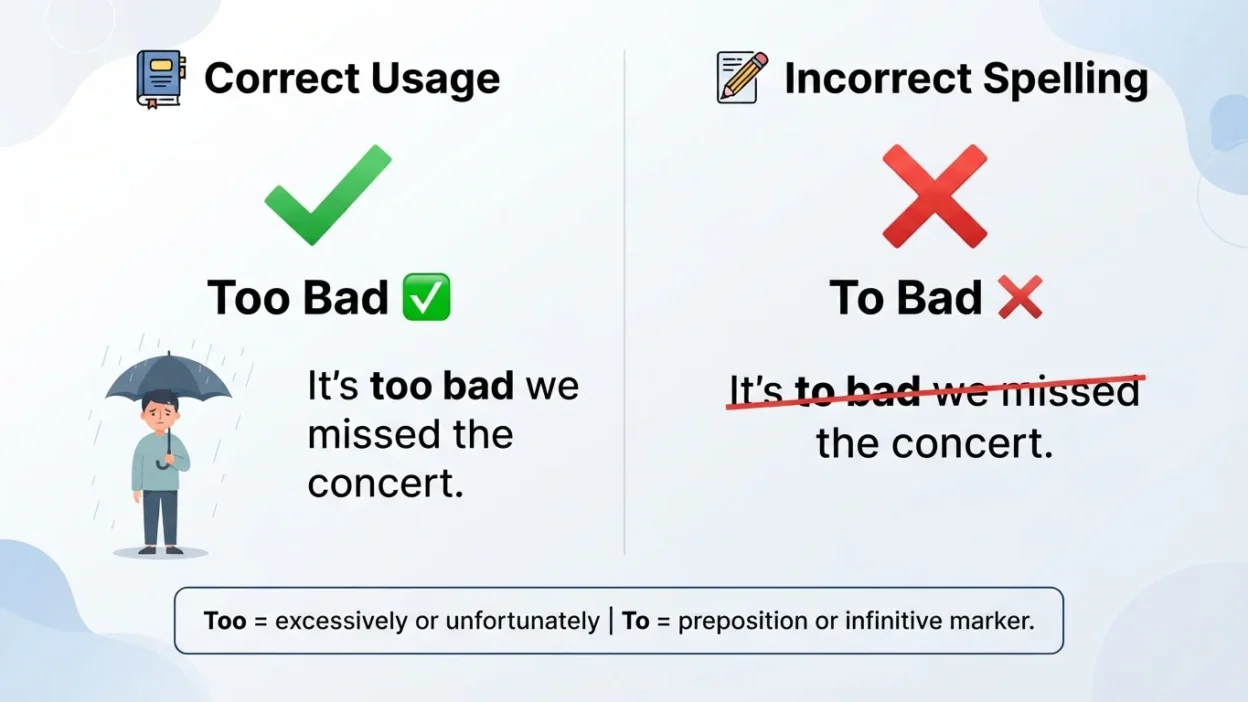
- That’s too bad you missed the concert.
- It’s too bad we couldn’t meet.
- That’s too bad the project was canceled.
The second meaning describes something that is excessive.
Examples
- The weather is too bad for hiking.
- The road conditions are too bad to continue driving.
- The signal is too bad to make a phone call.
In both cases, too means excessively or expresses regret.
What Does “To Bad” Mean?
To bad is not a standard English phrase.
The word to is normally used as:
- A preposition
- Part of an infinitive verb
When followed directly by bad, the phrase is usually incomplete.
Incorrect Examples
❌ That is to bad.
❌ It was to bad outside.
Correct Versions
✅ That is too bad.
✅ It was too bad outside.
Too Bad vs To Bad: Key Differences
| Point | Too Bad | To Bad |
|---|---|---|
| Correct English phrase | Yes | Usually No |
| Expresses disappointment | Yes | No |
| Means excessively bad | Yes | No |
| Used in everyday conversation | Yes | No |
| Accepted in professional writing | Yes | No |
Why Do People Confuse Too Bad and To Bad?
Several factors contribute to this common mistake.
1. Identical Pronunciation
To and too sound exactly the same.
2. Fast Typing
People often type quickly and accidentally leave out one “o.”
3. Homophones
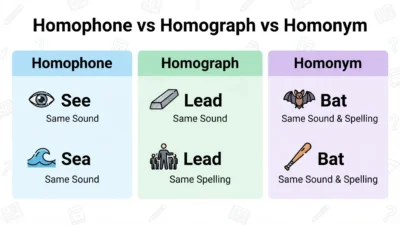
These words are homophones, meaning they sound alike but have different meanings.
4. Lack of Proofreading
Many spelling mistakes happen because writers don’t review their work before sending it.
Grammar of “Too”
The word too has two main functions.
- It means also.
- It means more than necessary or excessively.
Examples:
- I want to come too.
- The coffee is too hot.
- The movie was too long.
In too bad, it means excessively or emphasizes regret.
Grammar Forms Table
| Word | Part of Speech | Example |
|---|---|---|
| Too | Adverb | It is too cold. |
| To | Preposition/Infinitive marker | Go to school. |
| Bad | Adjective | The weather is bad. |
| Too bad | Common phrase | That’s too bad. |
When Should You Use “Too Bad”?
Use too bad when expressing regret, sympathy, disappointment, or describing something as excessively negative.
Everyday Examples
- That’s too bad you couldn’t attend.
- It’s too bad the store closed early.
- The traffic is too bad today.
Real-Life Examples
Business
It’s too bad the meeting had to be postponed.
Education
It’s too bad that several students missed the exam review.
Healthcare
The patient’s condition became too bad to ignore.
Science
The experimental results were too bad to support the hypothesis.
Customer Service
It’s too bad your package was delayed.
Sports
It’s too bad the match was canceled because of rain.
Industry Usage Table
| Industry | Correct Example |
|---|---|
| Business | It’s too bad the contract wasn’t approved. |
| Education | That’s too bad you missed the lecture. |
| Healthcare | The symptoms became too bad overnight. |
| Retail | It’s too bad the item is out of stock. |
| Hospitality | It’s too bad your reservation was canceled. |
| Technology | The network connection is too bad for video calls. |
Common Mistakes
Many writers accidentally replace too with to.
Correct vs Incorrect Sentences
| Incorrect | Correct |
|---|---|
| That’s to bad. | That’s too bad. |
| It is to bad outside. | It is too bad outside. |
| The signal is to bad. | The signal is too bad. |
| It’s to bad we lost. | It’s too bad we lost. |
| The weather was to bad. | The weather was too bad. |
Too Bad vs To Bad in Professional Writing
Always use too bad if you mean something is unfortunate or excessively negative.
Examples include:
- Business emails
- Customer service responses
- Reports
- Academic writing
- Workplace communication
Avoid to bad, as it is generally considered a spelling error.
Memory Trick to Remember the Difference
Here’s an easy way to remember:
Too has an extra “O,” meaning something extra.
If something is excessively bad or you’re expressing regret, use too bad.
Think:
Too = Extra
Extra bad = Too bad
Step-by-Step Guide to Avoid the Mistake
| Step | Action |
|---|---|
| 1 | Decide whether you mean “excessively” or “unfortunately.” |
| 2 | If yes, choose too. |
| 3 | Write too bad as two separate words. |
| 4 | Proofread your sentence. |
| 5 | Use spell check before publishing. |
Similar Expressions
| Expression | Meaning |
|---|---|
| Too bad | Unfortunate |
| What a shame | Expression of regret |
| Unfortunately | Sadly |
| Regrettably | In an unfortunate way |
| That’s disappointing | Expresses disappointment |
Tips for Using “Too Bad” Correctly
- Use too when you mean excessively.
- Use too bad to express sympathy or disappointment.
- Never replace too with to in this expression.
- Proofread emails and academic writing.
- Remember that too always contains the extra “O.”
Frequently Asked Questions
Is “to bad” ever correct?
Usually, no. In most situations, to bad is an incomplete phrase and should be replaced with too bad.
What does “too bad” mean?
It means something is unfortunate, disappointing, or excessively bad.
Why do people confuse “too” and “to”?
Because they are homophones—they sound the same but have different meanings and spellings.
Can I use “too bad” in formal writing?
Yes. It is acceptable when the tone is appropriate, though formal alternatives like unfortunately may sometimes fit better.
How can I remember the correct spelling?
Remember that too has an extra O, which represents extra. If something is excessively bad or unfortunate, write too bad.
Is “too bad” an idiom?
It is commonly used as a fixed expression to show sympathy or disappointment, though it can also be used literally to describe excessive severity.
Conclusion
Understanding too bad vs to bad is simple once you know the role of too. Too bad is the correct phrase for expressing disappointment, sympathy, or describing something as excessively negative. To bad is generally incorrect because to does not perform the same grammatical function.
Remember that too has an extra O for extra, making it easy to choose the correct phrase in both everyday and professional writing.