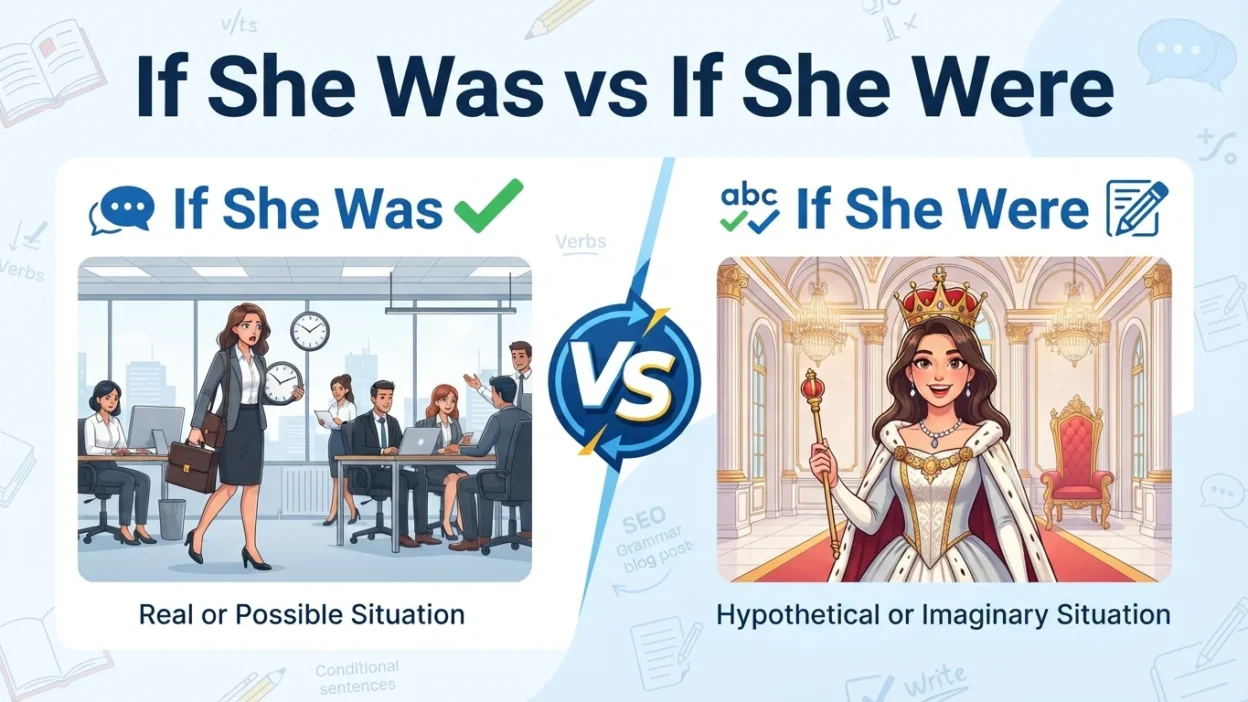
Many English learners struggle with if she was vs if she were because both phrases sound correct in everyday conversation.
The confusion comes from the fact that one is used for real or possible situations, while the other is used for imaginary, hypothetical, or unreal situations.
Understanding if she was vs if she were can greatly improve your grammar and make your writing sound more natural.
Knowing when to use if she was vs if she were is especially important in academic writing, professional communication, and formal English.
Although native speakers sometimes use “if she was” informally, grammar rules still recommend “if she were” for hypothetical situations.
This guide explains the meaning, differences, grammar rules, examples, common mistakes, and memory tips in simple English.
Quick Answer
- Use if she was when talking about something that actually happened or may have happened.
- Use if she were when talking about imaginary, impossible, or hypothetical situations.
- “If she were” is the standard choice in formal English for unreal conditions.
If She Was vs If She Were Comparison Table
| Feature | If She Was | If She Were |
|---|---|---|
| Meaning | Real or possible situation | Imaginary or hypothetical situation |
| Grammar mood | Indicative mood | Subjunctive mood |
| Formal English | Correct for real events | Correct for unreal situations |
| Informal speech | Very common | Also common |
| Example | If she was late, she missed the meeting. | If she were taller, she could reach the shelf. |
What Does “If She Was” Mean?
If she was refers to something that may have actually happened or could realistically be true.
It is used when the speaker is uncertain about a real event rather than imagining one.
Examples
- If she was at home, she probably heard the news.
- If she was sick yesterday, she should see a doctor.
- I don’t know if she was ready.
- If she was responsible, we’ll find out soon.
These examples describe situations that may actually have occurred.
What Does “If She Were” Mean?
If she were is used for hypothetical, imaginary, impossible, or unlikely situations.
It follows the subjunctive mood, which English uses for unreal conditions and wishes.
Examples
- If she were here, she would help us.
- If she were the manager, things would change.
- If she were older, she could vote.
- If she were a millionaire, she would travel the world.
These situations are imagined rather than real.
The Main Difference Between If She Was vs If She Were
| Situation | Correct Choice |
|---|---|
| Something actually happened | If she was |
| Something might have happened | If she was |
| Imaginary situation | If she were |
| Impossible situation | If she were |
| Formal hypothetical writing | If she were |
The easiest way to remember the difference is:
- Real possibility = if she was
- Imaginary possibility = if she were
Grammar Rule Behind If She Was vs If She Were
The difference comes from two grammatical moods.
| Grammar Mood | Purpose | Example |
|---|---|---|
| Indicative | States facts or possibilities | If she was tired, she rested. |
| Subjunctive | Expresses wishes or unreal situations | If she were taller, she would play basketball. |
The subjunctive mood often uses were for all subjects, including I, he, she, and it.
Grammar Forms Table
| Subject | Real Situation | Hypothetical Situation |
|---|---|---|
| I | If I was | If I were |
| He | If he was | If he were |
| She | If she was | If she were |
| It | If it was | If it were |
| They | If they were | If they were |
Notice that only singular subjects change in hypothetical situations.
When Should You Use “If She Was”?
Choose if she was when discussing facts, reports, or real possibilities.
Examples
- If she was absent yesterday, she missed the quiz.
- If she was driving, she should arrive soon.
- If she was upset, I understand why.
- Ask him if she was available.
These sentences describe events that may actually be true.
When Should You Use “If She Were”?
Choose if she were when imagining situations that are not true or unlikely.
Examples
- If she were my teacher, I would study harder.
- If she were here now, she would laugh.
- If she were president, she would change the law.
- If she were richer, she would buy a larger house.
These examples describe unreal or imagined conditions.
Real-Life Examples
Business
| Sentence | Correct Form |
|---|---|
| If she was in yesterday’s meeting, she knows the decision. | If she was |
| If she were the CEO, profits would increase. | If she were |
Education
| Sentence | Correct Form |
|---|---|
| If she was absent, she needs the notes. | If she was |
| If she were the class monitor, she would organize everyone. | If she were |
Science
| Sentence | Correct Form |
|---|---|
| If she was part of the experiment, her data is included. | If she was |
| If she were conducting the experiment, the procedure might differ. | If she were |
Daily Conversation
| Sentence | Correct Form |
|---|---|
| If she was home, she probably answered the phone. | If she was |
| If she were here, we’d ask her directly. | If she were |
Why Do People Confuse If She Was and If She Were?
Many speakers mix these forms because:
- Everyday conversation often ignores the subjunctive mood.
- Both phrases sound natural.
- American English sometimes accepts “if she was” informally.
- Many people never learn the subjunctive grammar rule.
- Movies and casual speech frequently use both forms interchangeably.
Professional and Academic Usage
| Context | Preferred Form |
|---|---|
| Academic writing | If she were |
| Business reports | If she were (hypothetical) |
| Legal writing | If she were |
| Formal speeches | If she were |
| Casual conversation | Both, depending on meaning |
Formal writing strongly prefers if she were for imaginary situations.
Common Mistakes
| Incorrect | Correct |
|---|---|
| If she was you, I’d apologize. | If she were you, I’d apologize. |
| If she were at school yesterday, she saw the event. | If she was at school yesterday, she saw the event. |
| If she was a bird, she would fly. | If she were a bird, she would fly. |
| If she were absent yesterday, call her. | If she was absent yesterday, call her. |
Correct vs Incorrect Sentences
Correct
- If she was late, she missed the train.
- If she were my friend, I would help her.
- If she was at work, she finished the report.
- If she were an engineer, she would solve the problem.
Incorrect
- If she was my sister, I would visit her every day.
- If she were at the office yesterday, she attended the meeting.
- If she was a queen, she would live in a palace.
- If she were sick yesterday, she missed class.
Memory Trick
Remember this simple formula:
Was = Reality
Were = Imagination
Ask yourself one question:
“Did this actually happen?”
- Yes → If she was
- No, it’s imaginary → If she were
This shortcut works almost every time.
How to Choose the Correct Form
| Step | Ask Yourself | Use |
|---|---|---|
| 1 | Is it real or possible? | If she was |
| 2 | Is it imaginary? | If she were |
| 3 | Is it a wish? | If she were |
| 4 | Is it formal writing? | If she were (for hypotheticals) |
| 5 | Is it describing a past event? | If she was |
People Also Ask
Is “if she was” grammatically correct?
Yes. It is correct when referring to a real or possible past situation.
Is “if she were” more formal?
Yes. It is the preferred form for hypothetical or unreal situations, especially in formal English.
Why do people say “if she was” instead of “if she were”?
In everyday speech, many native speakers use if she was even in hypothetical situations because it sounds more natural in casual conversation.
Which is correct: “If she was you” or “If she were you”?
If she were you is grammatically correct because it expresses an unreal situation.
Can both forms be correct?
Yes. The correct choice depends on whether the situation is real (was) or hypothetical (were).
Conclusion
Understanding if she was vs if she were is mainly about recognizing the difference between reality and imagination. Use if she was when talking about events that happened or may have happened. Use if she were for hypothetical, imaginary, or impossible situations, especially in formal writing.
By remembering the simple rule “was for reality, were for imagination,“ you can avoid common grammar mistakes and write with greater confidence and accuracy.