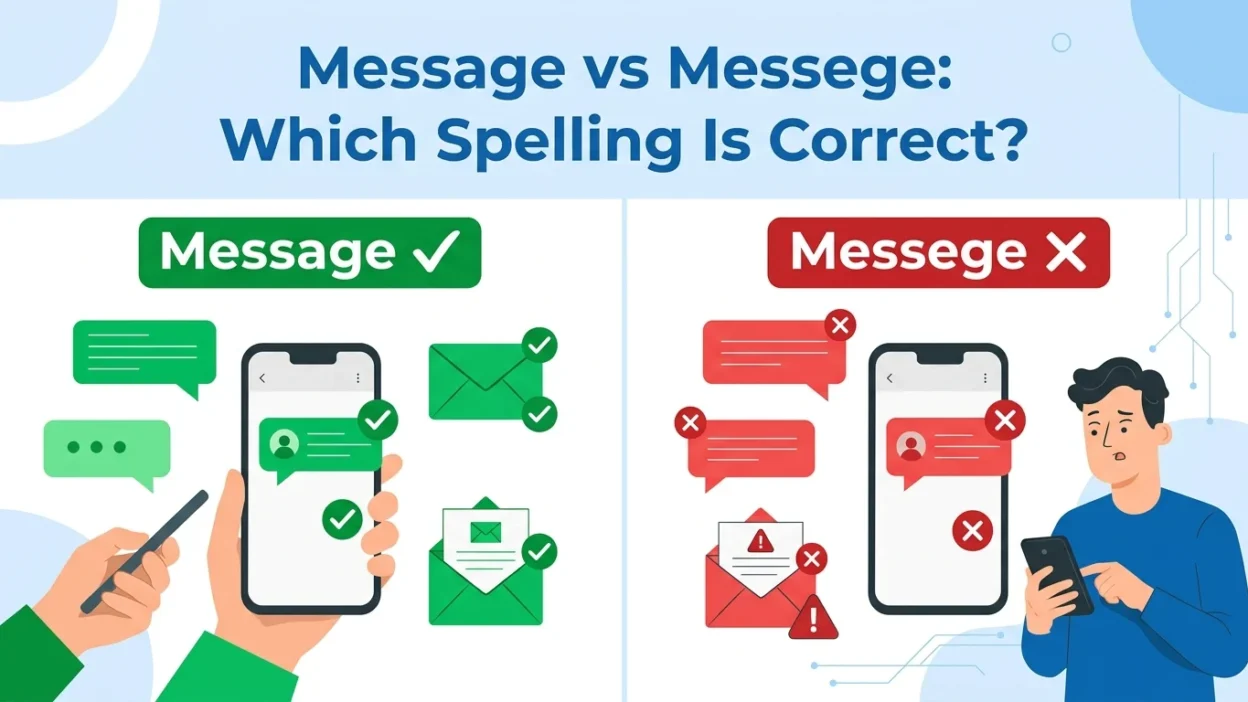
Have you ever typed “messege” instead of “message” and wondered whether both spellings are correct? The confusion around message vs messege is very common because the words sound almost identical. Many people accidentally use the wrong spelling in emails, texts, assignments, and social media posts.
Understanding message vs messege is important for clear communication. In simple terms, message is the correct English spelling, while messege is a misspelling and is not recognized as a standard English word. This guide explains the meaning, difference, usage, examples, and common mistakes related to these terms.
Quick Answer: Message vs Messege
Message is the correct spelling and means a piece of communication, information, or a written or spoken note.
Messege is an incorrect spelling of the word message and should be avoided in formal and informal writing.
Main Comparison Table: Message vs Messege
| Feature | Message | Messege |
|---|---|---|
| Spelling Status | Correct | Incorrect |
| Dictionary Word | Yes | No |
| Meaning | Communication or information | No accepted meaning |
| Used in Writing | Yes | No |
| Suitable for Professional Writing | Yes | No |
| Accepted in English Grammar | Yes | No |
What Does “Message” Mean?
The word message refers to information that someone sends, speaks, writes, or communicates to another person.
A message can be delivered through text, email, speech, letters, social media, or even symbols.
Examples of Message
- I received your message this morning.
- Please leave a message after the beep.
- The teacher sent a message to all parents.
- His speech carried an inspiring message.
What Does “Messege” Mean?
The word messege has no meaning in standard English because it is simply a spelling mistake of the word message.
People often type “messege” accidentally because the pronunciation of “message” can make the spelling seem confusing.
Examples of Incorrect Usage
❌ I got your messege.
❌ Please send me a messege.
✅ I got your message.
✅ Please send me a message.
Message vs Messege: Key Differences
Although the words look similar, only one is correct.
| Aspect | Message | Messege |
|---|---|---|
| Correct English Word | Yes | No |
| Appears in Dictionaries | Yes | No |
| Used in Academic Writing | Yes | No |
| Accepted by Grammar Checkers | Yes | No |
| Recommended Usage | Always | Never |
Why Do People Confuse Message and Messege?
The confusion happens mainly because of pronunciation and typing habits.
Common reasons include:
- Both spellings sound almost identical.
- People type quickly on phones and keyboards.
- English spelling rules can be confusing.
- Autocorrect may not always catch the error.
How to Use “Message” Correctly
The word message can function as both a noun and a verb.
As a Noun
- I received an important message.
- Her message inspired the entire team.
As a Verb
- Please message me when you arrive.
- He messaged his friend yesterday.
Grammar Forms of Message
| Form | Example |
|---|---|
| Singular Noun | message |
| Plural Noun | messages |
| Verb (Base Form) | message |
| Past Form | messaged |
| Present Participle | messaging |
| Third-Person Singular | messages |
Real-Life Examples of Message in Different Contexts
Business Example
The manager sent a message about the upcoming meeting.
Education Example
The teacher posted a message on the school’s online portal.
Technology Example
The app displays an error message when something goes wrong.
Healthcare Example
The doctor left a message for the patient regarding test results.
Social Media Example
She posted a motivational message on her profile.
Industry Usage Table
| Industry | Example of Message Usage |
|---|---|
| Business | Meeting reminder message |
| Education | Student announcement message |
| Technology | System error message |
| Healthcare | Appointment message |
| Marketing | Promotional message |
| Customer Service | Support message |
Examples of Message in Sentences
| Situation | Example Sentence |
|---|---|
| Texting | Send me a message later. |
| I received your message yesterday. | |
| Workplace | The CEO’s message encouraged employees. |
| School | The principal shared an important message. |
| Social Media | Her message gained thousands of likes. |
Common Mistakes with Message and Messege
Many writers accidentally use the incorrect spelling.
Correct vs Incorrect Sentences
| Incorrect Sentence | Correct Sentence |
|---|---|
| I received your messege. | I received your message. |
| Please send me a messege. | Please send me a message. |
| Her messege was inspiring. | Her message was inspiring. |
| The teacher posted a messege. | The teacher posted a message. |
Memory Trick to Remember the Correct Spelling
A simple trick is to remember that message contains the word “mess” at the beginning.
Mess + age = Message
Think of it this way:
“You can send a message at any age.”
This memory trick helps you remember that the correct spelling is message, not messege.
How to Avoid Writing “Messege”
Follow these simple steps:
| Step | Action |
|---|---|
| Step 1 | Remember the spelling starts with “mess”. |
| Step 2 | Read your writing before sending it. |
| Step 3 | Use spell-check tools. |
| Step 4 | Practice writing the word correctly. |
| Step 5 | Notice the correct spelling in books and articles. |
Why Correct Spelling Matters
Using the correct spelling improves communication and professionalism.
Benefits include:
- Creates a positive impression
- Improves writing credibility
- Prevents misunderstandings
- Shows attention to detail
- Enhances academic and professional writing
Frequently Asked Questions
Is “messege” a real English word?
No. “Messege” is not a recognized English word. It is a misspelling of “message.”
Which spelling is correct: message or messege?
The correct spelling is message.
Can I use “messege” in formal writing?
No. You should never use “messege” in formal or informal writing.
Why do people spell message as messege?
People usually make this mistake because the pronunciation can make the spelling seem confusing.
Is message a noun or a verb?
It can be both. It is commonly used as a noun and can also function as a verb.
How can I remember the correct spelling?
Remember the phrase: Mess + age = Message.
Conclusion
The difference between message vs messege is simple. Message is the correct English word that refers to information or communication sent from one person to another.
Messege is merely a spelling mistake and has no accepted meaning in English. Whenever you write emails, texts, assignments, or social media posts, always use message. Remembering the simple rule “Mess + age = Message” can help you avoid this common error and improve your writing accuracy.