Many English learners struggle with giving vs given because both words come from the verb give, yet they serve different grammatical purposes. Understanding giving vs given is important for writing and speaking correct English in everyday conversations, academic work, and professional communication.
The confusion between giving vs given usually comes from their similar spelling and shared origin.
However, they have different meanings and grammar functions. This guide explains the meaning, difference, usage, examples, grammar rules, common mistakes, and memory tricks so you can confidently choose the correct word every time.
Quick Answer
The difference between giving vs given is simple:
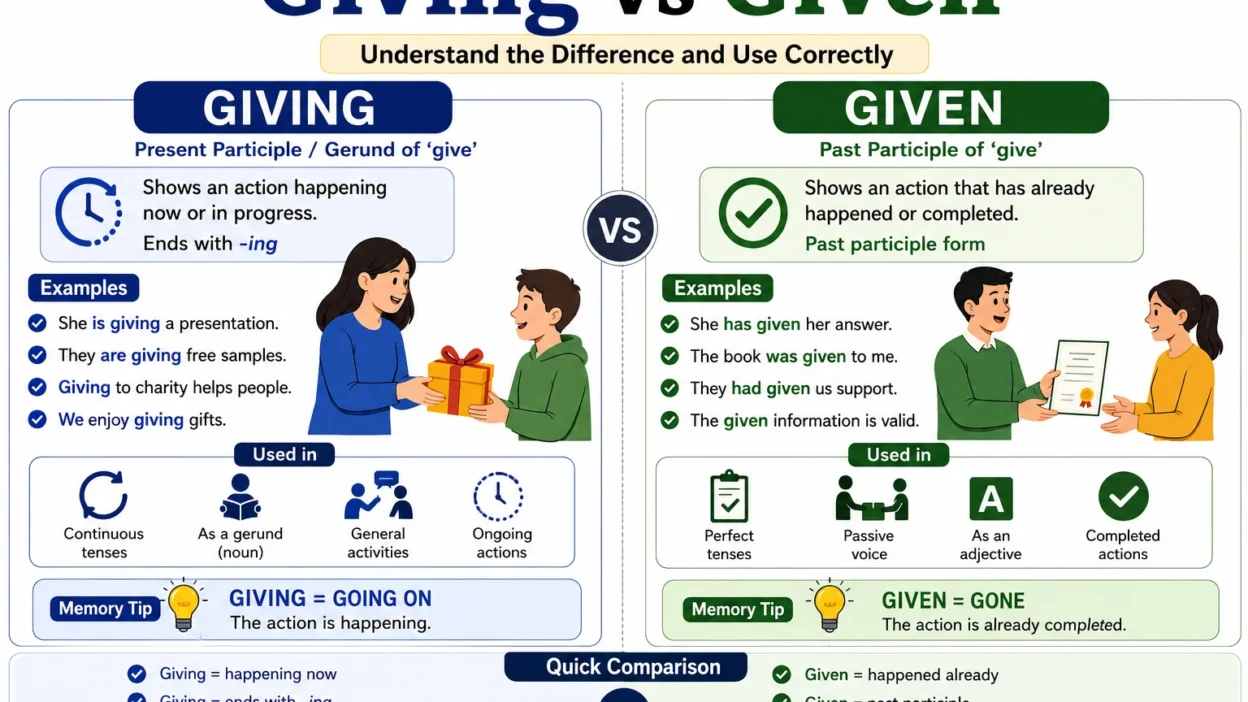
- Giving is the present participle or gerund of give and describes an ongoing action.
- Given is the past participle of give and is used with helping verbs or as an adjective.
Giving vs Given Comparison Table
| Feature | Giving | Given |
|---|---|---|
| Part of Speech | Present participle / Gerund | Past participle / Adjective |
| Time | Present or ongoing | Completed action |
| Main Function | Shows an action happening now | Shows an action already completed |
| Example | She is giving a speech. | She has given a speech. |
| Used with Helping Verbs | Is giving | Has given, Had given, Was given |
| Can Act as Adjective | Rarely | Yes |
What Does “Giving” Mean?
Giving is the -ing form of the verb give. It usually describes an action that is happening now or functions as a noun (gerund).
Examples
- She is giving a presentation.
- They are giving free samples.
- Giving to charity helps people.
- We enjoy giving gifts during holidays.
In these examples, the action is happening or is being discussed in general.
What Does “Given” Mean?
Given is the past participle of give. It usually describes an action that has already happened or is used as an adjective.
Examples
- She has given her answer.
- The teacher had given homework.
- The award was given yesterday.
- Under the given conditions, the project succeeded.
The action has already been completed.
Giving vs Given: Key Differences
| Giving | Given |
|---|---|
| Shows ongoing action | Shows completed action |
| Ends with -ing | Past participle form |
| Used in continuous tenses | Used in perfect and passive tenses |
| Can be a noun (gerund) | Can be an adjective |
| Focuses on action | Focuses on result |
Grammar Forms of Give
| Verb Form | Word |
|---|---|
| Base Form | Give |
| Third Person Singular | Gives |
| Present Participle | Giving |
| Past Tense | Gave |
| Past Participle | Given |
Remember this sequence:
Give → Gave → Given
When Should You Use Giving?
Use giving when talking about:
- Actions happening now
- Continuous tenses
- Activities in general
- Gerunds
Examples
- He is giving instructions.
- They are giving interviews.
- Giving feedback improves performance.
- We kept giving support throughout the project.
When Should You Use Given?
Use given when talking about:
- Perfect tenses
- Passive voice
- Completed actions
- Descriptions
Examples
- The company has given bonuses.
- Students were given certificates.
- She had given her permission.
- The given information is accurate.
Real-Life Examples of Giving vs Given
Business
| Giving | Given |
|---|---|
| The manager is giving instructions. | The manager has given approval. |
Education
| Giving | Given |
|---|---|
| The teacher is giving a quiz. | The teacher has given grades. |
Science
| Giving | Given |
|---|---|
| Researchers are giving presentations. | The results were given yesterday. |
Healthcare
| Giving | Given |
|---|---|
| Nurses are giving medication. | The patient was given treatment. |
Daily Life
| Giving | Given |
|---|---|
| She is giving her friend advice. | She has given her friend advice. |
Professional and Industry Usage
| Industry | Giving Example | Given Example |
|---|---|---|
| Business | Giving customer support | Given customer approval |
| Education | Giving assignments | Given final grades |
| Healthcare | Giving medicine | Given diagnosis |
| Law | Giving testimony | Given evidence |
| Marketing | Giving discounts | Given customer feedback |
Why Do People Confuse Giving vs Given?
Several reasons make these words confusing:
- Both come from the verb give.
- Both can appear in similar-looking sentences.
- English verb forms change depending on tense.
- Learners often confuse present participles with past participles.
Learning their grammar roles removes most of the confusion.
Common Mistakes and Corrections
| Incorrect | Correct |
|---|---|
| She has giving a speech. | She has given a speech. |
| He is given a lecture. | He is giving a lecture. |
| They have giving us help. | They have given us help. |
| I am given gifts every year. (if actively giving) | I am giving gifts every year. |
Correct vs Incorrect Sentences
❌ She has giving me a book.
✅ She has given me a book.
❌ The teacher is given homework.
✅ The teacher is giving homework.
❌ They were giving awards yesterday. (if awards were received)
✅ They were given awards yesterday.
Memory Trick to Remember the Difference
A simple trick is:
- Giving = Going on (the action is continuing)
- Given = Gone (the action is already finished)
Think of the endings:
- -ing = happening
- -en = completed
This shortcut helps you remember the correct form quickly.
Step-by-Step Guide to Choosing the Right Word
| Step | Question | Use |
|---|---|---|
| 1 | Is the action happening now? | Giving |
| 2 | Has the action already happened? | Given |
| 3 | Is there a helping verb like has, had, have? | Given |
| 4 | Is it a continuous tense with is, am, are? | Giving |
| 5 | Is it describing something already provided? | Given |
People Also Ask
Is “giving” a verb?
Yes. Giving is the present participle and gerund form of give.
Is “given” past tense?
No. Given is the past participle. The simple past tense is gave.
Can “given” be an adjective?
Yes. For example:
“The given instructions were easy to follow.”
Can “giving” be used as a noun?
Yes. As a gerund, giving functions as a noun.
Example:
“Giving is an important part of kindness.”
Which is correct: “has giving” or “has given”?
Has given is correct because given is the past participle used with has.
FAQs
What is the main difference between giving vs given?
Giving shows an ongoing action, while given refers to a completed action.
Is “given” always used with has or have?
No. It is also used in passive voice and as an adjective.
Can giving and given be used in the same sentence?
Yes.
Example: “She is giving the presentation she was given yesterday.”
Is “giving” present tense?
It is the present participle used in continuous tenses, not the simple present tense.
Which word is more common in formal writing?
Both are common, but given appears more often in formal reports because it is frequently used in passive constructions.
Conclusion
Understanding giving vs given is mainly about recognizing whether the action is ongoing or completed.
Use giving for actions that are happening now or as a gerund, and use given as the past participle for perfect tenses, passive voice, and adjective forms. Once you remember that giving means the action is in progress while given means the action has already happened, choosing the correct word becomes much easier.

Julian Wyatt is a passionate researcher and writer who explores symbols, mythology, cultural traditions, and hidden meanings. Through engaging articles, he helps readers uncover the fascinating stories and significance behind symbols worldwide.