The confusion between reevaluation vs re evaluation is common because English often combines prefixes with base words in different ways.
Many writers wonder whether reevaluation should be written as one word or separated into re evaluation, especially in academic, business, and professional writing.
Understanding reevaluation vs re evaluation helps you write more accurately and professionally.
In modern English, one form is considered standard, while the other is generally incorrect except in very rare formatting situations.
This guide explains the meaning, spelling rules, examples, grammar, and usage so you’ll know exactly which version to use.
Quick Answer
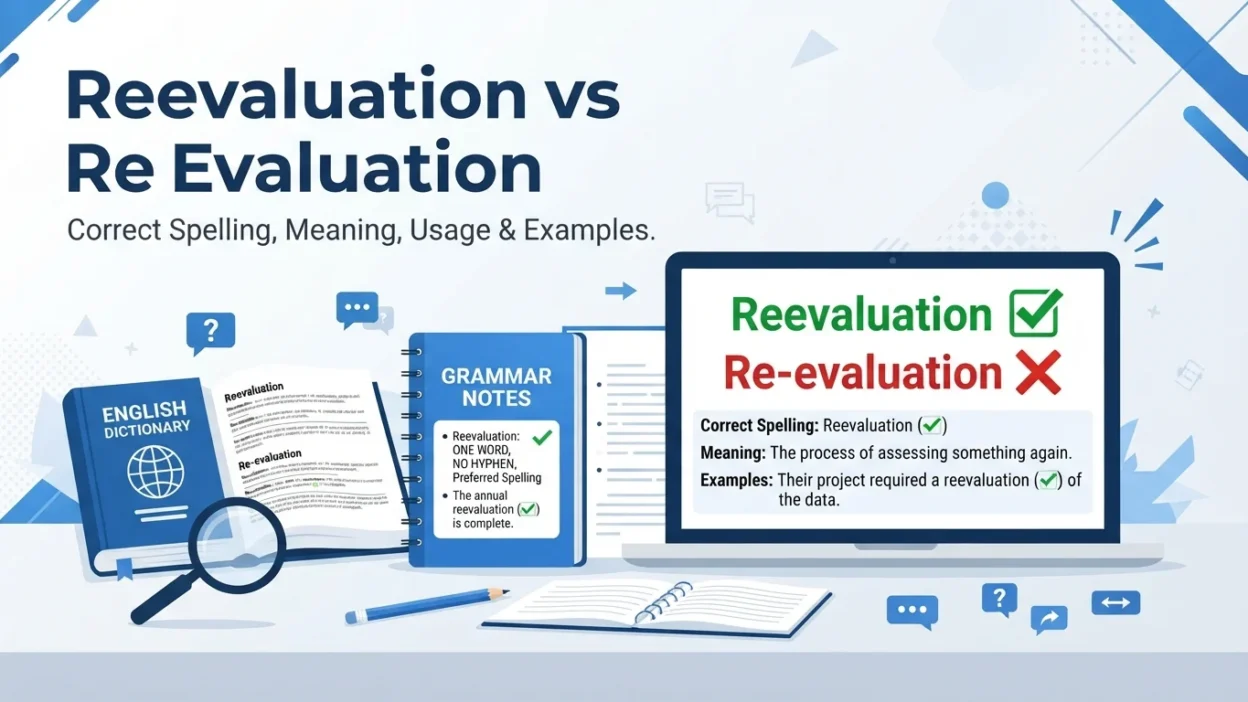
Reevaluation (one word) is the correct standard spelling in modern English.
Re evaluation (two words) is generally considered incorrect because the prefix re- should be attached directly to the base word evaluation.
Reevaluation vs Re Evaluation Comparison Table
| Feature | Reevaluation | Re Evaluation |
|---|---|---|
| Correct spelling | ✅ Yes | ❌ Generally No |
| Standard English | Yes | No |
| Dictionary form | Yes | No |
| Professional writing | Recommended | Not recommended |
| Academic writing | Preferred | Incorrect |
| Business documents | Preferred | Avoid |
| Meaning | A new evaluation | Intended to mean the same but incorrectly written |
What Does Reevaluation Mean?
Reevaluation is a noun that means the act of evaluating something again after reviewing new information, evidence, or circumstances.
The prefix re- means again, while evaluation means the process of judging or assessing something.
Examples
- The company conducted a reevaluation of its marketing strategy.
- The doctor recommended a reevaluation after six months.
- Students received a reevaluation of their exam papers.
- Scientists completed a reevaluation of the research findings.
What Does Re Evaluation Mean?
Re evaluation is simply the prefix re separated from the word evaluation.
In standard English spelling, prefixes like re-, un-, pre-, and non- are attached directly to the main word.
Therefore:
❌ re evaluation
✅ reevaluation
The separated form occasionally appears because of typing mistakes or incorrect formatting, but it is not accepted in formal writing.
Main Difference Between Reevaluation vs Re Evaluation
Although both forms appear to express the same idea, only one follows standard English spelling rules.
| Aspect | Reevaluation | Re Evaluation |
|---|---|---|
| Meaning | Evaluate again | Intended same meaning |
| Correctness | Correct | Incorrect |
| Dictionary entry | Yes | No |
| Used in publications | Yes | Rarely |
| Recommended | Yes | No |
The difference is purely spelling, not meaning.
Why Do People Confuse Reevaluation and Re Evaluation?
Several reasons cause this confusion.
1. Long Double Vowels
People think the double ee looks unusual.
Example:
- reevaluate
- reelection
- reexamine
These are all correct.
2. Prefix Confusion
Some writers mistakenly separate every prefix from the base word.
3. Spell Checker Issues
Older software or incorrect autocorrect settings sometimes split the word.
4. Visual Preference
Some people believe two shorter words look easier to read, even though the spelling is incorrect.
Grammar Rule Behind Reevaluation
English prefixes normally attach directly to the main word.
| Prefix | Correct Form | Incorrect Form |
|---|---|---|
| re- | reevaluation | re evaluation |
| un- | unhappy | un happy |
| pre- | preschool | pre school |
| non- | nonfiction | non fiction |
| mis- | misunderstand | mis understand |
When re- comes before a word beginning with e, the result often has ee together.
Examples:
- reelect
- reenter
- reevaluate
- reevaluation
- reexamine
This spelling is completely correct.
Reevaluation in Different Industries
The word is widely used across many professions.
| Industry | Example Usage |
|---|---|
| Business | Reevaluation of company goals |
| Education | Reevaluation of student performance |
| Healthcare | Patient reevaluation after treatment |
| Science | Reevaluation of research data |
| Finance | Reevaluation of investment risks |
| Government | Reevaluation of public policies |
| Engineering | Reevaluation of project safety |
Real-Life Examples of Reevaluation
Business
The company performed a reevaluation of customer feedback before launching the product.
Education
Teachers completed a reevaluation of students’ assignments after receiving appeals.
Healthcare
Doctors recommended a reevaluation following the patient’s recovery.
Science
Researchers published a reevaluation of earlier climate studies.
Human Resources
The manager requested a reevaluation of employee performance ratings.
Personal Development
Many people undergo a reevaluation of career goals after gaining experience.
Process of a Reevaluation
A reevaluation usually follows several steps.
| Step | Description |
|---|---|
| 1 | Review existing information |
| 2 | Collect updated evidence |
| 3 | Compare old and new findings |
| 4 | Analyze results |
| 5 | Make a new judgment |
| 6 | Document conclusions |
Common Expressions Using Reevaluation
These phrases are frequently used.
- performance reevaluation
- policy reevaluation
- financial reevaluation
- project reevaluation
- medical reevaluation
- annual reevaluation
- strategic reevaluation
- academic reevaluation
- career reevaluation
- risk reevaluation
Common Mistakes
Many writers accidentally separate the prefix.
| Incorrect Sentence | Correct Sentence |
|---|---|
| We completed the re evaluation yesterday. | We completed the reevaluation yesterday. |
| The teacher ordered a re evaluation. | The teacher ordered a reevaluation. |
| A re evaluation is necessary. | A reevaluation is necessary. |
| They requested another re evaluation. | They requested another reevaluation. |
Memory Trick to Remember the Correct Spelling
A simple trick is:
The prefix “re-” stays attached to the word.
Think of these words:
- reelect
- reevaluate
- reenter
- reevaluation
If the base word starts with e, don’t separate it—just keep both e letters together.
Reevaluation vs Reevaluate
Many learners confuse the noun and verb forms.
| Word | Part of Speech | Example |
|---|---|---|
| Reevaluation | Noun | The reevaluation took two days. |
| Reevaluate | Verb | We need to reevaluate the proposal. |
| Reevaluated | Verb (Past) | The team reevaluated the budget. |
| Reevaluating | Verb (-ing) | They are reevaluating the plan. |
When Should You Use Reevaluation?
Use reevaluation whenever you mean evaluating something again.
It is appropriate in:
- academic papers
- research articles
- business reports
- government documents
- legal writing
- healthcare records
- professional communication
- everyday English
Avoid writing re evaluation unless you are intentionally separating words because of unusual formatting or line breaks.
Frequently Asked Questions
Is reevaluation one word?
Yes. Reevaluation is the correct one-word spelling.
Is re evaluation correct?
No. It is generally considered an incorrect spelling in standard English.
Why does reevaluation have two “e” letters?
The prefix re- joins the word evaluation, naturally creating ee together.
Is reevaluation used in business writing?
Yes. It is widely used in reports, audits, performance reviews, and strategic planning.
What is the verb form of reevaluation?
The verb is reevaluate.
Can I use reevaluation in academic writing?
Absolutely. It is the preferred and standard spelling in academic and professional English.
Conclusion
Understanding reevaluation vs re evaluation is straightforward once you know the spelling rule. Reevaluation is the correct, dictionary-approved form used in business, education, healthcare, science, and everyday writing. The separated form re evaluation is generally considered incorrect because the prefix re- should remain attached to the base word. Whenever you mean to evaluate something again, confidently use reevaluation. Following this simple rule will make your writing clearer, more professional, and grammatically accurate.

Julian Wyatt is a passionate researcher and writer who explores symbols, mythology, cultural traditions, and hidden meanings. Through engaging articles, he helps readers uncover the fascinating stories and significance behind symbols worldwide.