
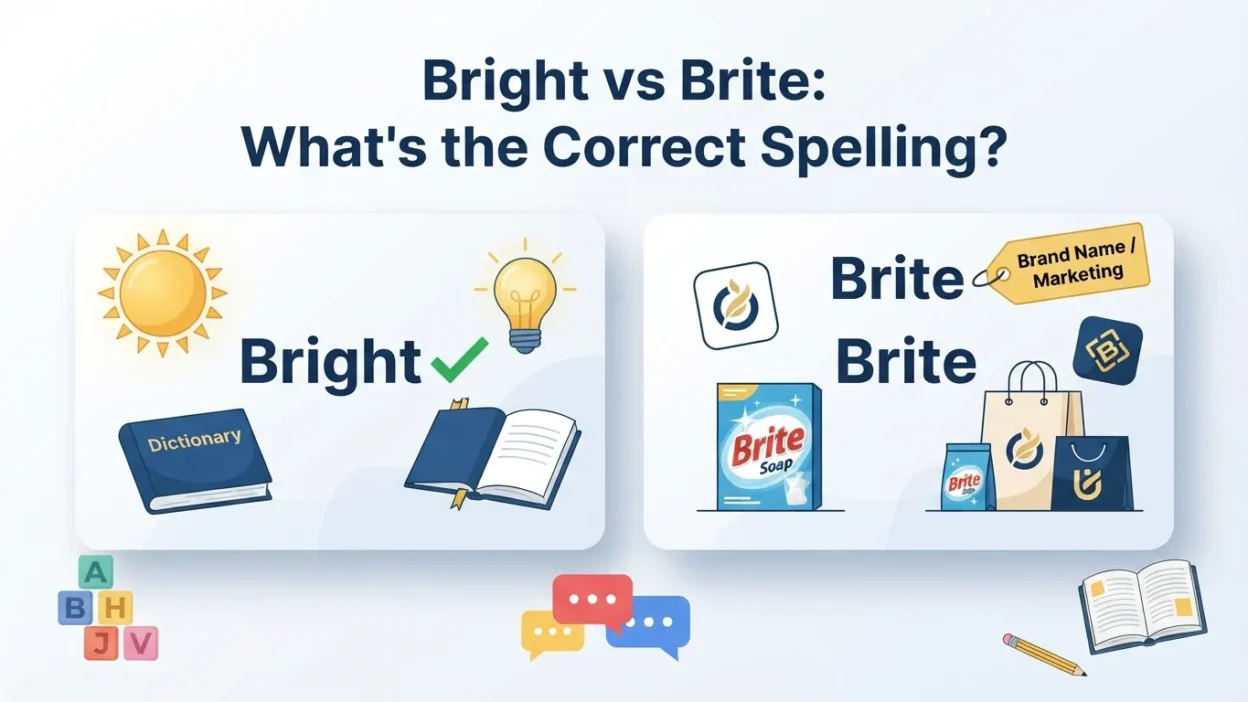
The comparison bright vs brite often confuses English learners because both words look and sound similar.
While bright is a standard English word used in everyday writing and speech, brite frequently appears in brand names, product labels, and informal spellings.
This similarity makes many people wonder which form is grammatically correct.
Understanding bright vs brite is important for writing accurately in school, business, and daily communication.
In this guide, you’ll learn the meaning of each word, their differences, grammar, real life examples, professional usage, common mistakes, and easy memory tricks.
By the end, you’ll know exactly when to use bright and when brite is appropriate.
Quick Answer
Bright is the correct standard English spelling and means giving off much light, intelligent, cheerful, or vivid.
Brite is not a standard dictionary spelling of bright. It is mainly used in brand names, trademarks, product names, or creative marketing.
Bright vs Brite: Main Comparison Table
| Feature | Bright | Brite |
|---|---|---|
| Standard English Word | ✔ | ✘ |
| Dictionary Entry | ✔ | Usually No (except as a proper name) |
| Used in Formal Writing | ✔ | ✘ |
| Common in Branding | Sometimes | ✔ |
| Meaning | Light, intelligent, vivid | Usually a stylized spelling of bright |
What Does “Bright” Mean?
Bright is an adjective with several meanings depending on the context.
It can describe:
- A strong light
- High intelligence
- Cheerfulness
- Vivid colors
- Hopeful situations
Examples
- The sun is bright today.
- She is a bright student.
- He wore a bright yellow jacket.
- The future looks bright.
What Does “Brite” Mean?
Brite is not a standard English adjective.
Instead, it is commonly used as:
- A brand name
- A company name
- A product name
- A creative spelling in advertising
Examples include:
- ColorBrite
- BrightBrite
- Brite Smile
- Brite Laundry Products
Outside branding, brite is generally considered a misspelling of bright.
Key Differences Between Bright and Brite
| Point | Bright | Brite |
|---|---|---|
| Correct spelling | ✔ | ✘ (for standard English) |
| Academic writing | ✔ | ✘ |
| Business reports | ✔ | ✘ |
| Product names | Sometimes | ✔ |
| Everyday English | ✔ | Rare |
Grammar of “Bright”
Bright is mainly used as an adjective.
It can also appear in comparative and superlative forms.
Grammar Forms Table
| Form | Word | Example |
|---|---|---|
| Positive | Bright | The room is bright. |
| Comparative | Brighter | Today is brighter than yesterday. |
| Superlative | Brightest | She is the brightest student. |
| Adverb | Brightly | The stars shone brightly. |
| Noun | Brightness | The brightness hurt my eyes. |
When to Use “Bright”
Use bright whenever you’re writing standard English.
Examples:
- The classroom is bright.
- She has a bright future.
- His bright ideas impressed everyone.
- The stars looked bright tonight.
When to Use “Brite”
Use brite only when referring to:
- Brand names
- Product names
- Registered trademarks
- Official company names
Examples:
- We bought Brite detergent.
- The company launched a new Brite cleaning product.
Do not replace bright with brite in normal writing.
Real-Life Examples
Business
- The company has a bright future.
- Brite Solutions launched new software.
Education
- She is a bright learner.
- Bright students often enjoy challenges.
Science
- The star appeared unusually bright.
- Scientists observed bright galaxies.
Marketing
- Brite Toothpaste introduced a new formula.
- Bright colors attract customers.
Everyday Conversation
- What a bright morning!
- Your idea is bright and creative.
Industry Usage Table
| Industry | Bright | Brite |
|---|---|---|
| Education | Bright student | Rare |
| Science | Bright star | Rare |
| Marketing | Bright colors | Brand names |
| Retail | Bright packaging | Product branding |
| Technology | Bright display | Company names |
Why Do People Confuse Bright vs Brite?
Several reasons explain the confusion.
- Both words sound exactly the same.
- Many brands intentionally use brite.
- English has many alternative spellings in advertising.
- Product packaging often makes brite look official.
However, in standard English, bright is the correct spelling.
Common Mistakes
| Incorrect | Correct |
|---|---|
| She is a brite student. | She is a bright student. |
| Today is very brite. | Today is very bright. |
| The room looks brite. | The room looks bright. |
| His future is brite. | His future is bright. |
| The stars were brite. | The stars were bright. |
Memory Trick
Remember this simple rule:
Bright = Right
Both words end with -ght.
If you’re writing normal English, choose bright.
Think:
Bright light = Correct spelling
Choosing the Correct Word
| Situation | Recommended Word |
|---|---|
| School essay | Bright |
| Business email | Bright |
| Academic paper | Bright |
| Product brand | Brite (if it’s the official name) |
| Marketing slogan | Either, depending on branding |
| Daily conversation | Bright |
Tips for Correct Usage
- Always use bright in standard English.
- Use brite only if it is part of an official brand name.
- Proofread your writing for spelling errors.
- Remember that dictionaries recognize bright, not brite, as the standard adjective.
- Follow the official spelling of trademarks when mentioning products.
Frequently Asked Questions
Is “brite” a real English word?
Not as a standard adjective. It is mainly used in brand names and trademarks.
Which spelling is correct?
Bright is the correct spelling in standard English.
Why do companies use “brite”?
Many brands use creative spellings to create unique and memorable product names.
Can I use “brite” in school essays?
No. Use bright unless you’re referring to a specific brand.
Is “brite” ever accepted in dictionaries?
Some dictionaries list it as a trademark, variant, or proper noun, but bright remains the standard English spelling.
Conclusion
Understanding bright vs brite is simple once you know the difference.
Bright is the correct standard English word used to describe light, intelligence, vivid colors, or hopeful situations.
Brite, on the other hand, is primarily a creative spelling used in brand names and marketing.
For school, professional writing, and everyday communication, always use bright unless you’re referring to an official product or company name that intentionally uses brite.