Many English learners find by which vs in which confusing because both are relative phrases used to connect ideas in a sentence.
Although they look similar, they serve different grammatical purposes. Choosing the wrong phrase can make your writing unclear or even change the intended meaning.
Understanding by which vs in which is essential for academic writing, business communication, legal documents, and formal English.
These expressions often appear in reports, essays, contracts, and research papers.
This guide explains their meanings, differences, grammar rules, examples, and common mistakes so you can confidently choose the correct phrase in any context.
Quick Answer
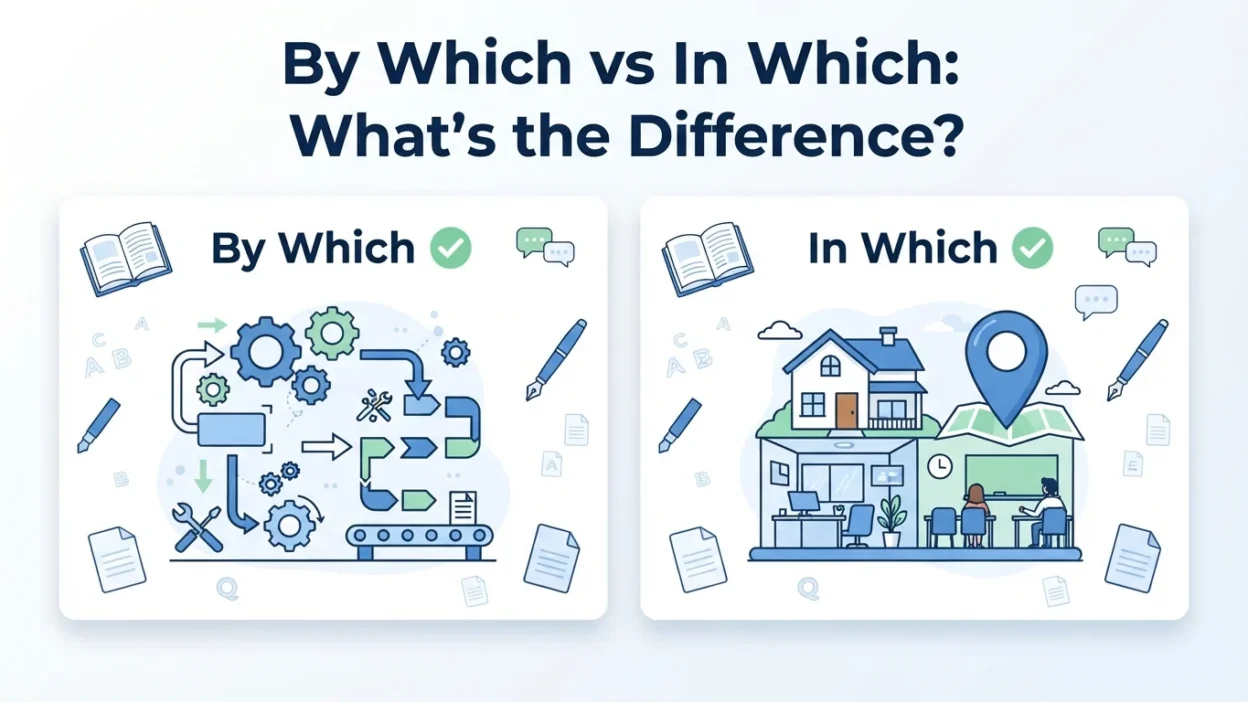
By which refers to the method, means, or process used to achieve something.
In which refers to location, situation, condition, or context where something happens.
Choose the phrase based on whether you’re describing a method or a setting.
By Which vs In Which: Main Comparison Table
| Feature | By Which | In Which |
|---|---|---|
| Main Meaning | Method or means | Location, situation, or context |
| Preposition | By | In |
| Common Usage | Process, action | Place, condition |
| Formal Writing | Very common | Very common |
| Academic Writing | Frequently used | Frequently used |
| Relative Clause | Yes | Yes |
What Does “By Which” Mean?
By which introduces the method, process, or means through which something happens.
It often answers the question “How?”
Examples
- This is the method by which the machine operates.
- We developed a system by which customers can track orders.
- The law establishes rules by which disputes are resolved.
What Does “In Which” Mean?
In which refers to the place, situation, condition, or context where something occurs.
It often answers the question “Where?” or “In what situation?”
Examples
- This is the room in which the meeting was held.
- We discussed a situation in which everyone benefited.
- She works in an office in which teamwork is encouraged.
Key Differences Between By Which and In Which
| Point | By Which | In Which |
|---|---|---|
| Refers to method | ✔ | ✘ |
| Refers to location | ✘ | ✔ |
| Refers to process | ✔ | Sometimes |
| Refers to condition | Rarely | ✔ |
| Answers | How? | Where? / In what situation? |
Grammar Rule
Both phrases introduce relative clauses.
The preposition depends on the relationship between the noun and the clause.
By Which
Used after nouns referring to:
- Method
- Process
- System
- Technique
- Procedure
In Which
Used after nouns referring to:
- Place
- Situation
- Environment
- Case
- Condition
Grammar Forms Table
| Phrase | Function | Example |
|---|---|---|
| By which | Relative phrase | The process by which data is collected. |
| In which | Relative phrase | The room in which we met. |
| By which + verb | Method | The system by which payments are made. |
| In which + verb | Location | The office in which she works. |
When to Use “By Which”
Use by which when describing how something happens or the means through which it is done.
Examples:
- The software includes a feature by which users can recover files.
- This is the process by which plants grow.
- The agreement explains the method by which payments are processed.
- We designed a procedure by which quality is measured.
When to Use “In Which”
Use in which when referring to a place, situation, or condition.
Examples:
- The classroom in which students study is modern.
- This is the environment in which innovation thrives.
- The country in which she was born is beautiful.
- We discussed a case in which the evidence was insufficient.
Real-Life Examples
Business
- The policy outlines the process by which promotions are awarded.
- The office in which employees work was recently renovated.
Education
- Teachers explained the method by which grades are calculated.
- The classroom in which the lecture took place was full.
Science
- Scientists studied the mechanism by which cells divide.
- The laboratory in which experiments were conducted was upgraded.
Technology
- The software uses an algorithm by which images are compressed.
- The server room in which data is stored is secure.
Law
- The contract specifies the procedure by which disputes are settled.
- The court in which the trial occurred is well known.
Industry Usage Table
| Industry | By Which Example | In Which Example |
|---|---|---|
| Business | Method by which products are delivered. | Office in which meetings occur. |
| Healthcare | Process by which patients are treated. | Hospital in which surgeries are performed. |
| Education | System by which exams are graded. | School in which students learn. |
| Science | Mechanism by which reactions occur. | Laboratory in which tests are conducted. |
| Technology | Algorithm by which data is processed. | Database in which records are stored. |
Why Do People Confuse By Which vs In Which?
The confusion happens because both phrases:
- Begin with a preposition.
- Introduce relative clauses.
- Frequently appear in formal English.
- Can sometimes be replaced with where or how in simpler sentences.
However, remembering the purpose of each preposition makes the choice easier.
Common Mistakes
| Incorrect | Correct |
|---|---|
| The room by which we met. | The room in which we met. |
| The method in which the machine works. | The method by which the machine works. |
| The office by which she works. | The office in which she works. |
| The process in which payments are made. | The process by which payments are made. |
| The city by which he lives. | The city in which he lives. |
Memory Trick
Use this simple rule:
By = By means of
In = Inside or within
Ask yourself:
- How did it happen? → By which
- Where or in what situation did it happen? → In which
Choosing the Correct Phrase
| Situation | Best Choice |
|---|---|
| Describing a process | By which |
| Explaining a method | By which |
| Referring to a room | In which |
| Talking about a situation | In which |
| Describing an algorithm | By which |
| Referring to an environment | In which |
Tips for Correct Usage
- Identify whether you’re describing a method or a place.
- Replace by which with by means of which to check if it makes sense.
- Replace in which with where in informal writing if appropriate.
- Read the complete sentence before choosing the preposition.
- Practice using both phrases in formal writing.
Frequently Asked Questions
What does “by which” mean?
It refers to the method, process, or means used to accomplish something.
What does “in which” mean?
It refers to the place, situation, or condition where something occurs.
Can “by which” and “in which” be used interchangeably?
No. They have different meanings and should be used according to context.
Is “in which” more formal than “where”?
Yes. In which is generally more formal and common in academic and professional writing.
How do I remember the difference?
Think:
- By = Method
- In = Location or Situation
Conclusion
Understanding by which vs in which is essential for writing clear and grammatically correct English.
By which introduces the method, means, or process used to achieve something, while in which refers to the place, situation, or context where something happens.
Although both phrases are common in formal writing, they are not interchangeable.
By remembering that by relates to how and in relates to where, you can confidently use each expression in academic, professional, and everyday communication.