
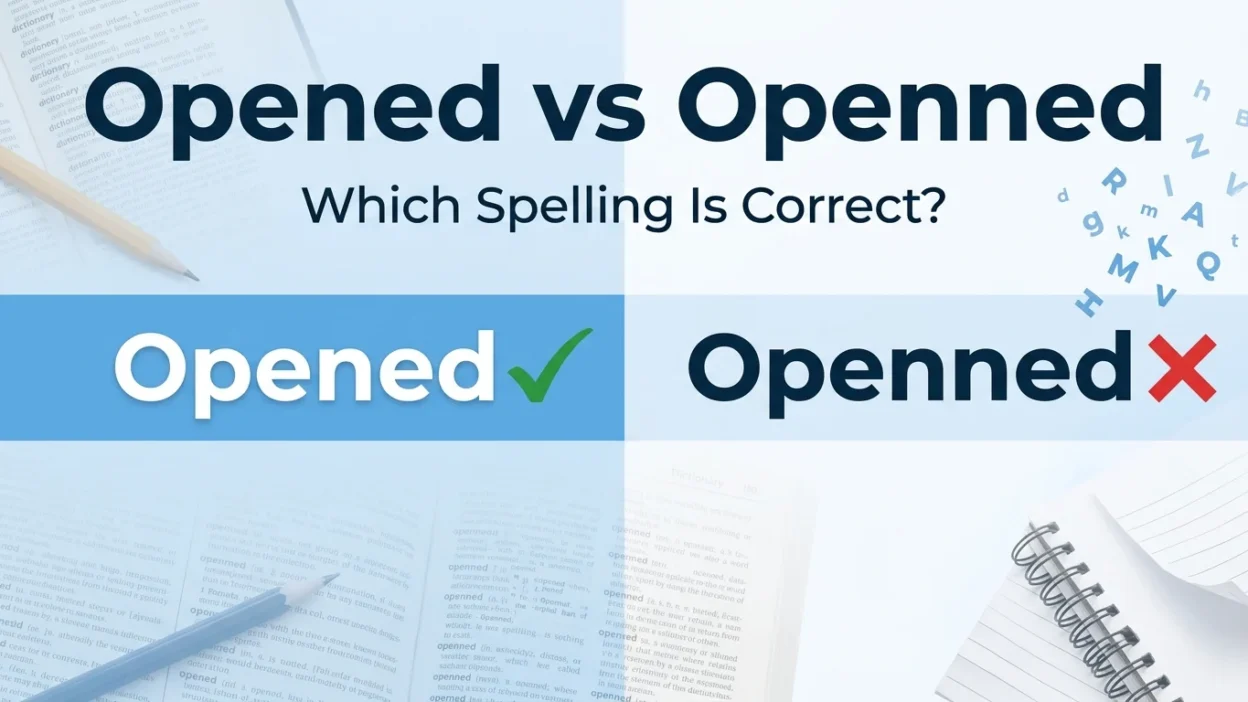
Have you ever typed opened vs openned and wondered which spelling is correct?.
Many English learners and even native speakers become confused because some English verbs double their final consonants when adding ed, while others do not.
The confusion around opened vs openned usually happens because words like stopped and planned require double consonants before adding ed. However, the verb open follows a different spelling rule.
Understanding the meaning, difference, and usage of these terms can help you avoid common grammar mistakes and improve your writing.
Quick Answer
Opened is the correct past tense and past participle of the verb open.
Openned is incorrect and is not recognized as a standard English word.
Always write opened, never openned.
Main Comparison Table: Opened vs Openned
| Feature | Opened | Openned |
|---|---|---|
| Is it a real English word? | Yes | No |
| Part of speech | Verb (past tense and past participle) | Incorrect spelling |
| Dictionary accepted | Yes | No |
| Used in writing | Yes | No |
| Example | I opened the door. | I openned the door. ❌ |
What Does “Opened” Mean?
Opened is the past tense and past participle form of the verb open. It means something was made accessible, uncovered, unlocked, or started.
Examples:
- She opened the window.
- The company opened a new office.
- The teacher opened the discussion.
The word can describe physical actions as well as abstract actions.
What Does “Openned” Mean?
Openned has no meaning in standard English grammar because it is not a valid word.
People sometimes write openned because they incorrectly apply spelling rules from other verbs that double their final consonants.
Examples of incorrect usage:
- I openned the file. ❌
- He openned the box. ❌
- They openned a restaurant. ❌
The correct word in all these sentences is opened.
Why Do People Confuse Opened vs Openned?
English spelling rules can be confusing.
Many verbs double their last consonant before adding -ed.
Examples:
| Base Verb | Past Tense |
|---|---|
| Stop | Stopped |
| Plan | Planned |
| Admit | Admitted |
| Open | Opened |
Because of these patterns, people mistakenly assume that open becomes openned.
Why Doesn’t “Open” Double the N?
The verb open has two syllables:
O-pen
The stress falls on the first syllable:
O-pen
English usually doubles the final consonant only when:
- The word ends with a consonant-vowel-consonant pattern.
- The final syllable is stressed.
Since open has stress on the first syllable, the final n is not doubled.
Grammar Forms of Open
| Verb Form | Word |
|---|---|
| Base Form | Open |
| Third Person Singular | Opens |
| Present Participle | Opening |
| Past Tense | Opened |
| Past Participle | Opened |
Examples:
- I open the store every morning.
- She opens the gate.
- They are opening the package.
- He opened the email.
- The door has opened.
Opened vs Openned: Key Differences
| Feature | Opened | Openned |
|---|---|---|
| Correct spelling | Yes | No |
| Accepted by dictionaries | Yes | No |
| Used in formal writing | Yes | No |
| Used in exams | Yes | No |
| Recommended usage | Always | Never |
The key difference is simple: opened is correct, while openned is merely a spelling error.
Examples of Opened in Everyday Life
Business
- The company opened a branch in Dubai.
- The manager opened the meeting.
Education
- The teacher opened the lesson with a quiz.
- The university opened admissions for new students.
Science
- Researchers opened a new area of study.
- The scientist opened the container carefully.
Technology
- I opened the application on my laptop.
- She opened the attachment.
Personal Life
- He opened the gift.
- They opened the front door.
Common Mistakes and Corrections
| Incorrect Sentence | Correct Sentence |
|---|---|
| I openned the window. | I opened the window. |
| She openned the document. | She opened the document. |
| We openned a new store. | We opened a new store. |
| They have openned the gate. | They have opened the gate. |
Remember that adding an extra n creates a spelling error.
Industry Usage of “Opened”
| Industry | Example Sentence |
|---|---|
| Business | The company opened another office. |
| Banking | The customer opened a savings account. |
| Healthcare | The hospital opened a new wing. |
| Education | The school opened registrations. |
| Technology | The user opened the software application. |
| Retail | The store opened early today. |
In every professional field, the correct spelling remains opened.
How to Remember the Correct Spelling
Try these memory tricks:
Trick 1: Think of “Opening”
The word is opening, not openning. Therefore, the past tense is opened.
Trick 2: Remember the Stress Rule
Open stresses the first syllable:
O-pen
Because the final syllable is not stressed, you do not double the n.
Trick 3: Use This Sentence
“An open door becomes opened, not openned.”
Step-by-Step Process for Forming the Past Tense
| Step | Action |
|---|---|
| 1 | Start with the verb “open” |
| 2 | Check the stress pattern |
| 3 | Do not double the n |
| 4 | Add -ed |
| 5 | Result: opened |
Sentences Using Opened Correctly
- She opened the door quietly.
- I opened my notebook.
- The museum opened last year.
- We opened the email immediately.
- They opened the discussion after lunch.
- The company opened a new factory.
Is “Openned” Ever Acceptable?
No.
Modern dictionaries, grammar books, academic institutions, and style guides do not recognize openned as a correct English word.
In exams, professional documents, business communication, and academic writing, you should always use opened.
FAQs:
Is it opened or openned?
The correct spelling is opened.
Why is openned wrong?
Because the verb open does not follow the consonant-doubling rule.
Is opened a real word?
Yes. It is the past tense and past participle of open.
Can I use openned in formal writing?
No. It is considered a spelling mistake.
Why do people write openned?
People often confuse it with verbs like stopped and planned, which require doubled consonants.
What is the past tense of open?
The past tense of open is opened.
Conclusion
The debate over opened vs openned is actually very simple. Opened is the correct spelling and serves as both the past tense and past participle of the verb open.
Openned is not a valid English word and should never be used in formal or informal writing.
Whenever you need to describe something that was unlocked, started, or made accessible in the past, choose opened and avoid adding an extra n.