The phrase among others meaning is a common search because many English learners are unsure how and when to use it correctly.
You may hear it in conversations, books, news reports, and business emails, but its exact meaning can sometimes feel unclear.
Understanding among others meaning helps you write and speak more naturally.
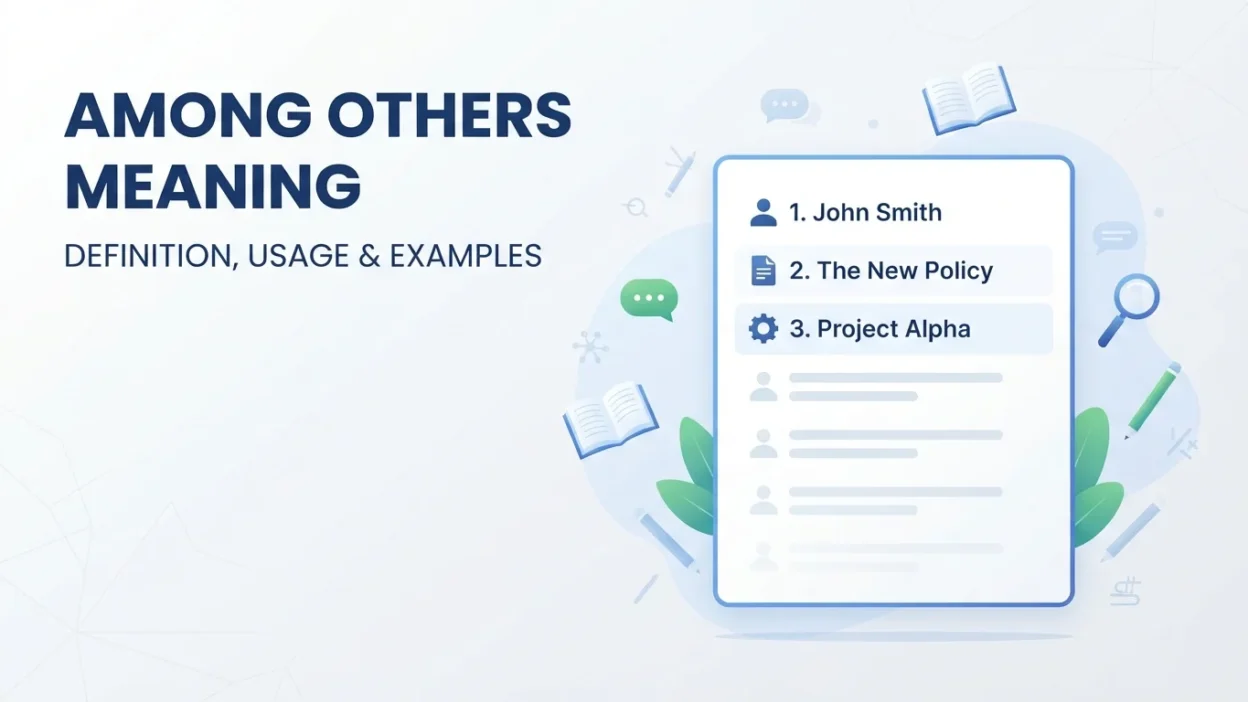
In simple terms, among others means including other people or things that are not specifically named.
It shows that the list mentioned is incomplete. This guide explains the among others meaning, correct usage, grammar, examples, common mistakes, and practical tips so you can confidently use this useful English expression.
Quick Answer
Among others means “including other people or things not mentioned.” It is used to show that the examples given are only part of a larger group.
Example: She speaks English, French, and Spanish, among others.
What Does “Among Others” Mean?
The phrase among others means including additional people, things, or examples that are not listed.
Instead of naming every item, the speaker mentions a few examples and uses among others to indicate there are more.
Examples
- She enjoys reading mystery novels, historical fiction, and biographies, among others.
- Google, Microsoft, and Apple, among others, attended the conference.
- The museum displays paintings by Picasso, Monet, and Van Gogh, among others.
Main Meaning at a Glance
| Feature | Explanation |
|---|---|
| Meaning | Including other unnamed people or things |
| Purpose | Shows the list is not complete |
| Part of speech | Prepositional phrase |
| Common usage | Formal and informal English |
| Similar expressions | Including, such as, for example, and others |
Why Do People Use “Among Others”?
People use this phrase to avoid writing or saying very long lists.
Instead of mentioning every item, they highlight a few important examples.
Example
Instead of writing:
The company sells laptops, desktops, tablets, printers, scanners, monitors, keyboards, and speakers.
You can write:
The company sells laptops, tablets, and printers, among others.
This sounds shorter and more natural.
How to Use “Among Others” Correctly
The phrase usually comes after a list of examples.
Correct Structure
Example(s) + among others
Examples
- She has visited Japan, Canada, and Italy, among others.
- Our team includes engineers, designers, and marketers, among others.
- The report discusses climate change, pollution, and renewable energy, among others.
Grammar of “Among Others”
Although simple, the phrase follows a common grammatical pattern.
| Grammar Feature | Explanation |
|---|---|
| Phrase Type | Prepositional phrase |
| Function | Adds unnamed examples |
| Position | Usually after listed items |
| Comma Usage | Usually separated by commas |
| Formality | Suitable for all writing styles |
“Among Others” vs Similar Expressions
Many expressions have similar meanings but are not exactly the same.
| Expression | Meaning | Best Use |
|---|---|---|
| Among others | Including additional unnamed examples | General writing |
| Including | Directly introduces examples | Formal and informal |
| Such as | Gives examples | Explanations |
| For example | Introduces one or more examples | Teaching and writing |
| And others | Mentions additional unnamed items | Casual writing |
Example Comparison
- We studied biology, chemistry, and physics, among others.
- We studied subjects such as biology and chemistry.
- We studied biology, chemistry, and others.
Real-Life Examples
Business
The company manufactures smartphones, laptops, and smartwatches, among others.
Education
Students learn mathematics, literature, and science, among others.
Science
Researchers examined bacteria, viruses, and fungi, among others.
Healthcare
The hospital treats heart disease, diabetes, and asthma, among others.
Technology
The software supports Windows, macOS, and Linux, among others.
Sports
The athlete has won regional, national, and international competitions, among others.
Industry Usage Table
| Industry | Example |
|---|---|
| Business | We serve retail, healthcare, and finance, among others. |
| Education | The curriculum covers math, science, and history, among others. |
| Technology | The platform supports Python, Java, and C++, among others. |
| Medicine | Symptoms include fever, cough, and fatigue, among others. |
| Marketing | We advertise through email, social media, and television, among others. |
| Tourism | Popular destinations include Paris, Rome, and Tokyo, among others. |
When Should You Use “Among Others”?
Use this phrase when:
- Your list is not complete.
- You only want to mention a few examples.
- The remaining examples are less important.
- You want your writing to be concise.
Process Table
| Step | Action |
|---|---|
| 1 | Mention a few examples. |
| 2 | Decide not to list everything. |
| 3 | Add “among others.” |
| 4 | Use commas correctly. |
Common Mistakes
Many learners misuse the phrase.
| Incorrect | Correct |
|---|---|
| Among other | Among others |
| He likes football among others sports. | He likes football, among others. |
| Among others means all. | Among others means including additional examples. |
| She speaks among others English. | She speaks English, among others. |
Correct vs Incorrect Sentences
Correct
- We discussed economics, history, and politics, among others.
- The award recognized teachers, doctors, and volunteers, among others.
- The city attracts tourists from Canada, Germany, and Australia, among others.
Incorrect
- Among others she likes pizza.
- She among others plays tennis.
- Among other is correct.
- We visited among others London.
Why Do People Confuse “Among Others”?
There are several reasons.
- It looks similar to among other things.
- It is often confused with and others.
- Some learners think it means “everyone.”
- Others mistakenly use it before a list instead of after one.
Remember that among others usually follows examples.
Memory Trick
Think of this simple sentence:
Name a few, hide the rest.
If you mention only some examples and there are more you do not mention, among others is the right phrase.
More Example Sentences
Everyday Conversation
- She watches documentaries, dramas, and comedies, among others.
- My hobbies include hiking, photography, and cooking, among others.
Academic Writing
- The study analyzed income, education, and employment, among others.
Professional Writing
- The report examined customer satisfaction, product quality, and pricing, among others.
News
- The summit welcomed leaders from France, Germany, and Japan, among others.
People Also Ask
Is “among others” grammatically correct?
Yes. It is a standard English phrase used to indicate additional unnamed examples.
Can I use “among others” in formal writing?
Yes. It is common in academic, business, and professional writing.
Does “among others” mean everyone?
No. It only means including additional people or things that are not mentioned.
Where should “among others” be placed?
It usually comes after a list of examples and is separated by commas.
Can I replace “among others” with “including”?
Sometimes, yes. However, including introduces examples, while among others usually follows them.
Frequently Asked Questions
What is the exact among others meaning?
It means including other unnamed people or things besides those mentioned.
Is “among others” formal or informal?
It works well in both formal and informal English.
Can I use it in emails?
Yes. It is widely used in business emails and reports.
Is it the same as “among other things”?
Not exactly. Among others usually refers to people or items, while among other things refers specifically to things or topics.
Can I use “among others” at the beginning of a sentence?
It is possible but much less common. It is usually placed after examples.
Conclusion
Understanding among others meaning makes your English clearer and more natural. The phrase simply means including other unnamed people or things and helps you avoid long, repetitive lists. Whether you’re writing an email, report, academic paper, or having a conversation, among others is a useful expression that keeps your language concise while indicating that more examples exist.
Remember to place it after a list of examples and separate it with commas for correct grammar and smooth readability.