The difference between when I can vs when can I may seem small, but it changes the grammar and purpose of a sentence.
Many English learners mix up these two phrases because they contain the same words in a different order.
However, each one has a specific role in English grammar and cannot always be used interchangeably.
Understanding when I can vs when can I will help you ask questions correctly and build natural sentences.
In this guide, you’ll learn the meaning, grammar, usage, real life examples, common mistakes, and simple memory tricks. By the end, you’ll know exactly when to use each phrase with confidence.
Quick Answer
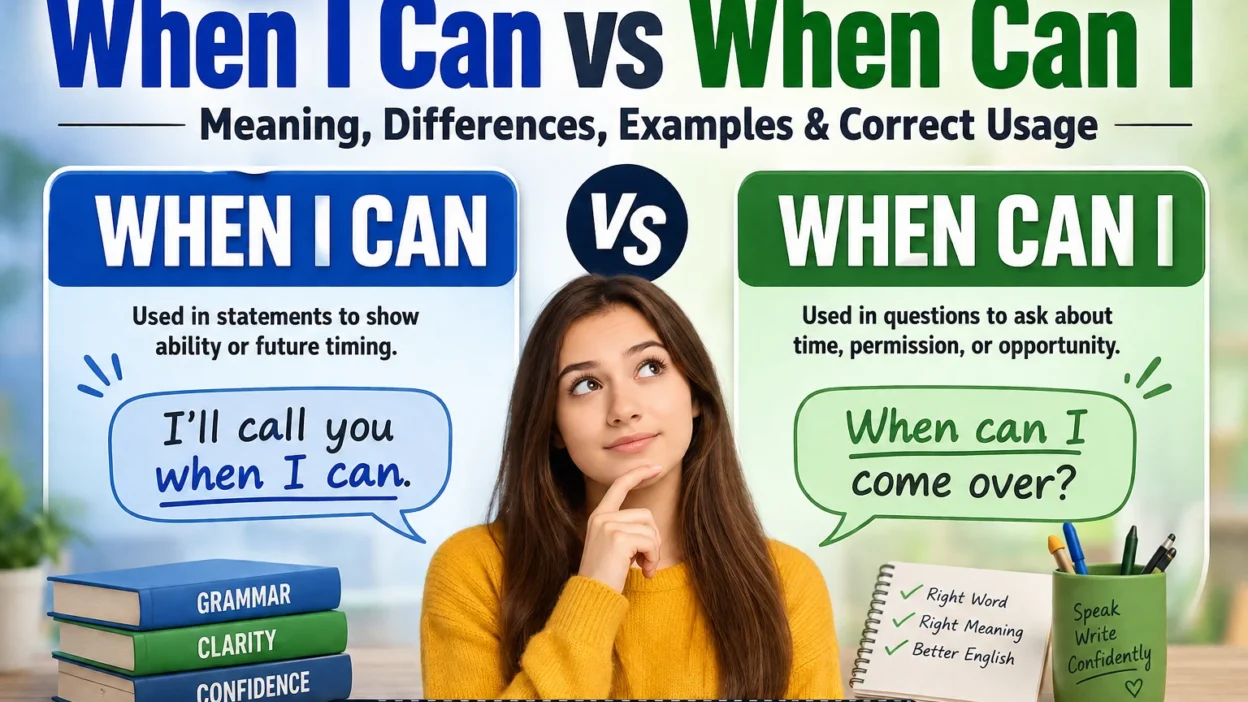
“When I can” is a clause used to talk about the time you are able to do something.
“When can I” is a question used to ask about the appropriate or possible time to do something.
The main difference is that “when I can” is a statement, while “when can I” is a question.
When I Can vs When Can I at a Glance
| Phrase | Type | Purpose | Example |
|---|---|---|---|
| When I can | Dependent clause | Expresses ability or future timing | I’ll call you when I can. |
| When can I | Question | Asks about the correct or possible time | When can I leave? |
What Does “When I Can” Mean?
When I can means at the time I am able to do something.
It usually appears as part of a larger sentence rather than standing alone.
Examples
- I’ll visit you when I can.
- I’ll reply when I can.
- We will finish the project when I can help.
- She’ll explain everything when I can join the meeting.
It often refers to future availability or ability.
What Does “When Can I” Mean?
When can I is used to ask about the right or possible time to do something.
It begins a direct question.
Examples
- When can I start work?
- When can I call you?
- When can I submit my assignment?
- When can I expect the results?
It asks for information rather than making a statement.
Main Difference Between When I Can vs When Can I
The biggest difference is sentence structure.
| Feature | When I can | When can I |
|---|---|---|
| Sentence type | Clause | Question |
| Word order | Subject before verb | Verb before subject |
| Ends with | Usually another clause | Question mark |
| Purpose | Shows ability or timing | Requests information |
| Can stand alone | Usually no | Yes |
Grammar Rule Behind the Difference
English uses different word order for statements and questions.
Statement Pattern
Subject + Modal Verb
I can
Question Pattern
Modal Verb + Subject
Can I
Adding when creates:
- When I can…
- When can I…?
Grammar Forms Table
| Pattern | Example |
|---|---|
| When I can + verb | I’ll help when I can. |
| When I can + noun phrase | I’ll return when I can tomorrow. |
| When can I + base verb | When can I begin? |
| When can I + receive | When can I receive the package? |
When Should You Use “When I Can”?
Use when I can whenever you’re talking about your availability or ability.
Common Situations
- Promising future action
- Explaining availability
- Talking about schedules
- Offering help
Examples
- I’ll answer when I can.
- I’ll pay you when I can.
- We’ll travel when I can take vacation.
- I’ll finish it when I can.
When Should You Use “When Can I”?
Use when can I whenever you’re asking for permission, timing, or availability.
Common Situations
- Asking permission
- Asking about deadlines
- Requesting schedules
- Seeking instructions
Examples
- When can I check in?
- When can I apply?
- When can I take the exam?
- When can I receive my certificate?
Real-Life Examples
Business
When I can
- I’ll send the report when I can.
- I’ll attend the meeting when I can.
When can I
- When can I submit the proposal?
- When can I schedule the interview?
Education
When I can
- I’ll finish the assignment when I can.
- I’ll review the lesson when I can.
When can I
- When can I retake the test?
- When can I meet the professor?
Healthcare
When I can
- I’ll visit the clinic when I can.
When can I
- When can I resume exercising?
Everyday Conversation
- I’ll call you when I can.
- When can I come over?
- I’ll text you when I can.
- When can I pick you up?
Professional and Industry Usage
| Industry | When I can | When can I |
|---|---|---|
| Business | I’ll respond when I can. | When can I start? |
| Customer Service | I’ll update you when I can. | When can I receive support? |
| Education | I’ll grade them when I can. | When can I enroll? |
| Healthcare | I’ll call when I can. | When can I drive again? |
| IT | I’ll fix it when I can. | When can I access the system? |
| HR | I’ll review it when I can. | When can I join the company? |
Why Do People Confuse These Phrases?
The phrases contain the same words but follow different grammar rules.
Common reasons include:
- Similar vocabulary
- Different word order
- Confusion between statements and questions
- Translating directly from another language
Comparison Table
| Situation | Correct Phrase |
|---|---|
| Asking permission | When can I |
| Asking about timing | When can I |
| Promising future action | When I can |
| Explaining availability | When I can |
| Offering assistance | When I can |
| Asking for instructions | When can I |
Common Mistakes
Many learners accidentally use statement word order inside questions.
Correct vs Incorrect
| Incorrect | Correct |
|---|---|
| When I can leave? | When can I leave? |
| I’ll help when can I. | I’ll help when I can. |
| When I can start? | When can I start? |
| I’ll finish when can I. | I’ll finish when I can. |
| When I can submit this? | When can I submit this? |
Memory Trick
Remember this simple rule:
Question = Can comes first
When can I leave?
Statement = I comes first
I’ll leave when I can.
Easy reminder:
Questions flip the order. Statements don’t.
Step-by-Step Guide
| Step | Ask Yourself | Use |
|---|---|---|
| 1 | Am I asking a question? | When can I |
| 2 | Am I making a statement? | When I can |
| 3 | Does the sentence end with a question mark? | When can I |
| 4 | Am I describing future ability? | When I can |
People Also Ask
Is “when I can” correct?
Yes. It is a correct clause used to express future ability or availability.
Is “when can I” grammatically correct?
Yes. It is the correct way to ask about timing or permission.
Can both phrases appear in the same conversation?
Yes.
Example:
“When can I call you?”
“Call me when I can answer.”
Which phrase is more common?
Both are common, but they serve different grammatical purposes.
Can “when I can” be a complete sentence?
Usually no. It normally depends on another clause.
Frequently Asked Questions
Is “when can I” always a question?
Yes. It begins a direct question asking about time or permission.
Can I replace one phrase with the other?
No. Their grammar and meaning are different.
Which is better in formal English?
Both are equally correct when used in the proper context.
Why is word order different?
English questions place the modal verb before the subject, while statements keep the subject before the modal verb.
How can I remember the difference?
If you’re asking, put can before I. If you’re stating, put I before can.
Conclusion
Understanding when I can vs when can I is essential for speaking and writing correct English. When I can is used in statements to express ability or availability, while when can I is used to ask questions about timing, permission, or opportunity.
Although the phrases use the same words, their word order follows different grammar rules. Remember the simple guideline: questions use “can I,” while statements use “I can.” With regular practice and attention to sentence structure, you’ll use both expressions naturally and confidently.