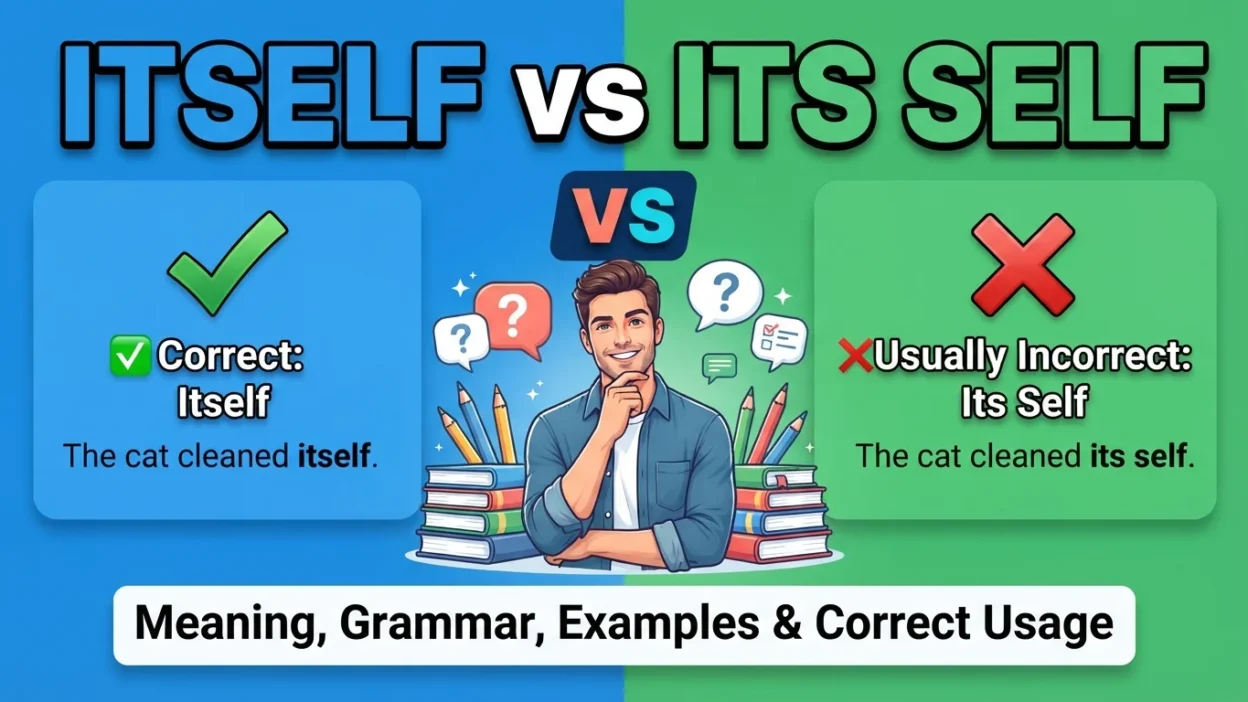
Many English learners get confused by itself vs its self because both expressions look similar but are used very differently.
In modern English, itself is the standard reflexive pronoun, while its self is rarely used and appears only in special or historical contexts.
Understanding this distinction helps you write more naturally and avoid common grammar mistakes.
If you’ve searched for itself vs its self, you’re probably wondering whether writing the words together or separately is correct.
The answer depends on the context, but in almost every everyday situation, itself is the correct choice.
This guide explains the meaning, difference, grammar rules, examples, and usage tips so you can confidently use the right form.
Quick Answer
Itself is the correct reflexive pronoun in modern English.
Its self is generally considered incorrect in everyday writing and appears only in rare literary, philosophical, or historical contexts where its and self function as separate words.
Itself vs Its Self at a Glance
| Term | Correct? | Meaning | Common Usage |
|---|---|---|---|
| Itself | ✅ Yes | Reflexive pronoun referring back to “it” | Standard English |
| Its self | ⚠️ Rare | “Its” + noun “self” used separately | Historical or literary writing |
What Does “Itself” Mean?
Itself is a reflexive pronoun. It refers back to a thing, object, animal, idea, or organization already mentioned.
It can also be used for emphasis.
Examples
- The computer restarted itself.
- The cat cleaned itself.
- The company itself announced the news.
- The door closed itself.
What Does “Its Self” Mean?
Its self is not normally used in modern English.
Occasionally, writers separate the words when they literally mean the self of something, usually in philosophy, psychology, or older literature.
Rare Examples
- The nation found its self through struggle. (Literary style)
- The machine developed its self over time. (Uncommon and stylistic)
In almost every modern sentence, itself is the preferred form.
Main Difference Between Itself vs Its Self
| Feature | Itself | Its Self |
|---|---|---|
| Word Type | Reflexive pronoun | Possessive adjective + noun |
| Modern English | Standard | Very rare |
| Everyday writing | Yes | No |
| Academic writing | Yes | Rarely |
| Formal writing | Yes | Only in special contexts |
Grammar Rule
Reflexive pronouns are written as one word.
Examples include:
- myself
- yourself
- himself
- herself
- itself
- ourselves
- themselves
Because itself belongs to this group, it should normally remain one word.
Grammar Forms Table
| Subject | Reflexive Pronoun |
|---|---|
| I | myself |
| You | yourself |
| He | himself |
| She | herself |
| It | itself |
| We | ourselves |
| They | themselves |
When Should You Use “Itself”?
Use itself whenever the object of the sentence refers back to it.
Common Uses
- Reflexive action
- Emphasis
- Automatic actions
- Describing objects or organizations
Examples
- The phone turned itself off.
- The engine repaired itself in the simulation.
- The software updates itself.
- The school itself approved the program.
When Could “Its Self” Be Used?
Although uncommon, its self may appear when self is treated as a separate noun.
This mostly happens in:
- Philosophy
- Literary writing
- Historical texts
- Discussions of identity
Examples
- The culture reinvented its self. (Literary)
- The organization examined its self in the author’s metaphor.
Most style guides recommend using itself instead.
Real-Life Examples
Business
- The company itself released the report.
- The system updated itself overnight.
Education
- The lesson explains itself clearly.
- The school itself organized the event.
Science
- The organism protects itself from predators.
- The chemical reacts with itself.
Technology
- The software installs itself.
- The application restarts itself automatically.
Everyday Conversation
- The dog scratched itself.
- The door opened itself.
- The television turned itself off.
- The problem solved itself.
Professional and Industry Usage
| Industry | Example |
|---|---|
| Business | The company itself issued the statement. |
| Healthcare | The body heals itself naturally. |
| Education | The lesson explains itself. |
| Engineering | The machine calibrates itself. |
| Technology | The software updates itself automatically. |
| Science | The cell reproduces itself. |
Comparison Table
| Situation | Correct Form |
|---|---|
| Reflexive pronoun | Itself |
| Emphasizing an organization | Itself |
| Everyday conversation | Itself |
| Academic writing | Itself |
| Literary discussion of identity | Its self (rare) |
| Historical writing | Its self (rare) |
Why Do People Confuse Itself and Its Self?
Several factors cause confusion.
| Reason | Explanation |
|---|---|
| Similar appearance | Both contain the same words. |
| Possessive “its” | Writers assume “its” should stay separate. |
| Lack of grammar knowledge | Many learners don’t recognize reflexive pronouns. |
| Rare literary usage | Older books sometimes separate the words. |
Common Mistakes
Many learners accidentally separate itself into two words.
Correct vs Incorrect
| Incorrect | Correct |
|---|---|
| The robot fixed its self. | The robot fixed itself. |
| The company its self announced it. | The company itself announced it. |
| The cat cleaned its self. | The cat cleaned itself. |
| The app updated its self. | The app updated itself. |
| The door opened its self. | The door opened itself. |
Memory Trick
Here’s an easy way to remember:
Reflexive pronouns are always one word.
Think of:
- myself
- yourself
- himself
- herself
- itself
If all the others are one word, itself should be too.
Easy reminder:
If the action comes back to “it,” write “itself.”
Step-by-Step Usage Guide
| Step | Question | Use |
|---|---|---|
| 1 | Does the action refer back to “it”? | Itself |
| 2 | Is it a reflexive pronoun? | Itself |
| 3 | Is this ordinary writing? | Itself |
| 4 | Is it a rare literary discussion of identity? | Its self (rare) |
People Also Ask
Is “its self” ever correct?
Yes, but only in rare literary, philosophical, or historical contexts where its and self are separate words.
Is “itself” one word?
Yes. It is always written as one word when used as a reflexive pronoun.
Why is “its self” uncommon?
Modern English treats itself as the standard reflexive pronoun, making the separated form unnecessary in most situations.
Which form should I use in essays?
Use itself unless you’re intentionally quoting or discussing historical or literary language.
Is “the company itself” correct?
Yes. Here, itself emphasizes the noun company.
Frequently Asked Questions
Is “itself” a pronoun?
Yes. It is a reflexive pronoun referring back to it.
Can “its self” replace “itself”?
Not in standard English. Only use it in rare stylistic or historical contexts.
Why is “itself” written as one word?
Because all English reflexive pronouns are single words.
Is “the machine repaired itself” correct?
Yes. The machine performs the action on itself.
Which form is accepted by grammar guides?
Nearly all modern grammar guides recommend itself for standard writing.
Conclusion
Understanding itself vs its self is simple once you know the grammar rule. Itself is the correct reflexive pronoun and should be used in almost every situation, from everyday conversation to professional and academic writing.
Its self is an uncommon form that appears mainly in historical, literary, or philosophical texts where its and self function as separate words. If you’re unsure, choose itself it’s the standard, widely accepted, and grammatically correct form in modern English.