Many English learners get confused by might as well vs mine as well vs mind as well because these phrases sound almost identical in everyday speech.
While they may seem interchangeable, only one of them is grammatically correct in standard English. Understanding the difference helps you avoid common writing and speaking mistakes.
If you’ve ever wondered whether to write might as well vs mine as well vs mind as well, you’re not alone. This confusion often comes from pronunciation rather than grammar.
In this guide, you’ll learn the meaning, correct usage, examples, common mistakes, and simple memory tricks so you can confidently use the right phrase every time.
Quick Answer
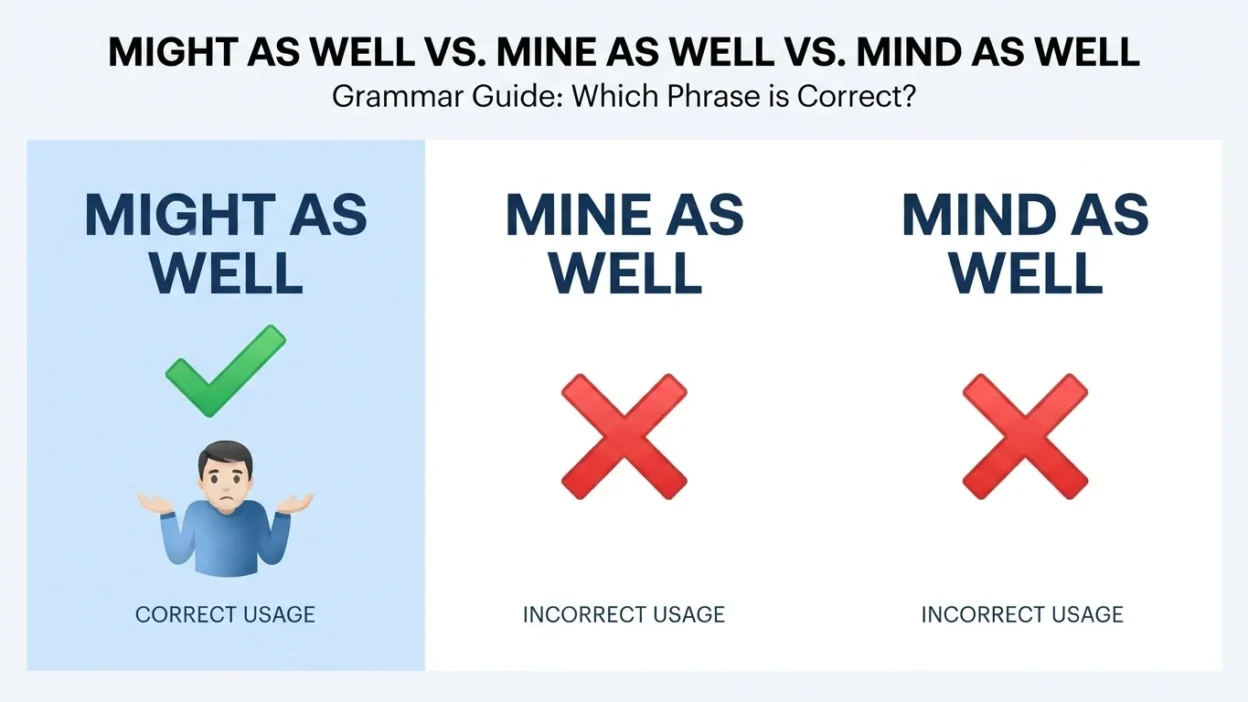
“Might as well” is the only correct English expression. It means there is no better option or it’s reasonable to do something. “Mine as well” and “mind as well” are incorrect spellings that result from mishearing the phrase.
Might As Well vs Mine As Well vs Mind As Well at a Glance
| Phrase | Correct? | Meaning | Usage |
|---|---|---|---|
| Might as well | ✅ Yes | A reasonable choice when no better option exists | Standard English |
| Mine as well | ❌ No | No recognized meaning in this context | Incorrect spelling |
| Mind as well | ❌ No | No recognized meaning in this context | Incorrect spelling |
What Does “Might As Well” Mean?
The phrase might as well means that doing something is a sensible or acceptable choice because there is no better alternative.
It often expresses:
- No better option
- A practical decision
- A suggestion
- Acceptance of a situation
Examples
- We have an hour to wait, so we might as well get coffee.
- It’s raining, so we might as well stay inside.
- Since everyone agrees, we might as well begin.
- You might as well ask the teacher for help.
What Does “Mine As Well” Mean?
Mine as well is not a correct English phrase.
People usually write it because might as well sounds similar in fast conversation.
Incorrect Examples
❌ Mine as well leave now.
❌ We mine as well finish today.
Correct Versions
✅ Might as well leave now.
✅ We might as well finish today.
What Does “Mind As Well” Mean?
Like mine as well, mind as well is also incorrect when people intend to say might as well.
Although mind is a real English word, it does not belong in this expression.
Incorrect Examples
❌ Mind as well try again.
❌ I mind as well call him.
Correct Versions
✅ Might as well try again.
✅ I might as well call him.
Why Do People Confuse These Phrases?
The confusion happens because spoken English often reduces sounds.
For example:
Might as well
can sound like
- mite-uhz-well
- mine-uhz-well
- mind-uhz-well
People hear these sounds and spell the phrase the way they think it sounds.
Common Reasons
| Reason | Explanation |
|---|---|
| Fast pronunciation | Sounds merge together |
| Learning by listening | Many people hear before reading |
| Similar sounds | “Might,” “mine,” and “mind” sound alike in quick speech |
| Lack of grammar knowledge | Writers assume the phrase contains familiar words |
Difference Between Might As Well, Mine As Well, and Mind As Well
| Feature | Might as well | Mine as well | Mind as well |
|---|---|---|---|
| Correct English | Yes | No | No |
| Dictionary expression | Yes | No | No |
| Used by native writers | Yes | No | No |
| Suitable for formal writing | Yes | No | No |
| Means “reasonable choice” | Yes | No | No |
Grammar Forms of “Might As Well”
The expression usually follows this pattern:
Subject + might as well + base verb
Grammar Table
| Pattern | Example |
|---|---|
| I might as well + verb | I might as well leave. |
| You might as well + verb | You might as well study. |
| We might as well + verb | We might as well wait. |
| They might as well + verb | They might as well join us. |
| He might as well + verb | He might as well apologize. |
More Examples
- I might as well take the train.
- She might as well tell the truth.
- We might as well start early.
Real-Life Examples in Different Contexts
Business
- We might as well schedule the meeting today.
- The proposal is ready, so we might as well submit it.
Education
- You finished your homework, so you might as well review for tomorrow’s quiz.
- We might as well ask the professor for clarification.
Science
- Since the experiment failed, we might as well repeat the test.
- The data is complete, so researchers might as well begin analysis.
Everyday Conversation
- We might as well order pizza.
- I might as well clean my room.
- You might as well come with us.
Professional and Industry Usage
Professionals frequently use might as well to suggest practical decisions.
| Industry | Example |
|---|---|
| Business | We might as well approve the budget today. |
| Healthcare | We might as well run another test. |
| Education | Students might as well submit online. |
| Engineering | We might as well replace the damaged part. |
| Technology | We might as well update the software now. |
| Customer Service | We might as well issue a refund. |
When Should You Use “Might As Well”?
Use it whenever:
- No better option exists
- A suggestion makes sense
- A decision is practical
- Someone accepts a situation
Decision Guide
| Situation | Use “Might as well”? |
|---|---|
| Waiting with free time | ✅ Yes |
| No better alternative | ✅ Yes |
| Giving practical advice | ✅ Yes |
| Referring to ownership (“mine”) | ❌ No |
| Talking about your mind | ❌ No |
Common Mistakes
Many writers accidentally replace might with mine or mind.
Correct vs Incorrect
| Incorrect | Correct |
|---|---|
| Mine as well go. | Might as well go. |
| Mind as well leave. | Might as well leave. |
| We mine as well eat now. | We might as well eat now. |
| I mind as well try. | I might as well try. |
| They mine as well stay. | They might as well stay. |
Memory Trick
Remember this simple rule:
Might = possibility
The phrase suggests a possible or reasonable action.
Mine refers to ownership.
Mind refers to thoughts or attention.
Only might as well fits the intended meaning.
Easy reminder:
If you’re suggesting an action, choose “might,” never “mine” or “mind.”
People Also Ask
Is “mine as well” ever correct?
No. It is simply a misspelling of might as well.
Is “mind as well” proper English?
No. It is another common spelling mistake caused by pronunciation.
What does “might as well” actually mean?
It means doing something because there is no better option or because it is practical.
Is “might as well” formal?
Yes. It is acceptable in both formal and informal English.
Why do native speakers say it so quickly?
Natural speech blends sounds together, making might as well sound similar to mine as well or mind as well.
Frequently Asked Questions
Is “might as well” an idiom?
Yes. It is a common English expression with a meaning that goes beyond the literal words.
Can I use “might as well” in academic writing?
Yes. It is grammatically correct, though very formal writing may prefer more direct alternatives like it is advisable to.
Why do spell checkers sometimes miss “mine as well”?
Because mine is a correctly spelled word. The mistake is contextual rather than spelling-related.
Is “might as well” used in American and British English?
Yes. It is commonly used in both varieties of English.
How can I remember the correct phrase?
Associate it with the modal verb might, which expresses possibility. If you’re making a suggestion, might as well is almost always correct.
Conclusion
When comparing might as well vs mine as well vs mind as well, the answer is simple: might as well is the only correct expression. It means that doing something is the most sensible or practical choice when there is no better alternative.
Both mine as well and mind as well are common mistakes caused by the way the phrase sounds in everyday speech. Remember that might is a modal verb expressing possibility, while mine relates to ownership and mind refers to thoughts. Keeping this distinction in mind will help you write more accurately and confidently in both casual and professional English.