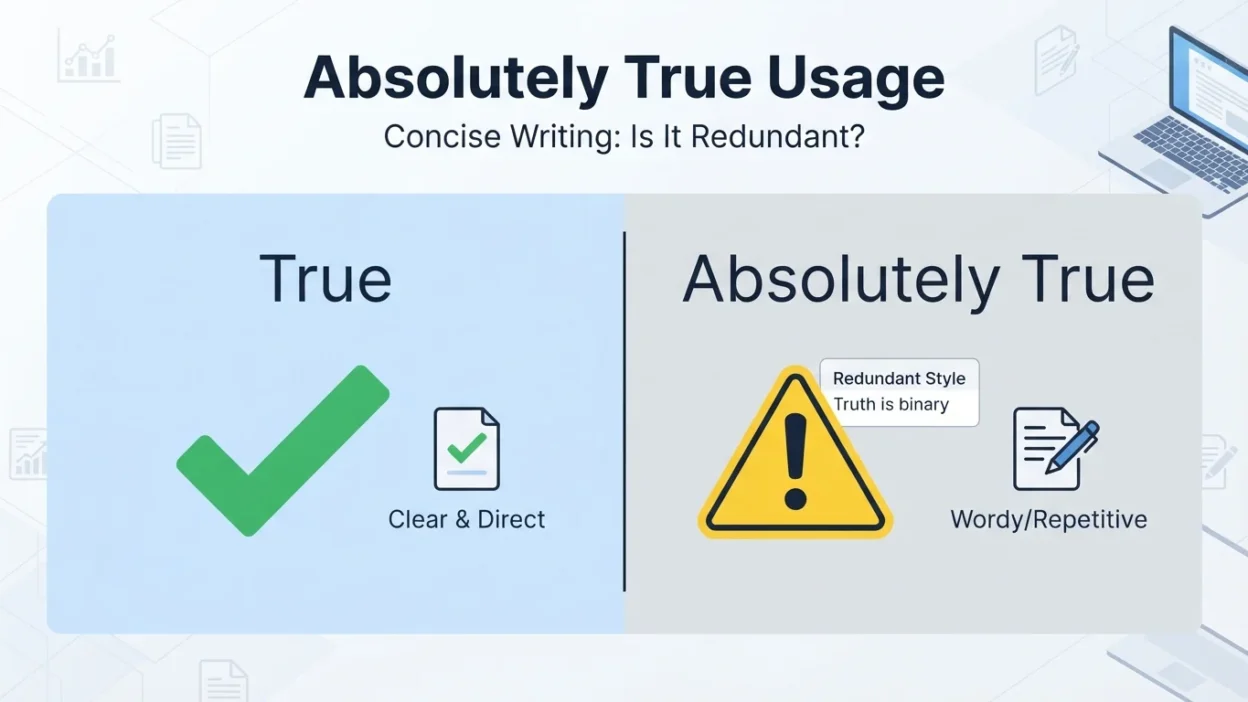
The phrase absolutely true usage often raises questions among English learners and writers. Some people wonder whether absolutely true is grammatically correct or if it is redundant because something is either true or false. In reality, the phrase is widely accepted in both spoken and written English to emphasize certainty or complete truth.
Understanding absolutely true usage can help you communicate more naturally and confidently. if you’re writing an academic paper, sending a business email, or having a casual conversation, knowing when and how to use this expression will improve your English. This guide explains the meaning, grammar, examples, common mistakes, and professional usage of absolutely true in simple terms.
Quick Answer
Absolutely true is a correct and natural English expression.
It means completely true, entirely accurate, or without any doubt. The word absolutely emphasizes the certainty of true.
Absolutely True at a Glance
| Phrase | Correct? | Meaning | Common Usage |
|---|---|---|---|
| Absolutely true | ✅ Yes | Completely true | Everyday and formal English |
| Very true | ✅ Yes | Highly accurate | Informal and formal |
| Completely true | ✅ Yes | Entirely correct | Formal writing |
| Totally true | ✅ Yes | Entirely accurate | Informal speech |
What Does “Absolutely True” Mean?
Absolutely true means something is completely correct, factual, or beyond doubt.
The adverb absolutely strengthens the adjective true by adding emphasis.
Examples
- That statement is absolutely true.
- It is absolutely true that water freezes at 0°C.
- Her explanation was absolutely true.
- The report is absolutely true according to the evidence.
Is “Absolutely True” Grammatically Correct?
Yes.
Although true already expresses certainty, English often uses intensifiers like absolutely, completely, or entirely for emphasis.
This makes the sentence sound stronger and more convincing.
Grammar Table
| Word | Part of Speech | Function |
|---|---|---|
| Absolutely | Adverb | Intensifies “true” |
| True | Adjective | Describes correctness |
Sentence Pattern
Subject + be verb + absolutely true
Examples:
- The story is absolutely true.
- This information is absolutely true.
- Everything she said was absolutely true.
When Should You Use “Absolutely True”?
Use absolutely true when you want to emphasize that something is unquestionably correct.
Common situations include:
- Confirming facts
- Agreeing strongly
- Defending a statement
- Correcting misinformation
Examples
- That’s absolutely true.
- Your observation is absolutely true.
- It is absolutely true that exercise improves health.
- Everything in the report is absolutely true.
Similar Expressions
Several phrases have a similar meaning.
| Expression | Meaning | Formality |
|---|---|---|
| Absolutely true | Completely true | Neutral |
| Completely true | Entirely accurate | Formal |
| Entirely true | Fully correct | Formal |
| Totally true | Completely correct | Informal |
| Quite true | Fairly or completely true (depends on context) | Formal |
Absolutely True vs Very True
Both expressions are correct, but they have slightly different emphasis.
| Feature | Absolutely True | Very True |
|---|---|---|
| Strength | Stronger | Moderate |
| Formal writing | Yes | Yes |
| Everyday conversation | Yes | Yes |
| Expresses certainty | High | Medium |
Examples
- That’s absolutely true.
- That’s very true.
Both are correct, but absolutely true sounds more emphatic.
Real-Life Examples
Business
- The audit report is absolutely true.
- The customer’s complaint is absolutely true.
Education
- It is absolutely true that regular practice improves learning.
- The teacher’s explanation was absolutely true.
Science
- It is absolutely true that gravity affects all objects.
- The experimental results were absolutely true based on the collected data.
Healthcare
- It is absolutely true that hydration is important for health.
- The doctor’s statement proved absolutely true.
Everyday Conversation
- That’s absolutely true.
- You’re absolutely right—that’s true.
- What you said is absolutely true.
- The rumor turned out to be absolutely true.
Professional and Industry Usage
| Industry | Example |
|---|---|
| Business | The financial report is absolutely true. |
| Healthcare | The diagnosis was absolutely true. |
| Law | The witness’s testimony was absolutely true. |
| Education | The information in the textbook is absolutely true. |
| Journalism | Every verified fact must be absolutely true. |
| Science | The conclusion is absolutely true based on current evidence. |
Why Do People Question “Absolutely True”?
Some believe true is already absolute, so adding absolutely seems unnecessary.
However, English frequently uses emphasis for stronger communication.
Examples include:
- absolutely certain
- completely correct
- entirely accurate
- perfectly clear
These combinations are widely accepted.
Comparison Table
| Phrase | Correct? | Common? | Best Use |
|---|---|---|---|
| Absolutely true | Yes | Very common | Strong emphasis |
| Completely true | Yes | Common | Formal writing |
| Totally true | Yes | Common | Informal speech |
| Very true | Yes | Common | Everyday English |
| Fully true | Less common | Occasional | Formal contexts |
Common Mistakes
Avoid using absolutely true where certainty cannot be proven.
Correct vs Incorrect
| Incorrect | Correct |
|---|---|
| I think it’s absolutely true. | I believe it’s true. |
| It might be absolutely true. | It might be true. |
| This rumor is absolutely true without evidence. | This claim appears to be true. |
| Absolutely true maybe. | It may be true. |
Memory Trick
Remember this simple rule:
Absolutely = Complete certainty
If you’re emphasizing a proven fact or something beyond doubt, absolutely true is appropriate.
If you’re uncertain, avoid using absolutely.
Easy reminder:
No doubt = Absolutely true.
Step-by-Step Guide
| Step | Ask Yourself | Use Absolutely True? |
|---|---|---|
| 1 | Is the statement certain? | ✅ Yes |
| 2 | Do you want emphasis? | ✅ Yes |
| 3 | Is it only an opinion? | ❌ Usually No |
| 4 | Is evidence available? | ✅ Yes |
People Also Ask
Is “absolutely true” correct English?
Yes. It is a common and grammatically correct English expression.
Is “absolutely true” redundant?
Some style experts consider it emphatic rather than redundant. It is widely accepted in modern English.
Can I use “absolutely true” in academic writing?
Yes, but use it carefully. Academic writing often prefers more objective phrases like supported by evidence or factually accurate.
Is “absolutely true” formal?
Yes. It is appropriate in both formal and informal contexts.
What is another way to say “absolutely true”?
You can say completely true, entirely true, factually correct, or undeniably true.
Frequently Asked Questions
Can “absolutely true” describe opinions?
Not usually. It should describe facts or statements that are certain.
Is “very true” better than “absolutely true”?
Both are correct. Absolutely true expresses stronger certainty.
Can I use it in business emails?
Yes. It is suitable when confirming verified information.
Is it common in everyday speech?
Yes. Native English speakers use it frequently.
Does “absolutely true” sound natural?
Yes. It is a natural and widely accepted phrase in modern English.
Conclusion
Understanding absolutely true usage helps you communicate with greater clarity and confidence. The phrase is grammatically correct and commonly used to emphasize that a statement is completely accurate or beyond doubt.
While some may view it as an intensifier rather than a necessity, it remains a natural part of modern English in conversations, business communication, education, and professional writing.
Use absolutely true when you’re confident about the accuracy of a fact, and choose milder expressions if you’re expressing uncertainty or opinion.