Many English learners get confused by too fast vs to fast because the two phrases look almost identical.
However, only one of them is grammatically correct in standard English. Understanding the difference between too fast vs to fast helps you write more naturally and avoid common grammar mistakes.
The confusion usually comes from the words to and too, which sound exactly the same but have different meanings. In this guide, you’ll learn the meaning, usage, grammar rules, real-life examples, memory tricks, and common mistakes so you can confidently use the correct phrase every time.
Quick Answer
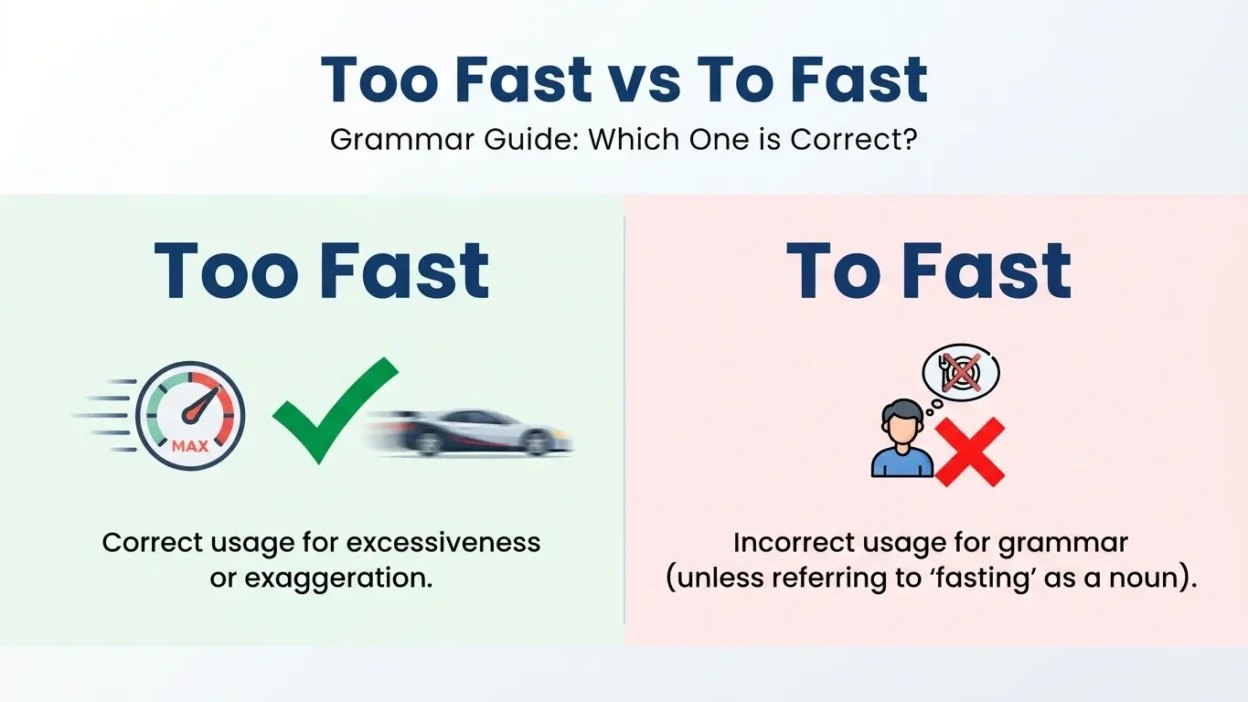
“Too fast” is the correct phrase when you mean excessively fast or more quickly than desired.
“To fast” is usually incorrect unless to belongs to an infinitive verb or refers to the act of fasting, such as “to fast during Ramadan.”
Too Fast vs To Fast Comparison Table
| Feature | Too Fast | To Fast |
|---|---|---|
| Correct as a phrase meaning excessive speed | ✅ Yes | ❌ No |
| Meaning | Excessively fast | Usually incorrect |
| Part of speech | Adverb + adjective/adverb | Preposition or infinitive marker |
| Common usage | You’re driving too fast. | I want to fast tomorrow. |
| Everyday English | Very common | Only correct in specific contexts |
What Does “Too Fast” Mean?
Too fast means more quickly than is acceptable, safe, comfortable, or expected.
The word too means excessively or more than necessary.
Examples
- The car was moving too fast.
- She finished the exam too fast.
- The music is playing too fast.
- The machine is running too fast.
In each sentence, too indicates that the speed exceeds a suitable limit.
What Does “To Fast” Mean?
To fast is not another version of “too fast.”
Instead, it appears only when fast is a verb meaning to avoid eating for a period of time.
Examples
- Muslims choose to fast during Ramadan.
- My doctor advised me to fast before the blood test.
- He plans to fast for one day.
Here, to introduces the infinitive verb fast.
Difference Between Too Fast and To Fast
Although they sound identical, they serve completely different grammatical purposes.
| Too Fast | To Fast |
|---|---|
| Means excessively fast | Means to avoid eating (verb) |
| Describes speed | Describes an action |
| Uses the adverb “too” | Uses the infinitive marker “to” |
| Common in daily conversation | Used when discussing fasting |
Grammar Rule Behind “Too”
The word too has two common meanings.
| Use of Too | Example |
|---|---|
| Excessively | The soup is too hot. |
| Also | I want to come too. |
When discussing speed, too always means excessively.
Examples:
- You’re walking too fast.
- The internet is loading too fast.
- Don’t speak too fast.
Grammar Rule Behind “To”
The word to has several grammatical uses.
| Function | Example |
|---|---|
| Shows direction | Go to school. |
| Begins an infinitive | To run is healthy. |
| Before the verb “fast” | I need to fast before surgery. |
Notice that to fast refers to fasting—not speed.
Real-Life Examples of Too Fast
Daily Life
- You’re talking too fast.
- My child is growing up too fast.
Business
- The company expanded too fast and faced financial problems.
- Sales increased too fast for production to keep up.
Education
- The teacher explained the lesson too fast.
- Students completed the quiz too fast without checking answers.
Science
- The chemical reaction occurred too fast.
- The satellite moved too fast for accurate tracking.
Real-Life Examples of To Fast
Healthcare
- Patients must to fast before certain medical procedures. (More naturally: Patients must fast before surgery.)
- The doctor instructed him to fast for twelve hours.
Religion
- Many people choose to fast during religious holidays.
- She decided to fast for spiritual reasons.
Nutrition
- Some individuals to fast as part of intermittent fasting plans.
- He plans to fast once each week.
Common Situations Where People Get Confused
Many learners mistakenly replace too with to because both words sound identical.
Examples of confusion:
| Incorrect | Correct |
|---|---|
| You’re driving to fast. | You’re driving too fast. |
| I walked to fast. | I walked too fast. |
| She speaks to fast. | She speaks too fast. |
A simple pronunciation difference doesn’t exist, making spelling especially important.
Common Mistakes and Corrections
| Incorrect Sentence | Correct Sentence |
|---|---|
| He ran to fast. | He ran too fast. |
| You’re speaking to fast. | You’re speaking too fast. |
| The train moved to fast. | The train moved too fast. |
| I need too fast before surgery. | I need to fast before surgery. |
| She is too fast before the test. | She is to fast before the test. (Only if “fast” means not eating.) |
Memory Trick to Remember the Difference
An easy trick is:
- Too = Too much
- Too fast = Faster than it should be
If you can replace too with excessively, it is correct.
Example:
- You’re driving excessively fast.
- You’re driving too fast.
If you’re talking about not eating, use to fast.
Example:
- I need to fast before surgery.
Grammar Forms Table
| Expression | Grammar Type | Example |
|---|---|---|
| Too fast | Adverb + adjective/adverb | You’re driving too fast. |
| Too slow | Adverb + adjective | You’re walking too slow. |
| Too quickly | Adverb + adverb | She finished too quickly. |
| To fast | Infinitive verb | I have to fast tomorrow. |
Professional and Industry Usage
| Industry | Too Fast Example | To Fast Example |
|---|---|---|
| Healthcare | Heart rate increased too fast. | Patients must fast before surgery. |
| Education | Students finished too fast. | Rarely used except health discussions. |
| Manufacturing | Machines operated too fast. | Not commonly used. |
| Sports | The runner started too fast. | Athletes may fast before competitions. |
| Technology | Downloads completed too fast for testing. | Not commonly used. |
Decision Guide: Which One Should You Use?
| Situation | Correct Choice |
|---|---|
| Describing excessive speed | Too fast |
| Talking about driving | Too fast |
| Talking about speaking quickly | Too fast |
| Discussing religious fasting | To fast |
| Medical instructions before surgery | To fast |
Examples in Everyday Conversations
Using “Too Fast”
- You’re walking too fast for me.
- The movie ended too fast.
- Don’t type too fast.
- Time goes by too fast.
Using “To Fast”
- I have to fast before my appointment.
- She decided to fast for 24 hours.
- They plan to fast during the festival.
- He was instructed to fast overnight.
People Also Ask
Is “to fast” ever correct?
Yes. It is correct only when fast is used as a verb meaning not eating.
Is “too fast” grammatically correct?
Yes. It is the correct phrase for describing excessive speed.
Why do people confuse too and to?
Because they are pronounced the same but have different spellings and meanings.
Can I say “you’re going to fast”?
No. The correct sentence is “You’re going too fast.”
What does “too fast” mean?
It means moving or happening faster than is appropriate, safe, or desired.
Frequently Asked Questions
Is “too fast” an adverb phrase?
No. It combines the adverb too with the adjective or adverb fast to describe excessive speed.
Can “to fast” describe speed?
No. It refers only to the verb fast, meaning to avoid eating.
Which phrase appears more often in English?
Too fast is far more common because it is used in everyday conversations about speed.
How can I remember the correct spelling?
Think of too as meaning too much. If the speed is excessive, use too fast.
Is “to fast” wrong in every sentence?
No. It is correct when referring to fasting, such as to fast before surgery.
Conclusion
Understanding too fast vs to fast is simple once you know the role of too and to. Use too fast whenever you mean that something is moving, happening, or being done more quickly than it should.
Use to fast only when fast is a verb meaning to avoid eating, such as before a medical test or during a religious practice. Remember the easy rule: if you mean excessively fast, choose too fast. If you mean not eating, choose to fast.