The confusion between loot vs lute is common because both words are short, sound somewhat similar, and differ by only one letter.
However, they have completely different meanings and are used in entirely different contexts.
Understanding loot vs lute helps you avoid embarrassing mistakes in writing and conversation.
Whether you’re reading historical texts, playing word games, studying English vocabulary, or writing professionally, knowing the difference between loot vs lute is essential.
One refers to stolen valuables, while the other is a beautiful musical instrument with a rich history.
This guide explains their meanings, differences, usage, examples, grammar, and common mistakes in simple English.
Quick Answer
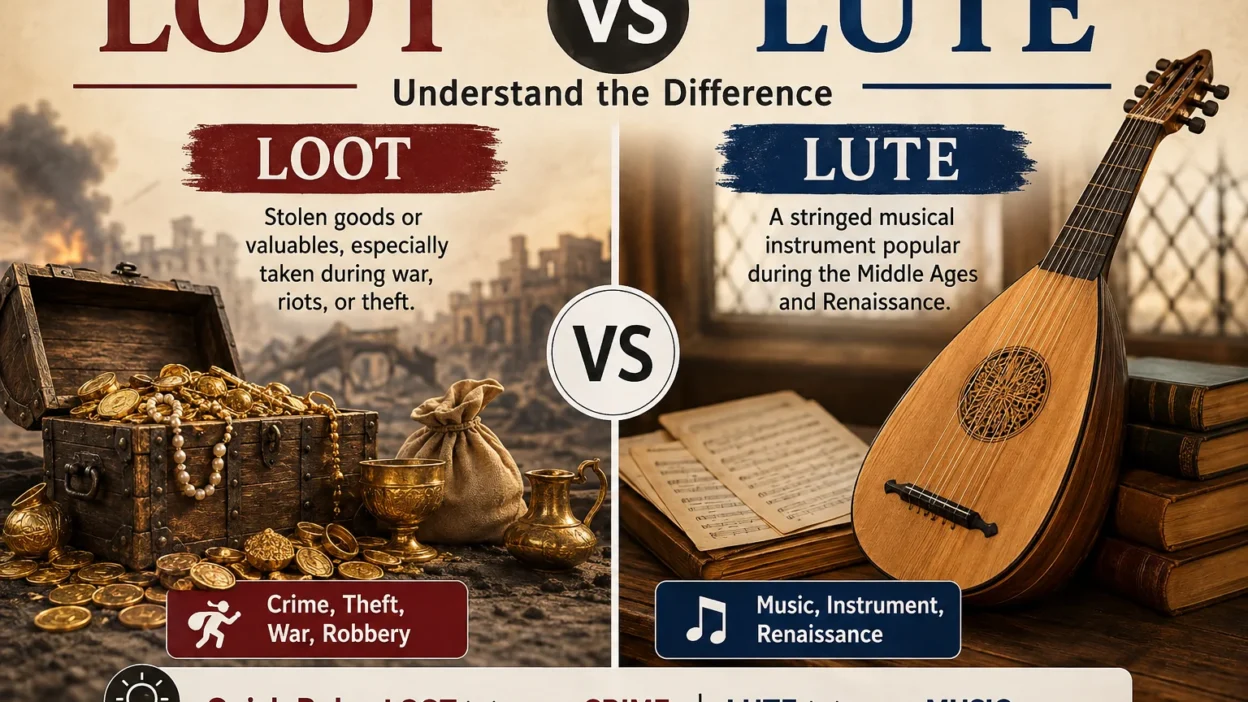
Loot means stolen money, goods, or valuables, especially taken during war, riots, or theft.
Lute is a stringed musical instrument popular during the Renaissance and medieval periods.
The words sound similar but have completely unrelated meanings.
Loot vs Lute Comparison Table
| Feature | Loot | Lute |
|---|---|---|
| Part of Speech | Noun, Verb | Noun |
| Meaning | Stolen goods or valuables | A stringed musical instrument |
| Category | Crime, History, Economics | Music, History |
| Pronunciation | /luːt/ | /luːt/ |
| Can Be a Verb? | Yes | No |
| Common Context | Robbery, war, riots | Music performances, classical music |
| Example | The thieves escaped with the loot. | She played the lute beautifully. |
What Does “Loot” Mean?
Loot refers to money, goods, or valuables stolen during a robbery, war, disaster, or riot. It can also be used as a verb meaning to steal or rob.
Examples
- The robbers divided the loot after the crime.
- Soldiers carried away valuable loot from the city.
- The store was looted during the riot.
- Pirates searched for hidden loot.
Loot as a Verb
- Protesters looted several shops.
- Criminals looted abandoned buildings.
What Does “Lute” Mean?
A lute is a pear-shaped string instrument with a long neck. It was widely played during the Middle Ages and the Renaissance and is considered an ancestor of the modern guitar.
Examples
- The musician performed beautifully on the lute.
- The museum displayed an ancient lute.
- She studies Renaissance lute music.
- The composer wrote several pieces for the lute.
Main Difference Between Loot and Lute
| Aspect | Loot | Lute |
|---|---|---|
| Meaning | Stolen property | Musical instrument |
| Used In | Crime, history, law | Music and arts |
| Action | Can describe stealing | Cannot describe an action |
| Verb Form | Yes | No |
| Associated With | Theft and robbery | Classical music |
The easiest way to remember loot vs lute is that loot belongs to crime, while lute belongs to music.
Pronunciation: Why People Confuse Loot and Lute
Interestingly, loot and lute are pronounced exactly the same.
Pronunciation: /luːt/
Because they are homophones, many writers accidentally use one instead of the other.
Examples:
❌ He played the loot.
✅ He played the lute.
❌ The robbers escaped with the lute.
✅ The robbers escaped with the loot.
Grammar Forms
| Word | Noun | Verb | Adjective | Plural |
|---|---|---|---|---|
| Loot | ✔ | ✔ | Looted | Loots (verb), loot (noun) |
| Lute | ✔ | ✖ | Lute-like (rare) | Lutes |
Loot vs Lute in Different Contexts
| Context | Loot | Lute |
|---|---|---|
| History | War loot | Medieval lute |
| Music | Not used | Common instrument |
| Crime | Stolen goods | Not used |
| Museums | Displayed as recovered loot | Displayed as historical instrument |
| Literature | Pirate loot | Court musicians playing the lute |
Real-Life Examples
Business
- Insurance covered the value of the stolen loot.
- A music company restored an antique lute.
Education
- Students learned about war loot in history class.
- Music students practiced the lute.
History
- Archaeologists uncovered buried loot from ancient battles.
- Historians studied Renaissance lute performances.
Entertainment
- Adventure games often include hidden loot.
- Historical films frequently feature the lute in royal courts.
Common Mistakes
| Incorrect Sentence | Correct Sentence |
|---|---|
| He played the loot. | He played the lute. |
| The thief carried a lute. | The thief carried the loot. |
| Pirates loved their lutes. | Pirates loved their loot. |
| She stole an expensive loot instrument. | She stole an expensive lute. |
Why People Confuse Loot and Lute
Several reasons explain the confusion:
- They are perfect homophones.
- Only one letter differs.
- Spell-check may not catch the mistake.
- Many people know one word but not the other.
- Both appear in historical books and movies.
Memory Trick to Remember the Difference
Use these simple tricks:
| Word | Memory Trick |
|---|---|
| Loot | Think of loot = looting = stealing. |
| Lute | Think of lute = music = guitar-like instrument. |
Another trick:
- Loot = Lost valuables
- Lute = Lovely tunes
Professional and Industry Usage
| Industry | Loot | Lute |
|---|---|---|
| Law Enforcement | Evidence of stolen loot | Rarely used |
| Gaming | Treasure loot | Medieval game soundtrack |
| Music | Not applicable | Historical instrument |
| Museums | Recovered artifacts and loot | Ancient musical exhibits |
| Education | Crime and history lessons | Music education |
When Should You Use Loot?
Use loot when talking about:
- Theft
- Robbery
- War
- Pirates
- Treasure
- Crime
- Stolen valuables
Examples:
- Police recovered the stolen loot.
- Pirates searched for hidden loot.
- The rioters looted several stores.
When Should You Use Lute?
Use lute when discussing:
- Musical instruments
- Renaissance music
- Medieval history
- Classical performances
- Music education
Examples:
- She bought a handmade lute.
- The concert featured a solo lute performance.
- The museum preserved a 500-year-old lute.
Quick Usage Checklist
| Situation | Correct Word |
|---|---|
| Stolen money | Loot |
| Treasure | Loot |
| Robbery | Loot |
| Musical instrument | Lute |
| Renaissance music | Lute |
| Classical concert | Lute |
Frequently Asked Questions
Is loot the same as lute?
No. Loot means stolen property, while lute is a musical instrument.
Why do loot and lute sound the same?
They are homophones, meaning they have the same pronunciation but different meanings and spellings.
Can loot be used as a verb?
Yes. Loot can mean to steal or rob.
Example: The crowd looted several shops.
Is lute still used today?
Yes. Although uncommon, the lute is still played by musicians specializing in early and classical music.
Which word is more common?
Loot appears more often in everyday news, gaming, and crime reports, while lute is mainly used in music and history.
People Also Ask
Is loot always stolen?
Generally yes. Loot refers to property taken illegally or during conflict.
Is a lute similar to a guitar?
Yes. The lute is an early string instrument and is considered one of the ancestors of the modern guitar.
Are loot and lute homophones?
Yes. They have identical pronunciation but different meanings and spellings.
Can I use loot in video games?
Yes. In gaming, loot refers to rewards, treasure, weapons, armor, or items collected by players.
Conclusion
Understanding loot vs lute is simple once you remember their meanings. Loot refers to stolen goods or valuables and can also function as a verb meaning to steal. Lute, on the other hand, is a historic stringed musical instrument associated with medieval and Renaissance music.
Although both words are pronounced the same, they belong to completely different fields. Whenever you’re writing, think of loot for crime or treasure and lute for music. This simple rule will help you use both words correctly every time.
Meta Description: