Choosing between appal vs appall can be confusing because both words look almost identical and are often used in the same context.
Many writers wonder whether appal and appall have different meanings or if one is simply an alternative spelling.
Understanding the distinction helps you write more confidently in both American and British English.
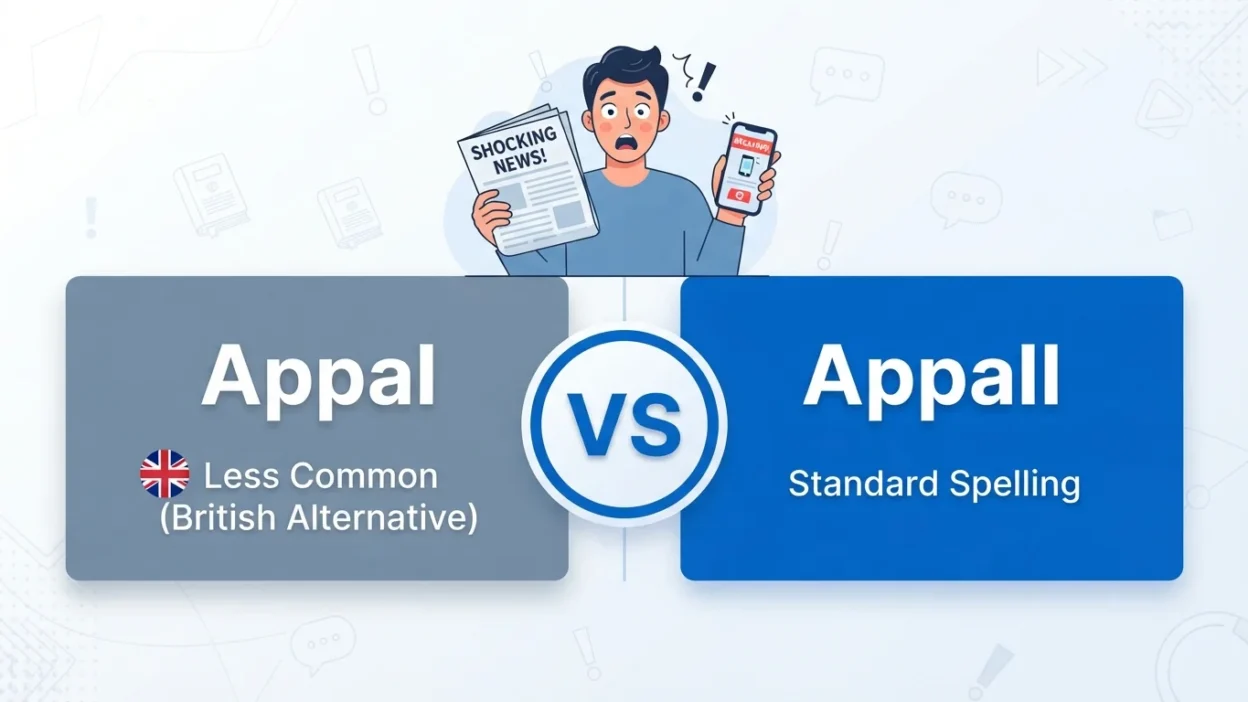
In reality, appal vs appall is mainly a spelling difference rather than a meaning difference.
Both words mean to shock, horrify, or deeply upset someone. However, one spelling is more common in certain regions.
Quick Answer
The difference between appal vs appall is only the spelling.
- Appall is the standard spelling in both American and British English.
- Appal is an accepted alternative spelling, mainly used in British English.
- Both mean to shock, horrify, or greatly disturb someone.
Appal vs Appall at a Glance
| Feature | Appal | Appall |
|---|---|---|
| Meaning | To shock or horrify | To shock or horrify |
| Part of Speech | Verb | Verb |
| American English | Rare | Standard |
| British English | Accepted alternative | Standard |
| Pronunciation | Uh-PAWL | Uh-PAWL |
| Preferred in modern writing | Less common | Most common |
What Does Appal Mean?
Appal is a verb meaning to greatly shock, horrify, or disgust someone.
Although correct, this spelling appears less frequently today. It is mainly seen in British publications and older texts.
Examples
- The accident appalled everyone in the neighborhood.
- The amount of waste continued to appal environmental groups.
- His careless behavior continued to appal his teachers.
What Does Appall Mean?
Appall has exactly the same meaning as appal. It is the preferred spelling in modern dictionaries and publications, especially in American English.
Examples
- The news appalled the entire nation.
- Scientists were appalled by the level of pollution.
- Customers were appalled by the poor service.
Main Difference Between Appal vs Appall
The only real difference is spelling preference.
| Aspect | Appal | Appall |
|---|---|---|
| Meaning | Same | Same |
| Pronunciation | Same | Same |
| Usage | Less common | More common |
| Preferred globally | No | Yes |
| Recommended for international writing | Occasionally | Yes |
If you’re writing for a global audience, appall is the safer choice.
Grammar Forms of Appal and Appall
| Base Verb | Past Tense | Past Participle | Present Participle | Noun | Adjective |
|---|---|---|---|---|---|
| Appal | Appalled | Appalled | Appalling | Appalment (rare) | Appalling |
| Appall | Appalled | Appalled | Appalling | Appalment/Appallment (rare) | Appalling |
Notice that both spellings share the same common forms:
- appalled
- appalling
- appalled by
- appalling behavior
When Should You Use Appal?
Use appal if:
- You’re following British spelling conventions.
- You’re matching an organization’s style guide.
- You’re quoting a source that uses this spelling.
Examples
- The decision will appal many voters.
- The report may appal readers.
When Should You Use Appall?
Use appall if:
- You’re writing for American readers.
- You’re creating online content.
- You’re writing SEO articles or business documents.
- You want the most widely accepted spelling.
Examples
- Rising prices appall consumers.
- The evidence appalled investigators.
- The results appalled the medical team.
Real-Life Examples of Appal vs Appall
Business
- Investors were appalled by the company’s financial losses.
- The unethical practices continued to appal industry experts.
Education
- Teachers were appalled by the cheating incident.
- Parents were appalled after reading the report.
Science
- Researchers were appalled by the pollution levels.
- Environmentalists were appalled by illegal dumping.
Healthcare
- Doctors were appalled by the lack of medical supplies.
- Nurses were appalled by unsafe working conditions.
Daily Conversation
- I was appalled by his rude comment.
- We were appalled to hear the bad news.
Industry Usage Table
| Industry | Preferred Word | Example |
|---|---|---|
| Journalism | Appall | The findings appalled readers. |
| Business | Appall | Investors were appalled. |
| Education | Appall | Teachers were appalled. |
| Government | Appall | The decision appalled citizens. |
| Healthcare | Appall | Doctors were appalled. |
| Environmental Science | Appall | Scientists were appalled by pollution. |
Why Do People Confuse Appal vs Appall?
Several reasons explain the confusion.
| Reason | Explanation |
|---|---|
| Nearly identical spelling | Only one extra “l” separates them. |
| Same pronunciation | Both are pronounced the same way. |
| Same meaning | There is no difference in definition. |
| Regional spelling | British English accepts both more readily than American English. |
| Dictionaries list both | Learners assume they have different meanings. |
Common Mistakes
Here are some mistakes people make with appal vs appall.
| Incorrect | Correct |
|---|---|
| I was appall by the news. | I was appalled by the news. |
| The story is appall. | The story is appalling. |
| Everyone was appal. | Everyone was appalled. |
| The results appalling everyone. | The results appalled everyone. |
Memory Trick to Remember the Difference
Here’s an easy way to remember:
- Appall has two L’s, and it’s the spelling you’ll see in most modern writing.
- Appal drops one L, making it the less common alternative.
If you’re unsure, choose appall. You’ll almost always be correct.
How to Choose the Right Spelling
| Situation | Best Choice |
|---|---|
| American English | Appall |
| British English | Appall or Appal |
| Academic writing | Appall |
| Business communication | Appall |
| Website content | Appall |
| International audience | Appall |
People Also Ask
Is appal a real word?
Yes. Appal is a correct but less common alternative spelling of appall, especially in British English.
Is appall the correct spelling?
Yes. Appall is the standard and most widely accepted spelling worldwide.
Do appal and appall have different meanings?
No. They have the same meaning: to shock, horrify, or greatly disturb someone.
Which spelling should I use in American English?
Use appall, as it is the standard American spelling.
Is appalling related to appall?
Yes. Appalling is the adjective form of appall, meaning extremely shocking or terrible.
Frequently Asked Questions
Which spelling is more common?
Appall is much more common in modern English.
Can I use appal in formal writing?
Yes, especially if you’re following British English style, although appall is still more common.
Are they pronounced differently?
No. Both are pronounced exactly the same.
Which spelling is better for SEO writing?
Appall is generally better because it matches the spelling most users search for.
Is appal incorrect?
No. It is correct but less frequently used.
Conclusion
Understanding appal vs appall is easier once you know that the two words share the same meaning. Both describe something that shocks, horrifies, or deeply upsets someone. The real difference lies in spelling rather than definition.
Appall is the standard spelling used in American English and the preferred choice in most modern writing, while appal remains an accepted but less common alternative, primarily in British English. If you’re writing for an international audience, creating professional documents, or publishing online content, choosing appall is the safest and most widely recognized option.