The phrase through the roof meaning is often searched by English learners and native speakers alike because it is a idiom used in everyday conversations, reports, articles, and social media.
While the expression sounds literal, it is actually figurative and describes something that rises to a very high level.
Understanding the through the roof meaning can help you communicate more naturally in English.
if you are talking about prices, emotions, sales, demand, or excitement, this idiom is widely used to emphasize a dramatic increase.
In this guide, you’ll learn the exact meaning, usage rules, examples, common mistakes, and practical tips for remembering this popular expression.
Quick Answer
Through the roof means extremely high or rising very quickly to a high level.
Example: Gas prices went through the roof last month.
It is commonly used to describe sharp increases in prices, costs, emotions, demand, sales, or statistics.
What Does Through the Roof Mean?
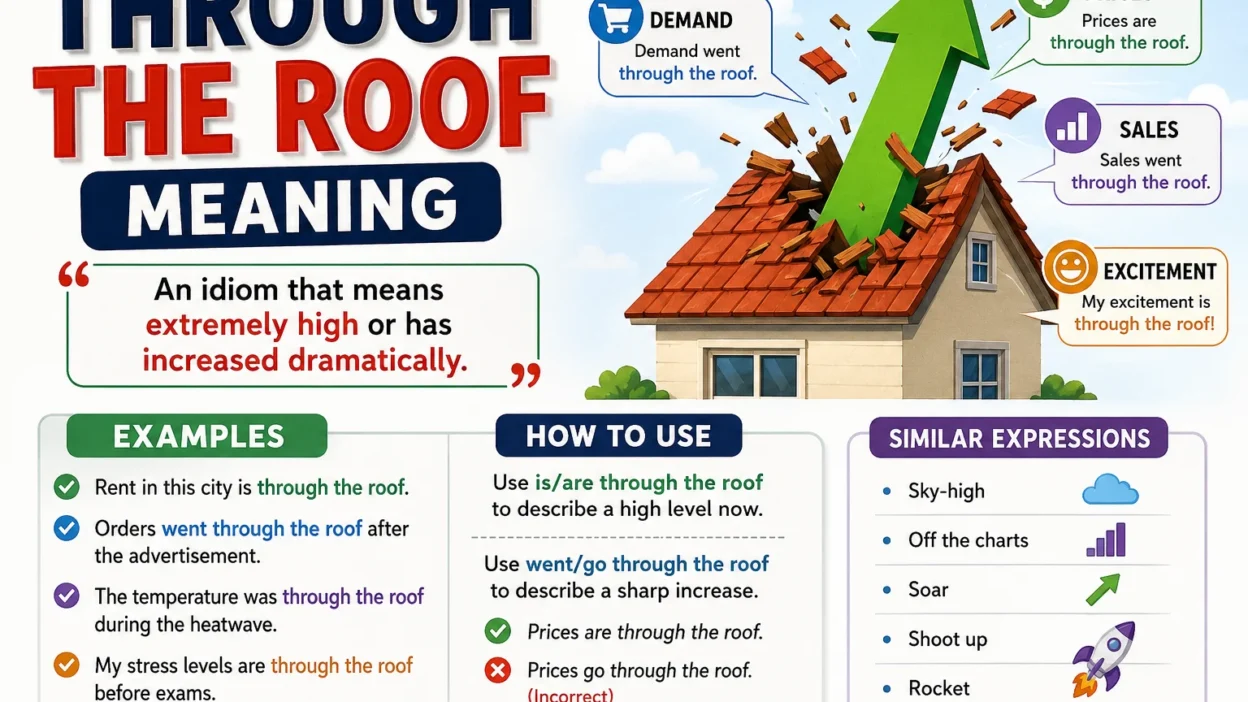
The idiom through the roof means that something has increased, risen, or reached an unusually high level.
It does not refer to a real roof. Instead, it creates the image of something rising so high that it breaks through a roof.
Examples
- House prices went through the roof.
- Her confidence went through the roof after winning the competition.
- Demand for the product went through the roof.
Through the Roof Meaning at a Glance
| Aspect | Details |
|---|---|
| Expression | Through the roof |
| Type | Idiom |
| Meaning | Extremely high or rapidly increasing |
| Tone | Informal to semi-formal |
| Common Uses | Prices, sales, emotions, demand, costs |
| Literal Meaning | Not usually used literally |
| Example | “The company’s profits went through the roof.” |
Origin of the Expression
The phrase comes from the idea of something rising so dramatically that it bursts through a building’s roof.
Over time, English speakers began using it metaphorically to describe anything that increases beyond normal expectations.
Today, it is one of the most common idioms for describing sharp growth or high levels.
When to Use Through the Roof
Use this idiom when you want to emphasize a significant increase.
Appropriate Situations
| Situation | Example |
|---|---|
| Prices | Food prices went through the roof. |
| Sales | Holiday sales went through the roof. |
| Demand | Demand for electric vehicles went through the roof. |
| Emotions | My stress levels went through the roof. |
| Website Traffic | Traffic went through the roof after the campaign. |
Through the Roof vs Very High
Many learners wonder about the difference between through the roof and very high.
| Through the Roof | Very High |
|---|---|
| Idiomatic expression | Standard description |
| Emphasizes dramatic increase | Simply describes a high level |
| More vivid and expressive | More neutral |
| Informal to semi-formal | Suitable everywhere |
| “Prices went through the roof.” | “Prices were very high.” |
Example Comparison
- Prices were very high this year.
- Prices went through the roof this year.
The second sentence sounds stronger and more dramatic.
Real-Life Examples in Different Contexts
Business
- Company profits went through the roof after launching a new product.
- Online orders went through the roof during the holiday season.
Education
- Student participation went through the roof after introducing rewards.
- Enrollment numbers went through the roof.
Science
- Interest in renewable energy research went through the roof.
- Funding for vaccine studies went through the roof.
Sports
- Ticket prices went through the roof after the team reached the finals.
Technology
- App downloads went through the roof after the update.
Grammar and Sentence Patterns
The phrase usually follows forms of the verb go.
Common Structures
| Structure | Example |
|---|---|
| Go through the roof | Prices went through the roof. |
| Went through the roof | Sales went through the roof last year. |
| Has gone through the roof | Demand has gone through the roof. |
| Is through the roof | Inflation is through the roof. |
| Were through the roof | Energy costs were through the roof. |
Common Collocations
These words frequently appear with through the roof.
| Noun | Example |
|---|---|
| Prices | Prices went through the roof. |
| Costs | Costs went through the roof. |
| Demand | Demand went through the roof. |
| Sales | Sales went through the roof. |
| Rent | Rent went through the roof. |
| Stress | Stress levels went through the roof. |
| Excitement | Excitement went through the roof. |
| Profits | Profits went through the roof. |
Professional and Industry Usage
The idiom is common in many professional settings.
| Industry | Example Usage |
|---|---|
| Finance | Stock prices went through the roof. |
| Real Estate | Property values went through the roof. |
| Marketing | Engagement went through the roof. |
| Retail | Sales went through the roof during promotions. |
| Healthcare | Demand for services went through the roof. |
| Technology | User registrations went through the roof. |
Common Mistakes and Corrections
Many learners misuse this expression.
| Incorrect | Correct |
|---|---|
| Prices are through roof. | Prices are through the roof. |
| Sales went on the roof. | Sales went through the roof. |
| Demand went to the roof. | Demand went through the roof. |
| My happiness was very through the roof. | My happiness went through the roof. |
Correct Sentences
- Fuel prices went through the roof.
- My excitement went through the roof.
- Website traffic has gone through the roof.
Incorrect Sentences
- Fuel prices went on the roof.
- My excitement went to the roof.
- Website traffic has gone roof.
Why People Confuse the Expression
Several factors create confusion.
| Reason | Explanation |
|---|---|
| Literal interpretation | People think it refers to an actual roof. |
| Similar phrases | Expressions like “on the roof” cause confusion. |
| Missing article | Learners forget the word “the.” |
| Direct translation | Some languages do not use similar idioms. |
Understanding that it is an idiom helps avoid these mistakes.
Memory Trick to Remember Through the Roof Meaning
Imagine a balloon rising so quickly that it crashes through a house roof and keeps going upward.
That image represents something becoming extremely high.
Roof = Limit
Through the roof = Beyond the limit
This simple visualization makes the meaning easy to remember.
Similar Idioms and Alternatives
English offers several alternatives with similar meanings.
| Idiom | Meaning |
|---|---|
| Sky-high | Extremely high |
| Off the charts | Beyond normal levels |
| Soaring | Rising rapidly |
| Booming | Growing quickly |
| Exploding | Increasing dramatically |
Examples
- Prices are sky-high.
- Demand is off the charts.
- Sales are soaring.
Examples of Through the Roof in Sentences
Here are practical examples showing proper usage.
| Sentence | Context |
|---|---|
| Rent prices went through the roof. | Housing |
| My confidence went through the roof after graduation. | Personal growth |
| Sales went through the roof during Black Friday. | Business |
| Website visits went through the roof. | Marketing |
| Demand for the product went through the roof. | Retail |
| Energy costs went through the roof. | Economics |
Frequently Asked Questions
What does through the roof mean?
It means something is extremely high or has increased dramatically.
Is through the roof an idiom?
Yes. It is an English idiom used figuratively rather than literally.
Can through the roof describe emotions?
Yes. It can describe emotions such as excitement, stress, confidence, or happiness.
Example: My excitement went through the roof.
Is through the roof formal or informal?
It is generally informal to semi-formal but is often used in business and journalism.
What is another way to say through the roof?
Alternatives include sky-high, off the charts, soaring, and extremely high.
Can I use through the roof for prices?
Yes. Prices are one of the most common things described as going through the roof.
Example: Gas prices went through the roof.
Conclusion
Understanding the through the roof meaning is important because it is one of the most common English used to dramatic increases.
The phrase means that something has become extremely high or has risen rapidly beyond normal levels.
It is commonly used for prices, sales, demand, profits, emotions, and statistics. Remember that the correct form is through the roof, not on the roof or to the roof.
By learning its meaning, examples, and usage patterns, you can use this idiom naturally and confidently in everyday English.