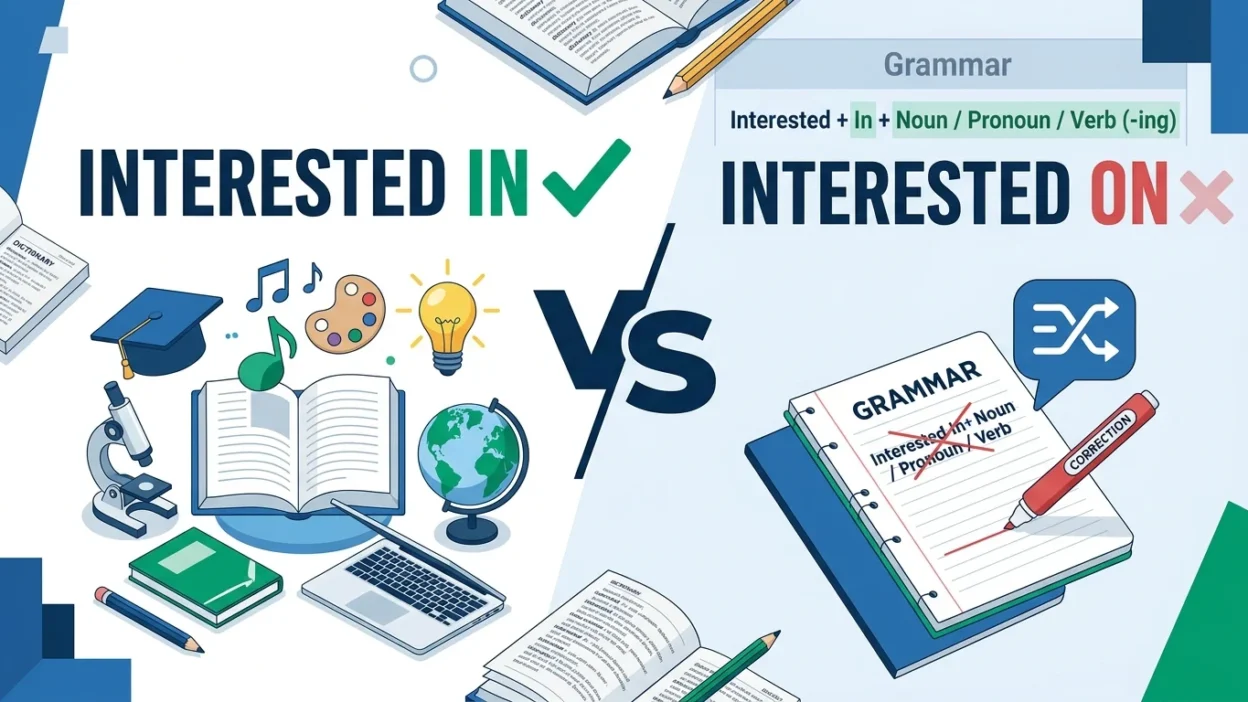
The confusion between interested in vs interested on is one of the most common preposition mistakes in English.
Since many languages use different prepositions after adjectives, English learners often wonder which phrase is correct.
Understanding interested in vs interested on is essential for writing naturally, speaking fluently, and avoiding grammar mistakes in school, business, and everyday conversations.
If you’ve ever asked whether to say “I’m interested in science” or “I’m interested on science,” you’re not alone.
This guide explains interested in vs interested on with simple grammar rules, comparison tables, examples, common mistakes, memory tricks, and FAQs so you can confidently use the correct expression in any situation.
Quick Answer
Interested in is the correct and standard English expression.
Interested on is generally incorrect in standard English when talking about hobbies, subjects, people, or activities.
Correct: I’m interested in photography.
Incorrect: I’m interested on photography.
Interested In vs Interested On Comparison Table
| Feature | Interested In | Interested On |
|---|---|---|
| Grammar Status | Correct | Generally incorrect |
| Standard English | Yes | No |
| Everyday Usage | Very common | Rare and usually incorrect |
| Formal Writing | Yes | No |
| Common with Subjects | Yes | No |
What Does “Interested In” Mean?
Interested in means feeling curiosity, enthusiasm, or concern about a person, subject, activity, or idea.
It is the standard collocation used after the adjective interested.
Examples
- I’m interested in history.
- She is interested in music.
- They’re interested in learning English.
- He is interested in technology.
What Does “Interested On” Mean?
In standard English, interested on is generally considered incorrect when expressing curiosity or preference.
However, in very limited situations, on may follow another noun or verb, such as:
- A lecture on climate change
- A book on history
- A discussion on education
Notice that interested itself still takes in, not on.
Correct:
- I’m interested in a book on history.
Key Differences Between Interested In and Interested On
| Interested In | Interested On |
|---|---|
| Correct English collocation | Usually incorrect |
| Expresses curiosity | Not standard usage |
| Used worldwide | Rarely accepted |
| Appropriate in formal writing | Avoid in formal writing |
Grammar Rule
The adjective interested is followed by the preposition in.
Grammar pattern:
Subject + be + interested + in + noun/pronoun/verb (-ing)
Examples:
- She is interested in science.
- We are interested in traveling.
- He is interested in investing.
Never replace in with on in this pattern.
Grammar Forms Table
| Structure | Example |
|---|---|
| Interested + in + noun | Interested in sports |
| Interested + in + pronoun | Interested in her |
| Interested + in + verb (-ing) | Interested in reading |
| Interested + in + subject | Interested in biology |
When to Use “Interested In”
Use interested in when talking about:
- Hobbies
- Careers
- Subjects
- People
- Research
- Business opportunities
- Skills
- Activities
Examples
- She is interested in medicine.
- We’re interested in your proposal.
- I’m interested in coding.
- They’re interested in buying the house.
Real Life Examples
Business
| Sentence | Correct Form |
|---|---|
| We’re interested ___ your services. | In |
| Investors are interested ___ the project. | In |
Education
| Sentence | Correct Form |
|---|---|
| Students are interested ___ mathematics. | In |
| She became interested ___ chemistry. | In |
Science
- Scientists are interested in genetics.
- Researchers are interested in climate change.
- Students are interested in astronomy.
Everyday Conversation
- I’m interested in cooking.
- She’s interested in photography.
- They’re interested in sports.
- He’s interested in learning Spanish.
Industry Usage Table
| Industry | Example |
|---|---|
| Business | Interested in investing |
| Education | Interested in mathematics |
| Healthcare | Interested in medical research |
| Technology | Interested in AI development |
| Science | Interested in environmental studies |
| Marketing | Interested in customer feedback |
Why People Confuse Interested In vs Interested On
Many learners make this mistake because:
- Their native language uses a different preposition.
- They translate directly from another language.
- English prepositions often seem unpredictable.
- “On” appears frequently with topics, such as a book on history.
- Many adjective-preposition combinations must simply be memorized.
Common Mistakes
| Incorrect Sentence | Correct Sentence |
|---|---|
| I’m interested on music. | I’m interested in music. |
| She is interested on science. | She is interested in science. |
| They are interested on your idea. | They are interested in your idea. |
| He became interested on coding. | He became interested in coding. |
| We’re interested on buying the house. | We’re interested in buying the house. |
Memory Tricks
Interested = In
Think of them as a pair:
Interested → In
They almost always go together.
Easy Phrase
Say this aloud:
“I’m interested in it.”
It sounds natural because it’s correct.
Remember This Rule
- Interested in a subject.
- Book on a subject.
The adjective uses in, while many nouns use on.
Comparison Table by Situation
| Situation | Correct Expression |
|---|---|
| Hobby | Interested in painting |
| Career | Interested in engineering |
| School Subject | Interested in biology |
| Business Proposal | Interested in your offer |
| Travel | Interested in visiting Japan |
| Investment | Interested in real estate |
Step-by-Step Guide to Choosing the Correct Expression
| Step | Ask Yourself | Choose |
|---|---|---|
| 1 | Are you describing curiosity? | Interested in |
| 2 | Is “interested” the adjective? | In |
| 3 | Are you discussing a subject? | Interested in |
| 4 | Is “on” attached to another noun like “book”? | Possible |
| 5 | Unsure? | Use Interested in |
Professional Usage
Professional English almost always uses interested in.
Examples:
- We are interested in partnering with your company.
- She is interested in the position.
- The client is interested in our services.
- Investors are interested in sustainable projects.
Using interested on in formal writing may appear grammatically incorrect.
Common Expressions
Interested In
- Interested in sports
- Interested in business
- Interested in science
- Interested in reading
- Interested in technology
- Interested in learning
Not Interested In
- Not interested in politics
- Not interested in buying
- Not interested in changing jobs
FAQs
Is “interested in” correct?
Yes. Interested in is the standard and grammatically correct expression.
Is “interested on” ever correct?
Generally, no. Standard English uses interested in after the adjective interested.
Why do people say “interested on”?
Usually because of direct translation from another language or confusion with phrases like a book on history.
Can I say “interested in learning”?
Yes. This is one of the most common and correct structures.
Which preposition follows “interested”?
The adjective interested is almost always followed by in.
How can I remember the rule?
Think:
Interested = In
Never separate them.
Conclusion
Understanding interested in vs interested on is straightforward once you learn the grammar rule.
Interested in is the correct expression because the adjective interested is always followed by the preposition in when expressing curiosity, enthusiasm, or concern.
Interested on is generally incorrect in standard English and should be avoided in speaking and writing. Remember the simple pairing interested + in and you’ll communicate more naturally and confidently in both professional and everyday situations.