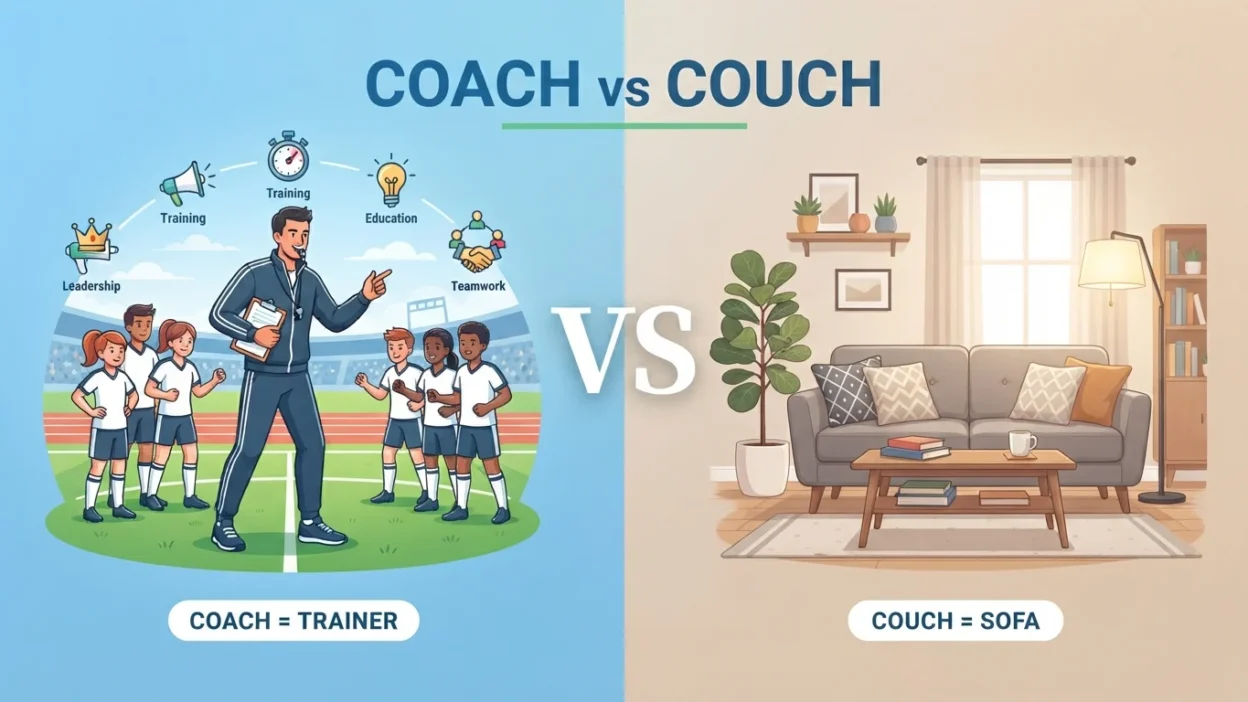
The confusion between coach vs couch is one of the most common spelling and pronunciation mistakes in English.
Although these two words differ by only one letter, they have completely different meanings.
Understanding coach vs couch can help you avoid embarrassing mistakes in conversations, emails, academic writing, and professional communication.
Many English learners and even native speakers accidentally type or pronounce one word instead of the other because they look and sound similar.
In this guide, you’ll learn the meanings, pronunciation, differences, grammar, real-life examples, common mistakes, memory tricks, and practical usage of coach vs couch so you can use both words confidently.
Quick Answer
The difference between coach vs couch is simple:
- Coach refers to a person who trains others or a large vehicle such as a bus.
- Couch refers to a piece of furniture used for sitting or lying down.
Coach vs Couch Comparison Table
| Feature | Coach | Couch |
|---|---|---|
| Part of Speech | Noun, Verb | Noun, Verb (less common) |
| Main Meaning | Trainer, instructor, or bus | Sofa or upholstered seat |
| Pronunciation | /koʊtʃ/ | /kaʊtʃ/ |
| Common Context | Sports, business, education | Home, furniture, interior design |
| Verb Usage | To train or guide | To express in words (rare) |
| Example | She hired a career coach. | We bought a new couch. |
What Does “Coach” Mean?
The word coach has multiple meanings depending on the context.
As a Noun
A coach is a person who teaches, trains, or guides someone to improve their skills.
Examples:
- The football coach planned today’s practice.
- She works with a career coach.
- Our debate coach gave helpful advice.
It can also mean a long-distance bus or passenger carriage.
Example:
- We traveled by coach to another city.
As a Verb
Coach means to train, teach, or guide someone.
Examples:
- She coaches the basketball team.
- Managers coach new employees.
What Does “Couch” Mean?
A couch is a piece of furniture designed for sitting or lying down.
Examples:
- The family relaxed on the couch.
- We bought a comfortable leather couch.
- The dog sleeps on the couch every afternoon.
Couch as a Verb
Although uncommon, couch can also be used as a verb.
Meaning:
To express something using particular words.
Example:
- The lawyer couched the statement carefully.
Key Differences Between Coach and Couch
| Point | Coach | Couch |
|---|---|---|
| Primary Meaning | Trainer or instructor | Sofa |
| Used For | Teaching, guiding, transportation | Seating and relaxation |
| Can Be a Verb? | Yes, commonly | Yes, rarely |
| Everyday Usage | Very common | Very common |
| Related Fields | Sports, education, business | Furniture, home décor |
Pronunciation Difference
Many learners confuse these words because they are spelled similarly.
| Word | Pronunciation | Sounds Like |
|---|---|---|
| Coach | Koh-ch | Long “O” sound |
| Couch | Kow-ch | “Ow” sound |
Practice saying them aloud:
- Coach → “kohch”
- Couch → “kowch”
Listening carefully to the vowel sound makes a big difference.
Grammar Forms
Coach
| Form | Example |
|---|---|
| Noun | The coach arrived early. |
| Verb | They coach students every weekend. |
| Past Tense | Coached |
| Past Participle | Coached |
| Present Participle | Coaching |
Couch
| Form | Example |
|---|---|
| Noun | The couch is comfortable. |
| Verb | He couched his criticism politely. |
| Past Tense | Couched |
| Past Participle | Couched |
| Present Participle | Couching |
Real-Life Examples
Business
Coach
- Executive coaches improve leadership skills.
- Companies hire business coaches.
Couch
- Offices often place couches in waiting rooms.
- Modern workplaces use comfortable couches in lounges.
Education
Coach
- Debate coaches prepare students for competitions.
- Academic coaches help improve study habits.
Couch
- Students sometimes study on the couch at home.
- Libraries occasionally include couches for reading.
Sports
Coach
- The coach motivated the team.
- Every athlete respects their coach.
Couch
- Players rested on the couch after the game.
Healthcare
Coach
- Health coaches encourage better lifestyles.
- Fitness coaches design exercise programs.
Couch
- Patients may sit on a couch during counseling sessions.
Industry Usage Table
| Industry | Coach Usage | Couch Usage |
|---|---|---|
| Sports | Sports coach | Team lounge couch |
| Business | Executive coach | Office couch |
| Education | Academic coach | Reading area couch |
| Healthcare | Wellness coach | Therapy couch |
| Hospitality | Travel coach | Hotel lobby couch |
| Interior Design | Rare | Living room couch |
When Should You Use Coach?
Use coach when referring to:
- A trainer
- A mentor
- A guide
- A sports instructor
- A career advisor
- A business consultant
- A passenger bus
Examples:
- My coach inspired me.
- She coaches young athletes.
- We traveled by coach.
When Should You Use Couch?
Use couch when referring to:
- A sofa
- Living room furniture
- Seating for relaxation
- Upholstered furniture
Examples:
- The couch matches the curtains.
- I fell asleep on the couch.
Why Do People Confuse Coach vs Couch?
Several reasons explain the confusion.
- Only one letter is different.
- Their pronunciation is similar.
- Fast typing causes spelling mistakes.
- Autocorrect sometimes changes one word into the other.
- English learners often mix similar vowel sounds.
Common Mistakes
Incorrect vs Correct Sentences
| Incorrect | Correct |
|---|---|
| I sat on the coach watching TV. | I sat on the couch watching TV. |
| Our football couch is excellent. | Our football coach is excellent. |
| She coaches in the living room. | She sits on the couch in the living room. |
| The couch trained the team. | The coach trained the team. |
| We bought a new coach for our house. | We bought a new couch for our house. |
Memory Tricks
| Word | Easy Trick |
|---|---|
| Coach | A coach helps people achieve goals. |
| Couch | A couch belongs in your house. |
| Coach | Think of sports coaching. |
| Couch | Think of relaxing while watching TV. |
Simple memory tip:
Coach = Coaching people
Couch = Comfortable furniture
Usage Tips
To avoid mistakes:
- Ask yourself whether you’re talking about a person or furniture.
- Remember that coaches teach.
- Remember that couches are for sitting.
- Read your writing before sending emails.
- Practice pronunciation regularly.
Everyday Examples
Coach
- The swimming coach encouraged every athlete.
- Our career coach reviewed my resume.
- She coaches children every Saturday.
- We hired a life coach.
Couch
- The cat jumped onto the couch.
- Everyone watched the movie from the couch.
- The new couch is extremely comfortable.
- We replaced the old couch last month.
Comparison Summary Table
| Question | Coach | Couch |
|---|---|---|
| Is it a person? | Yes | No |
| Is it furniture? | No | Yes |
| Can it be a verb? | Yes | Rarely |
| Used in sports? | Yes | No |
| Used in living rooms? | No | Yes |
| Common spelling mistake? | Often confused with couch | Often confused with coach |
FAQs
What is the difference between coach vs couch?
A coach is a trainer or instructor, while a couch is a piece of furniture used for sitting or lying down.
Is coach a verb?
Yes. Coach can be a verb meaning to teach, train, or guide someone.
Can couch be used as a verb?
Yes, but it is uncommon. It means to express something in particular words.
Why do people confuse coach and couch?
They have similar spellings and pronunciations, making them easy to mistype or mispronounce.
Which word is more common in daily conversation?
Both are common, but they are used in completely different situations. Coach is common in sports and business, while couch is common in homes and furniture discussions.
How can I remember the difference?
Think of coach as someone who trains people and couch as something you relax on.
Conclusion
Understanding coach vs couch is easy once you remember their meanings.
A coach is a person who trains, guides, or mentors others, and it can also refer to a passenger bus.
A couch is a comfortable piece of furniture found in homes and offices. Although these words differ by only one letter, they belong to entirely different contexts.
By learning their pronunciation, grammar, examples, and common mistakes, you’ll avoid confusion and use each word correctly in everyday English.