Verbs that start with P are some of the most useful action words in the English language.
They appear in everyday conversations, business communication, academic writing, and professional documents.
if you’re expanding your vocabulary, improving your writing, or helping children learn English, understanding verbs that start with P can make your communication more precise and engaging.
Many learners search for verbs beginning with the letter P because they want better word choices for essays, speeches, resumes, creative writing, or classroom activities.
This guide provides an extensive list of P verbs, their meanings, examples, grammar usage, and practical applications across different situations.
Quick Answer
Verbs that start with P are action, state, or helping words beginning with the letter P, such as play, prepare, protect, perform, produce, and persuade. They describe actions, conditions, or occurrences and are commonly used in spoken and written English.
What Are Verbs That Start With P?
A verb is a word that expresses an action, occurrence, or state of being. When a verb begins with the letter P, it is simply called a verb that starts with P.
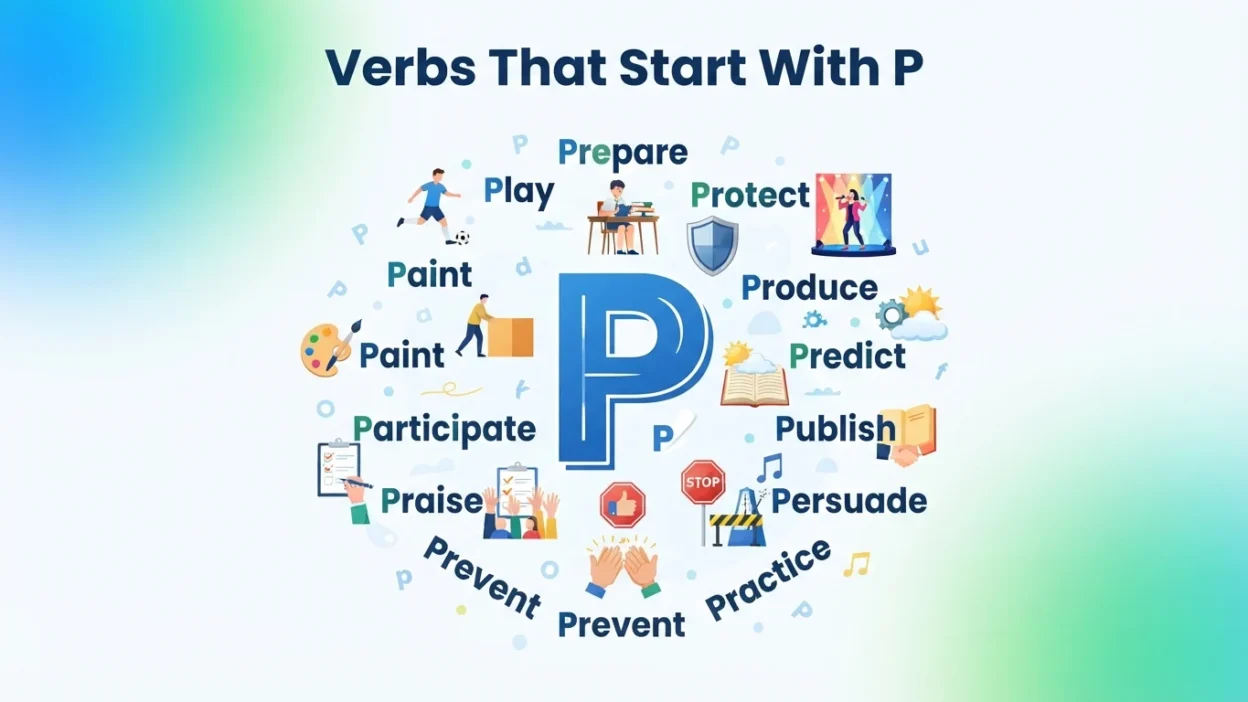
Examples include:
- Play
- Paint
- Prepare
- Prevent
- Protect
- Perform
- Publish
- Predict
- Produce
- Persuade
These verbs appear in nearly every form of English communication.
Main Comparison Table of Common Verbs That Start With P
| Verb | Meaning | Example | Common Use |
|---|---|---|---|
| Play | Take part in a game or activity | Children play outside. | Daily conversation |
| Paint | Apply color | She painted the wall. | Art |
| Prepare | Get ready | We prepared for the exam. | Education |
| Protect | Keep safe | Helmets protect riders. | Safety |
| Perform | Carry out | The surgeon performed the operation. | Business & Healthcare |
| Produce | Create or manufacture | The factory produces cars. | Manufacturing |
| Prevent | Stop something | Vaccines prevent disease. | Medicine |
| Predict | Say what will happen | Scientists predict rain. | Science |
| Persuade | Convince someone | She persuaded him to join. | Marketing |
| Publish | Make public | The author published a book. | Media |
Complete List of Verbs That Start With P
Here are over 250 commonly used verbs beginning with P:
Pack, Paddle, Paint, Pair, Panic, Parade, Pardon, Park, Participate, Pass, Paste, Patrol, Pause, Pay, Peel, Peek, Peer, Perform, Permit, Persuade, Phone, Photograph, Pick, Pin, Pinch, Pioneer, Pitch, Place, Plan, Plant, Play, Plead, Please, Pledge, Plug, Point, Polish, Pop, Pose, Possess, Post, Pour, Practice, Praise, Pray, Predict, Prefer, Prepare, Present, Preserve, Press, Pretend, Prevent, Print, Produce, Program, Progress, Promise, Promote, Pronounce, Proofread, Propose, Protect, Protest, Provide, Publish, Pull, Pump, Punch, Punish, Purchase, Pursue, Push, Put, Puzzle, Pack up, Pay off, Pass on, Pass through, Pull over, Pick up, Put away, Put off, Put together, Put up, Pay back, Plug in, Point out, Play around, Play along, Play down, Participate in, Prepare for, Prevent from, Produce for, Protect against, Progress through, Promote to, Publish online, and many more.
Meanings of Popular Verbs That Start With P
Play
Meaning: To engage in games, sports, or entertainment.
Examples:
- The children play football every evening.
- She plays the piano beautifully.
Prepare
Meaning: To make ready.
Examples:
- We prepared dinner.
- Students prepare for exams.
Protect
Meaning: To keep safe from danger.
Examples:
- Sunscreen protects your skin.
- Laws protect consumers.
Perform
Meaning: To carry out or complete.
Examples:
- Employees perform daily tasks.
- The singer performed live.
Produce
Meaning: To create or manufacture.
Examples:
- Farmers produce wheat.
- Companies produce software.
Prevent
Meaning: To stop something from happening.
Examples:
- Exercise prevents illness.
- Good planning prevents mistakes.
Persuade
Meaning: To convince someone.
Examples:
- She persuaded her friend.
- The advertisement persuaded customers.
Predict
Meaning: To forecast future events.
Examples:
- Experts predict economic growth.
- Meteorologists predict rain.
Publish
Meaning: To make available publicly.
Examples:
- The company published a report.
- She published her novel.
Praise
Meaning: To express approval.
Examples:
- Teachers praise hard work.
- Parents praised their child.
Grammar Forms of Common P Verbs
| Base Verb | Past Tense | Past Participle | Present Participle |
|---|---|---|---|
| Play | Played | Played | Playing |
| Prepare | Prepared | Prepared | Preparing |
| Protect | Protected | Protected | Protecting |
| Perform | Performed | Performed | Performing |
| Produce | Produced | Produced | Producing |
| Prevent | Prevented | Prevented | Preventing |
| Predict | Predicted | Predicted | Predicting |
| Publish | Published | Published | Publishing |
| Praise | Praised | Praised | Praising |
| Persuade | Persuaded | Persuaded | Persuading |
Real Life Examples of Verbs That Start With P
Business
- Managers plan quarterly goals.
- Companies promote new products.
- Teams prepare reports.
- Employees perform assigned duties.
Education
- Students practice mathematics.
- Teachers praise improvement.
- Schools provide resources.
- Learners participate in discussions.
Science
- Researchers predict climate changes.
- Scientists publish studies.
- Laboratories perform experiments.
- Engineers produce prototypes.
Healthcare
- Doctors prescribe medicine.
- Nurses protect patients.
- Hospitals prevent infections.
- Specialists perform surgery.
Technology
- Developers program applications.
- Designers prototype websites.
- Companies publish software updates.
- Users protect personal data.
Industry Usage Table
| Industry | Common P Verbs | Example |
|---|---|---|
| Business | Plan, Promote, Produce | Plan a marketing campaign |
| Education | Practice, Participate | Participate in class |
| Healthcare | Protect, Prevent, Perform | Perform surgery |
| Technology | Program, Publish | Publish software |
| Manufacturing | Produce, Package | Produce goods |
| Agriculture | Plant, Produce | Plant vegetables |
| Media | Publish, Present | Present news |
| Sales | Persuade, Promote | Persuade customers |
How to Choose the Right P Verb
| Situation | Best Verb | Example |
|---|---|---|
| Getting ready | Prepare | Prepare documents |
| Convincing people | Persuade | Persuade clients |
| Keeping safe | Protect | Protect information |
| Making products | Produce | Produce furniture |
| Forecasting | Predict | Predict demand |
| Completing work | Perform | Perform duties |
| Sharing information | Publish | Publish findings |
| Stopping problems | Prevent | Prevent accidents |
Common Mistakes With Verbs That Start With P
Many English learners confuse similar verbs or use incorrect grammar.
| Incorrect | Correct | Reason |
|---|---|---|
| I am prepare dinner. | I am preparing dinner. | Continuous tense needs -ing |
| She prevent me. | She prevented me. | Past tense required |
| We publish yesterday. | We published yesterday. | Past action |
| He persuade me yesterday. | He persuaded me yesterday. | Past tense |
| They perform good. | They performed well. | Use adverb after verb |
Why People Confuse These Verbs
Several P verbs have similar meanings.
For example:
- Protect vs Prevent
- Protect = keep safe.
- Prevent = stop from happening.
- Produce vs Provide
- Produce = create.
- Provide = supply.
- Present vs Publish
- Present = show or deliver.
- Publish = officially release.
Understanding the context helps you choose the correct verb.
Memory Tricks to Remember P Verbs
| Verb | Easy Memory Trick |
|---|---|
| Prepare | Prepare before you begin |
| Protect | Protect means safety |
| Produce | Produce creates something |
| Prevent | Prevent stops problems |
| Persuade | Persuade changes minds |
| Predict | Predict means future |
| Publish | Publish shares publicly |
| Praise | Praise gives compliments |
Tips for Using Verbs That Start With P Effectively
- Match the verb to the situation.
- Learn verbs in sentences instead of isolated lists.
- Practice using new verbs daily.
- Read books and articles regularly.
- Use different P verbs in your writing for variety.
- Memorize commonly used phrasal verbs.
Examples in Everyday Sentences
- Please prepare the presentation before Friday.
- Parents should protect their children online.
- The factory produces thousands of cars annually.
- Scientists predict warmer temperatures this year.
- The teacher praised every student.
- We participated in the workshop.
- The company published its annual report.
- She performed exceptionally during the interview.
- Exercise helps prevent many diseases.
- The salesperson persuaded the customer to upgrade.
Advantages of Learning Verbs That Start With P
- Improves writing quality.
- Expands vocabulary.
- Enhances speaking confidence.
- Makes communication clearer.
- Helps in competitive exams.
- Supports professional communication.
- Improves academic performance.
- Strengthens creative writing skills.
Frequently Asked Questions
What are verbs that start with P?
They are action or state words beginning with the letter P, such as play, prepare, protect, perform, and produce.
Which P verbs are most commonly used?
Some of the most common include play, prepare, protect, prevent, perform, produce, publish, persuade, predict, and praise.
Why should I learn verbs that start with P?
Learning them expands your vocabulary, improves writing, and helps you communicate more accurately in academic, business, and daily situations.
Are all P words verbs?
No. Many words beginning with P are nouns, adjectives, or adverbs. Only action or state words are verbs.
How can I remember new P verbs?
Practice them in complete sentences, group similar verbs together, and review them regularly through reading and writing.
Which P verbs are useful in business writing?
Common business verbs include prepare, plan, perform, produce, promote, persuade, present, publish, and provide.
Conclusion
Learning verbs that start with P is an excellent way to strengthen your English vocabulary and improve both spoken and written communication.
From everyday verbs like play and prepare to professional terms like perform, produce, publish, and persuade, these words help express actions clearly across business, education, science, healthcare, and daily life.
By understanding their meanings, grammar forms, and proper usage, you’ll write more confidently, avoid common mistakes, and communicate with greater precision.

Julian Wyatt is a passionate researcher and writer who explores symbols, mythology, cultural traditions, and hidden meanings. Through engaging articles, he helps readers uncover the fascinating stories and significance behind symbols worldwide.