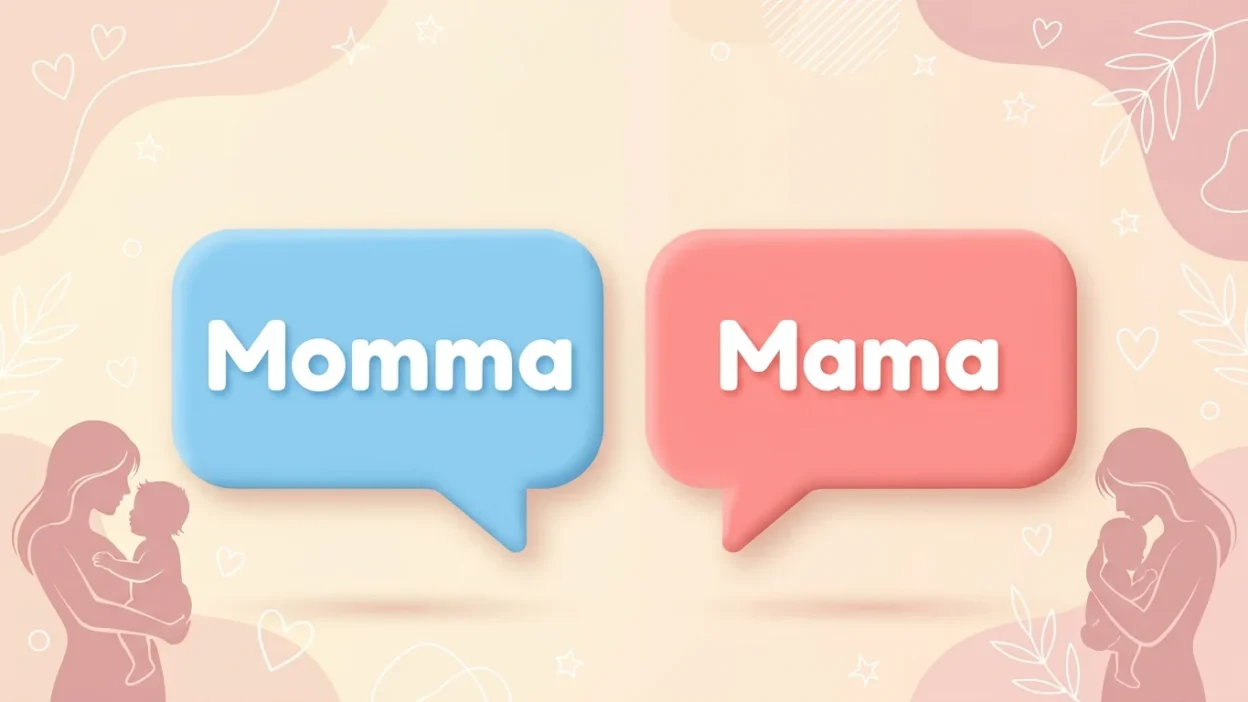
The debate over momma vs mama is common among English speakers, writers, and parents.
Although both words refer to a mother, they differ slightly in spelling, regional preference, and emotional tone.
Understanding momma vs mama helps you choose the right word for conversations, writing, greeting cards, books, social media, or creative content.
While neither spelling is grammatically incorrect, each has its own style and context.
Many people wonder whether momma vs mama has a correct or official form.
The answer depends on where you live, your family traditions, and the tone you want to convey.
This guide explains the meaning, differences, usage, grammar, examples, common mistakes, and practical tips so you can confidently decide which word fits your situation.
Quick Answer
Mama and momma both mean mother.
- Mama is the more widely recognized and traditional spelling.
- Momma is an affectionate, informal spelling that is especially common in American English, particularly in Southern dialects.
Momma vs Mama Comparison Table
| Feature | Mama | Momma |
|---|---|---|
| Meaning | Mother | Mother |
| Formality | Slightly more standard | Very informal |
| Common Regions | Worldwide | Mainly United States |
| Emotional Tone | Warm and affectionate | Very affectionate and casual |
| Dictionary Recognition | Common | Also recognized |
| Common in Literature | Yes | Yes |
What Does “Mama” Mean?
Mama is an affectionate word for mother. It is one of the earliest words many children learn because it is easy to pronounce.
The word appears in many languages and cultures around the world.
Examples
- Mama made my favorite dinner.
- I called my mama yesterday.
- The baby smiled at her mama.
What Does “Momma” Mean?
Momma is an informal spelling of mama. It carries the same meaning but often reflects regional speech or family traditions.
It is especially popular in the Southern United States and is commonly used in songs, stories, and everyday conversations.
Examples
- My momma always gives great advice.
- Momma baked fresh cookies.
- I miss my momma.
Key Differences Between Momma and Mama
| Mama | Momma |
|---|---|
| More traditional spelling | Informal spelling |
| Common internationally | Popular in American English |
| Used in books and education | Common in casual speech |
| Slightly more neutral | More emotional and affectionate |
| Suitable for most contexts | Best for informal contexts |
Is One More Correct Than the Other?
Neither spelling is incorrect.
Mama is generally considered the more standard spelling in dictionaries and educational materials.
Momma is accepted as an informal spelling and reflects pronunciation in many dialects.
Choose based on your audience and writing style.
Grammar and Part of Speech
Both mama and momma function as nouns.
| Word | Part of Speech | Example |
|---|---|---|
| Mama | Noun | My mama is kind. |
| Momma | Noun | Momma is making dinner. |
Neither word changes form for tense because they are nouns.
Real Life Examples
Family Conversations
- Mama, can you help me?
- Momma, I’m home!
Education
A child writing a school essay may write:
“My mama encourages me every day.”
In creative writing, an author may write:
“My momma believed I could achieve anything.”
Business
Although these words are uncommon in professional communication, they may appear in marketing aimed at parents.
Example:
“Our products are designed for every mama.”
Literature
Authors often choose momma when they want dialogue to sound warm, authentic, or regional.
Industry Usage Table
| Industry | Preferred Word | Example |
|---|---|---|
| Education | Mama | Children’s reading books |
| Literature | Mama or Momma | Character dialogue |
| Marketing | Mama | Parenting campaigns |
| Entertainment | Momma | Songs and movies |
| Social Media | Both | Personal captions |
| Greeting Cards | Both | Mother’s Day messages |
Why People Confuse Momma vs Mama
There are several reasons people confuse these spellings.
- They sound almost identical.
- Both refer to a mother.
- Different regions prefer different spellings.
- Movies and songs often use momma.
- Children’s books frequently use mama.
Because pronunciation is similar, many people assume one spelling is incorrect when both are acceptable.
Common Mistakes
| Incorrect Assumption | Correct Explanation |
|---|---|
| Momma is wrong. | Momma is an accepted informal spelling. |
| Mama is only for children. | Adults also commonly use mama. |
| Only one spelling is correct. | Both are correct depending on context. |
| Momma is a grammar mistake. | It is an informal spelling choice. |
Correct vs Incorrect Sentences
| Incorrect | Correct |
|---|---|
| Momma is the only correct spelling. | Both mama and momma are correct. |
| Mama is always formal. | Mama is affectionate but more standard. |
| Never use momma in stories. | Momma works well in informal dialogue. |
| Momma cannot appear in books. | Many novels use momma naturally. |
Memory Tricks
Remember these simple tips.
Mama = More Universal
Think of mama as the spelling recognized around the world.
Momma = More Personal
The extra M in momma can remind you of more emotion and more affection.
Easy Rule
- Formal or neutral writing → Mama
- Casual, regional, or emotional writing → Momma
Comparison Table by Writing Context
| Writing Situation | Better Choice |
|---|---|
| School essay | Mama |
| Children’s book | Mama |
| Novel dialogue | Momma |
| Social media | Either |
| Greeting card | Either |
| Song lyrics | Often Momma |
How to Choose the Right Word
| Step | Question | Recommendation |
|---|---|---|
| 1 | Is your writing formal? | Use Mama |
| 2 | Is it personal or emotional? | Momma works well |
| 3 | Is regional speech important? | Choose Momma |
| 4 | Writing for an international audience? | Choose Mama |
| 5 | Unsure? | Mama is the safest option |
Usage Tips
- Stay consistent throughout your writing.
- Match the spelling to your audience.
- Use momma for authentic dialogue.
- Use mama for educational or general content.
- Remember that neither spelling is grammatically incorrect.
FAQs
Is momma or mama correct?
Both are correct. Mama is more standard, while momma is an informal variation.
Which spelling is more common?
Mama is generally more common worldwide, while momma is especially popular in American English.
Can I use momma in formal writing?
It is better to use mama or mother in formal writing unless you’re quoting dialogue.
Why do songs often use momma?
Songwriters often choose momma because it reflects natural speech and creates a warm, emotional tone.
Are mama and momma pronounced differently?
Usually no. Most speakers pronounce them very similarly.
Which should I use in a greeting card?
Either spelling works. Choose the one your family normally uses.
Conclusion
Understanding momma vs mama is simple once you know the difference.
Both words mean mother, but mama is generally the more standard and widely accepted spelling,
while momma is an affectionate, informal variation often associated with American English and regional speech. Neither is wrong, so the best choice depends on your audience, writing style, and personal preference.
If you’re writing a heartfelt message, a story, or everyday conversation, choosing the appropriate spelling will make your writing sound natural and meaningful.