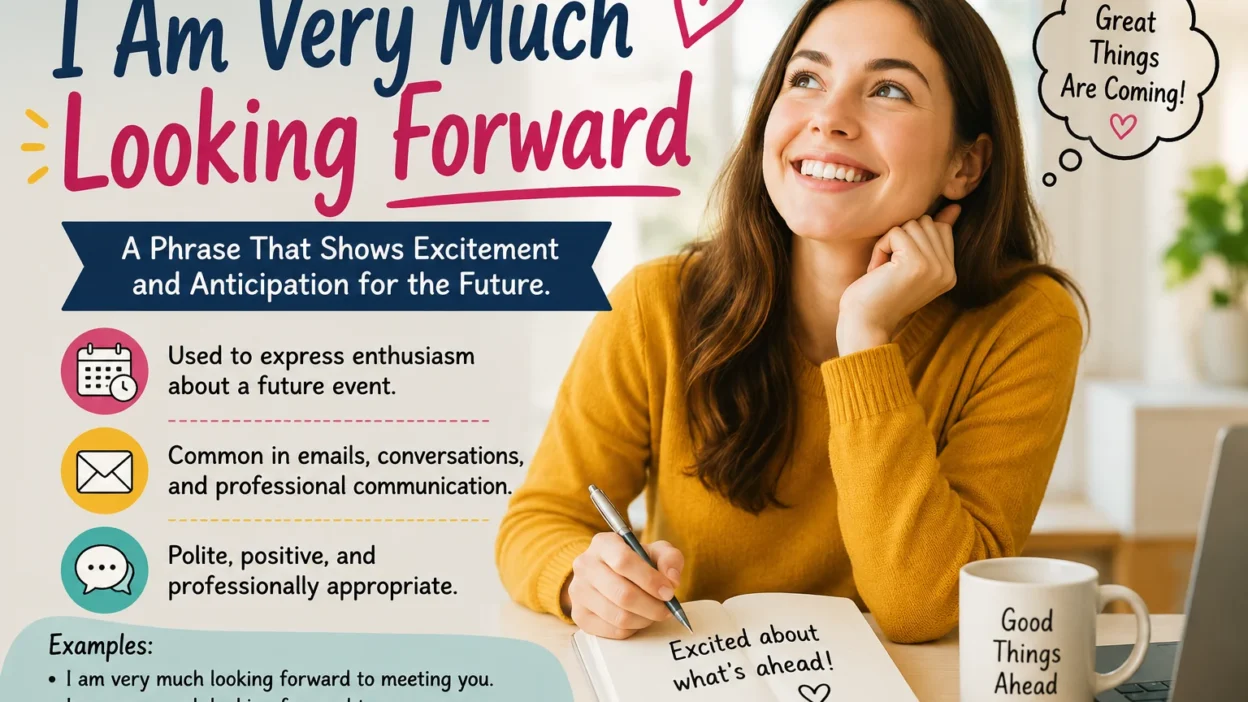
The phrase I am very much looking forward is a common English expression used to show excitement or anticipation about something that will happen in the future.
Many English learners wonder if this phrase is correct, if very much is necessary, or if simply saying I am looking forward sounds more natural.
Understanding I am very much looking forward can help you write more confident emails, messages, and professional communication.
In everyday conversation and formal writing, I am very much looking forward adds extra enthusiasm without changing the basic meaning of the sentence.
This guide explains the meaning, usage, grammar rules, examples, common mistakes, and professional applications of the phrase so you can use it naturally and correctly.
Quick Answer
I am very much looking forward is a grammatically correct phrase used to express strong excitement or anticipation about a future event.
It is more emphatic than I am looking forward, making it suitable for formal emails, business communication, and polite conversations.
What Does “I Am Very Much Looking Forward” Mean?
The expression I am very much looking forward means that you are eagerly waiting for or anticipating something in the future.
The words very much simply strengthen the feeling of excitement.
Examples:
- I am very much looking forward to meeting your team.
- I am very much looking forward to our vacation.
- I am very much looking forward to hearing from you.
Main Comparison Table
| Phrase | Meaning | Level of Enthusiasm | Common Usage |
|---|---|---|---|
| I am looking forward | Waiting with excitement | Moderate | Everyday conversation |
| I am very much looking forward | Waiting with strong excitement | High | Formal emails, speeches, business |
| I can’t wait | Extremely excited | Very High | Informal conversation |
| I’m excited about | Feeling happy about something | High | Casual and professional |
Is “I Am Very Much Looking Forward” Grammatically Correct?
Yes.
The phrase is completely correct because looking forward to is a fixed English expression.
Structure:
Subject + am/is/are + very much + looking forward to + noun/verb (-ing)
Examples:
- I am very much looking forward to the conference.
- She is very much looking forward to visiting London.
- We are very much looking forward to working together.
Grammar Structure Explained
The phrase follows the Present Continuous tense because looking forward to acts as an idiomatic expression rather than describing an ongoing action.
Grammar Formula
| Part | Example |
|---|---|
| Subject | I |
| Helping verb | am |
| Intensifier | very much |
| Expression | looking forward |
| Preposition | to |
| Object | your reply |
Example:
I am very much looking forward to your response.
Why Do People Use “Very Much”?
Adding very much makes the sentence sound warmer, more enthusiastic, and more sincere.
Compare these:
- I am looking forward to meeting you.
- I am very much looking forward to meeting you.
The second sentence expresses stronger anticipation.
I Am Looking Forward vs I Am Very Much Looking Forward
| Feature | I am looking forward | I am very much looking forward |
|---|---|---|
| Correct | Yes | Yes |
| Formal | Yes | Yes |
| Enthusiasm | Moderate | Strong |
| Professional emails | Excellent | Excellent |
| Friendly messages | Common | Common |
Both are correct.
Choose very much when you want to emphasize excitement.
When Should You Use This Phrase?
Use it when discussing future events.
Examples include:
- Job interviews
- Business meetings
- Vacations
- Family gatherings
- Graduation ceremonies
- Conferences
- School events
- Weddings
Real-Life Examples
Business
- I am very much looking forward to working with your company.
- We are very much looking forward to our partnership.
Education
- I am very much looking forward to starting university.
- Students are very much looking forward to graduation.
Science
- Researchers are very much looking forward to publishing the results.
- Scientists are very much looking forward to the next experiment.
Customer Service
- We are very much looking forward to serving you.
- Our team is very much looking forward to your visit.
Personal Life
- I am very much looking forward to seeing my grandparents.
- We are very much looking forward to the holidays.
Common Situations Where This Phrase Works Best
| Situation | Example |
|---|---|
| I am very much looking forward to your reply. | |
| Interview | I am very much looking forward to joining your team. |
| Travel | I am very much looking forward to visiting Japan. |
| Wedding | We are very much looking forward to celebrating with you. |
| Conference | I am very much looking forward to attending the event. |
| Meeting | I am very much looking forward to meeting everyone. |
Professional Usage
The phrase sounds polite, respectful, and professional.
It appears frequently in:
| Industry | Example |
|---|---|
| Business | I am very much looking forward to our collaboration. |
| Education | I am very much looking forward to the new semester. |
| Healthcare | We are very much looking forward to assisting you. |
| Government | We are very much looking forward to future cooperation. |
| Technology | Our developers are very much looking forward to launching the project. |
Common Mistakes
Many learners misuse looking forward to.
| Incorrect | Correct |
|---|---|
| I am very much looking forward see you. | I am very much looking forward to seeing you. |
| I very much am looking forward. | I am very much looking forward. |
| I look forward for meeting you. | I look forward to meeting you. |
| I am looking forward to meet you. | I am looking forward to meeting you. |
| I am looking forward your reply. | I am looking forward to your reply. |
Why People Get Confused
There are several reasons:
- They forget the preposition to.
- They use the infinitive instead of the -ing form.
- They think very much is incorrect.
- They confuse look forward with other phrasal verbs.
- They translate directly from another language.
Remember:
After looking forward to, always use:
- a noun
- a pronoun
- a verb ending in -ing
Memory Trick
A simple rule:
Looking Forward + To + ING
Think:
Forward → To → Doing
Examples:
- Looking forward to meeting
- Looking forward to seeing
- Looking forward to hearing
- Looking forward to working
Never say:
- Looking forward to meet ❌
Process for Using the Phrase Correctly
| Step | Action |
|---|---|
| 1 | Start with the subject |
| 2 | Add am/is/are |
| 3 | Add very much (optional) |
| 4 | Write looking forward |
| 5 | Add to |
| 6 | Finish with a noun or verb ending in -ing |
Example:
I → am → very much → looking forward → to → meeting you.
Similar Expressions
You can also say:
- I can’t wait.
- I eagerly await.
- I am excited about.
- I anticipate.
- I am delighted about.
- I am thrilled to.
Each has a slightly different tone, but all express anticipation.
Tips for Writing Better Emails
Professional examples:
- I am very much looking forward to your response.
- I am very much looking forward to meeting you next week.
- I am very much looking forward to discussing this opportunity.
- We are very much looking forward to working together.
These sentences sound polite and professional without being overly formal.
Frequently Asked Questions
Is “I am very much looking forward” correct?
Yes. It is grammatically correct and widely used in both formal and informal English.
Is “very much” necessary?
No. It is optional and simply adds extra emphasis and enthusiasm.
Can I use it in business emails?
Yes. It is commonly used in professional emails, meetings, and official correspondence.
Should I say “to meet” or “to meeting”?
Always use meeting because to is a preposition in this expression.
Correct: I am very much looking forward to meeting you.
Is it too formal?
No. It works well in both formal and everyday situations.
Conclusion
The phrase I am very much looking forward is a correct, polite, and natural way to express strong anticipation for a future event.
While I am looking forward is perfectly acceptable, adding very much emphasizes your enthusiasm without changing the grammar.
Remember the key rule: always follow looking forward to with a noun or a verb ending in -ing.
By mastering this simple structure, you’ll write clearer emails, sound more natural in conversations, and avoid one of the most common English grammar mistakes.