The phrase my question is alternatives is often by people who want to sound more natural or polite when asking questions in emails, meetings, , or everyday conversations.
While “my question is” is grammatically correct, using the same phrase repeatedly can make your communication sound repetitive.
Learning my question is alternatives helps you vary your language, improve your writing, and communicate more confidently.
if you’re speaking in a business meeting, writing an academic paper, or sending an email, choosing the right alternative makes your message clearer and more engaging.
Quick Answer
My question is” is a correct phrase used to introduce a question.
Some excellent alternatives include I’d like to ask, I was wondering, Can you clarify, Could you explain, May I ask, and Here’s my question, depending on the situation and level of formality.
What Does “My Question Is” Mean?
“My question is” is an introductory phrase used before asking something.
It signals to the listener that a question is coming.
Examples
- My question is: How long will the project take?
- My question is whether we need additional funding.
- My question is why the report was delayed.
It is grammatically correct and widely accepted in both spoken and written English.
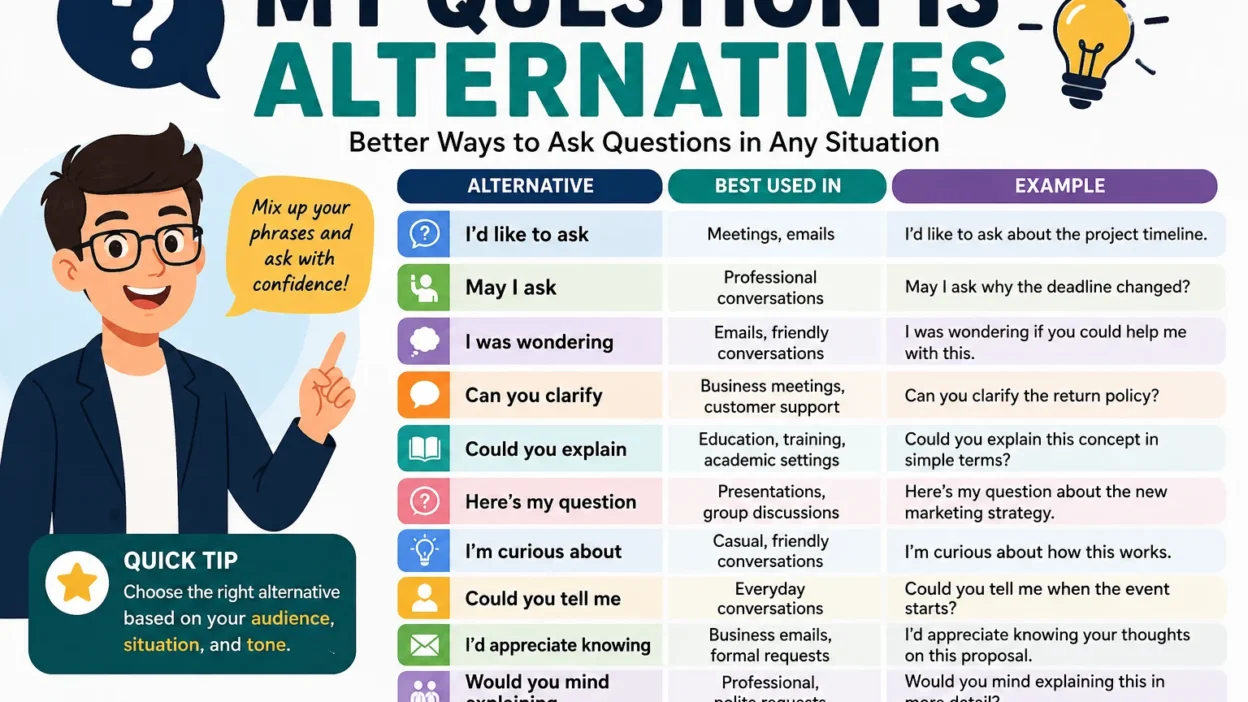
Best My Question Is Alternatives
The table below shows common alternatives and when to use them.
| Alternative | Formality | Best Used In |
|---|---|---|
| I’d like to ask | Neutral | Meetings, emails |
| May I ask | Formal | Professional conversations |
| I was wondering | Polite | Emails, customer service |
| Could you explain | Formal | Education, training |
| Can you clarify | Professional | Business meetings |
| Here’s my question | Casual | Presentations |
| I’m curious about | Casual | Friendly discussions |
| Could you tell me | Neutral | Everyday conversations |
| I’d appreciate knowing | Formal | Business emails |
| Would you mind explaining | Very polite | Professional settings |
| Could you elaborate | Formal | Academic discussions |
| Help me understand | Neutral | Coaching and training |
| What I’d like to know is | Neutral | Presentations |
| One thing I’m wondering is | Casual | Informal conversations |
| I have a question regarding | Formal | Business correspondence |
Difference Between “My Question Is” and Its Alternatives
Although all these phrases introduce questions, they create different tones.
| Phrase | Tone | Example |
|---|---|---|
| My question is | Direct | My question is: When does class begin? |
| I’d like to ask | Polite | I’d like to ask about your pricing. |
| Can you clarify | Professional | Can you clarify the policy? |
| I was wondering | Friendly | I was wondering if you’re available tomorrow. |
| May I ask | Respectful | May I ask why this changed? |
When Should You Use Each Alternative?
Choosing the right phrase depends on your audience.
| Situation | Recommended Alternative |
|---|---|
| Business meeting | I’d like to ask |
| Academic lecture | Could you explain |
| Customer support | Can you clarify |
| Job interview | May I ask |
| Presentation | Here’s my question |
| Casual conversation | I’m curious about |
| I was wondering |
Real-Life Examples
Business
Instead of:
My question is about the budget.
Say:
I’d like to ask about the budget allocation.
Education
Instead of:
My question is why this formula works.
Say:
Could you explain why this formula works?
Science
Instead of:
My question is about the experiment.
Say:
Can you clarify the experiment’s procedure?
Customer Service
Instead of:
My question is when my package will arrive.
Say:
I was wondering when my package will arrive.
Job Interview
Instead of:
My question is about promotion opportunities.
Say:
May I ask about career growth opportunities?
Professional Usage
Professionals often avoid repeating “my question is.”
Instead, they choose alternatives that sound smoother.
| Profession | Preferred Phrase |
|---|---|
| Teacher | Could you explain |
| Manager | I’d like to ask |
| Lawyer | May I ask |
| Doctor | Can you tell me |
| Customer Support | Could you clarify |
| Researcher | I’d like clarification on |
Grammar Forms
“My question is” can appear in different grammatical structures.
| Form | Example |
|---|---|
| Statement | My question is simple. |
| Before direct question | My question is: What caused this? |
| Before indirect question | My question is whether we should continue. |
| Formal writing | My question concerns the following issue. |
| Presentation | Here’s my question. |
Why Do People Search for My Question Is Alternatives?
There are several reasons.
- They want to sound more professional.
- They repeat “my question is” too often.
- They need better wording for emails.
- They want more polite expressions.
- They are preparing presentations.
- They want stronger interview communication.
Memory Trick
Think of this simple rule:
Direct → “My question is.”
Polite → “I’d like to ask.”
Formal → “May I ask.”
Friendly → “I was wondering.”
Remembering the tone first makes choosing the right alternative much easier.
Common Mistakes
Many learners use awkward or repetitive expressions.
| Incorrect | Correct |
|---|---|
| My question is can you help? | My question is: Can you help? |
| My question are | My question is |
| I have one question that is can you explain | My question is: Can you explain? |
| My asking is | My question is |
| My question is about that what happened | My question is: What happened? |
Correct Examples
- I’d like to ask about the schedule.
- Could you explain this concept?
- May I ask another question?
- I was wondering if you could help.
- Can you clarify this point?
Comparison Table of Common Alternatives
| Expression | Formal | Polite | Business | Academic | Casual |
|---|---|---|---|---|---|
| My question is | ✔ | ✔ | ✔ | ✔ | ✔ |
| I’d like to ask | ✔ | ✔ | ✔ | ✔ | ✔ |
| Can you clarify | ✔ | ✔ | ✔ | ✔ | ✘ |
| I was wondering | ✔ | ✔ | ✔ | ✘ | ✔ |
| Here’s my question | ✘ | ✔ | ✔ | ✔ | ✔ |
| Could you explain | ✔ | ✔ | ✔ | ✔ | ✘ |
| May I ask | ✔ | ✔ | ✔ | ✔ | ✔ |
Process for Choosing the Right Alternative
| Step | Action |
|---|---|
| 1 | Identify your audience. |
| 2 | Decide whether the situation is formal or casual. |
| 3 | Choose a polite alternative if needed. |
| 4 | Keep your question short and clear. |
| 5 | Review the tone before sending or speaking. |
People Also Ask
Is “my question is” grammatically correct?
Yes. It is completely correct and commonly used in English.
What is the most professional alternative?
“I’d like to ask” and “May I ask” are among the most professional options.
Is “I was wondering” more polite?
Yes. It sounds softer and less direct than “my question is.”
Can I use “my question is” in emails?
Absolutely. However, varying your wording can make your email sound more natural.
What is the best alternative for presentations?
“Here’s my question” and “I’d like to ask” work especially well during presentations.
FAQs
What is another way to say “my question is”?
You can say I’d like to ask, May I ask, Can you clarify, or I was wondering.
Which alternative is best for business emails?
“I’d like to ask” is clear, professional, and widely accepted.
Is “my question is” too formal?
No. It is neutral and appropriate for most situations.
Should I avoid repeating “my question is”?
Yes. Using different alternatives makes your writing more engaging and natural.
Which phrase sounds the most polite?
I was wondering” and “Would you mind explaining” are among the politest options.
Conclusion
Understanding my question is alternatives helps you communicate more naturally in professional, academic, and everyday situations.
While my question is remains grammatically correct and useful, varying your wording with alternatives like I’d like to ask, May I ask, Can you clarify, and I was improves clarity and tone.
Choose your expression based on the audience and context, and you’ll ask questions more confidently and effectively.