Many English learners confuse imitated vs intimated because the two words look and sound somewhat similar.
However, they have completely different meanings and are used in different situations. Understanding imitated vs intimated is important for writing clearly in academic, business, and everyday communication.
The confusion often happens because both words end with ated, but they come from different verbs.
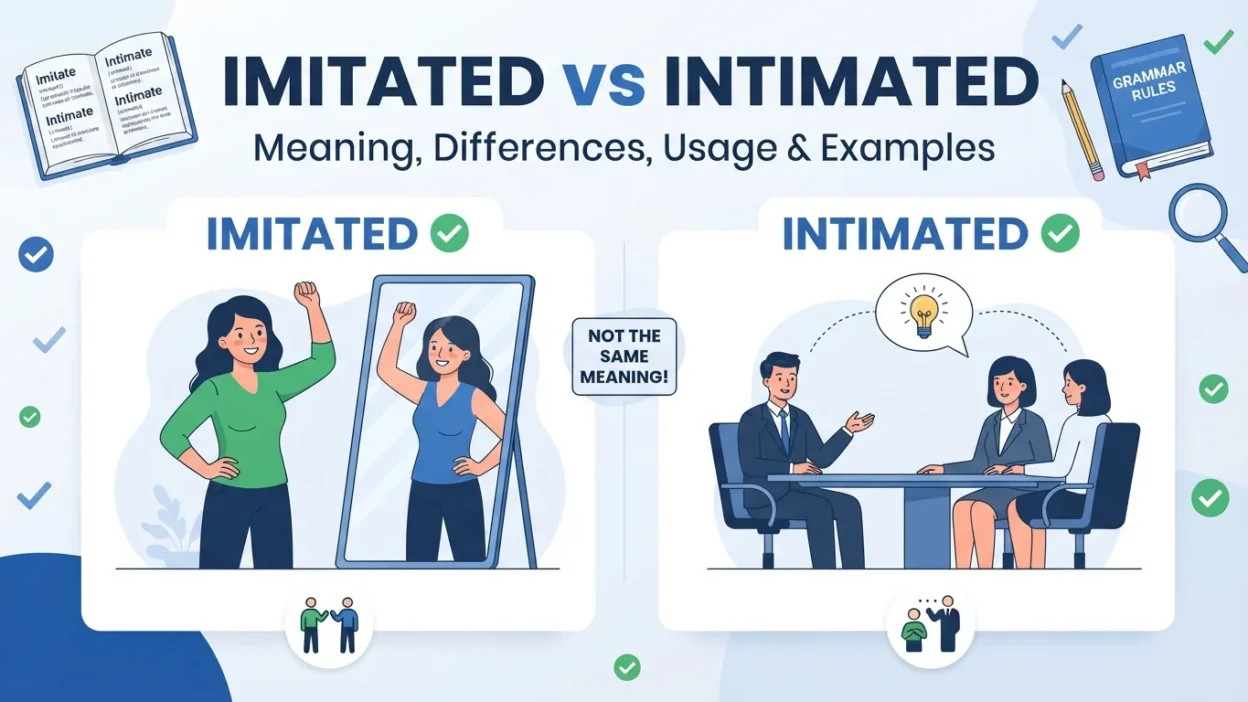
Imitated means copied or reproduced, while intimated means hinted or suggested indirectly.
This guide explains imitated vs intimated with simple definitions, grammar rules, examples, comparison tables, and practical usage tips so you can choose the correct word every time.
Quick Answer
- Imitated means copied or mimicked someone or something.
- Intimated means hinted, implied, or suggested indirectly.
- Although they look alike, they have different meanings and are never interchangeable.
Imitated vs Intimated Comparison Table
| Feature | Imitated | Intimated |
|---|---|---|
| Meaning | Copied or mimicked | Hinted or suggested indirectly |
| Base verb | Imitate | Intimate |
| Part of speech | Past tense/Past participle verb | Past tense/Past participle verb |
| Common usage | Behavior, art, speech, design | Communication, writing, formal speech |
| Interchangeable | ❌ No | ❌ No |
| Standard English | ✅ Yes | ✅ Yes |
What Does “Imitated” Mean?
Imitated is the past tense and past participle of imitate.
It means to copy someone’s actions, appearance, behavior, voice, style, or work.
Examples
- The child imitated her teacher.
- The actor imitated the president’s voice.
- Designers imitated the latest fashion trends.
- Scientists imitated natural processes to create new materials.
What Does “Intimated” Mean?
Intimated is the past tense and past participle of intimate (verb).
It means to suggest, hint, or communicate something indirectly rather than stating it openly.
Examples
- The manager intimated that promotions were coming.
- She intimated her disagreement without arguing.
- The report intimated possible financial problems.
- He intimated that he might resign next year.
Main Difference Between Imitated vs Intimated
The key difference is their meaning.
| Aspect | Imitated | Intimated |
|---|---|---|
| Action | Copying | Hinting |
| Purpose | Reproduce behavior or appearance | Suggest information indirectly |
| Common contexts | Education, acting, art | Business, law, formal communication |
| Direct or indirect | Direct copying | Indirect communication |
Simply put:
- Imitated = copied
- Intimated = hinted
Grammar Forms
| Word | Base Form | Past Tense | Past Participle | Present Participle |
|---|---|---|---|---|
| Imitate | imitate | imitated | imitated | imitating |
| Intimate (verb) | intimate | intimated | intimated | intimating |
When Should You Use “Imitated”?
Use imitated whenever someone copies another person’s:
- behavior
- speech
- appearance
- movements
- artistic style
- writing style
Examples
- Students imitated the experiment.
- The comedian imitated famous celebrities.
- Birds imitated human sounds.
When Should You Use “Intimated”?
Use intimated when someone gives information indirectly.
Examples
- The CEO intimated future organizational changes.
- The witness intimated that more evidence existed.
- The professor intimated that the exam would be difficult.
Real-Life Examples
Business
- The company intimated plans for international expansion.
- Competitors imitated the firm’s marketing strategy.
Education
- Students imitated the teacher’s pronunciation.
- The principal intimated that new policies would be introduced.
Science
- Engineers imitated bird wings to improve aircraft design.
- Researchers intimated that more studies were necessary.
Entertainment
- The comedian imitated famous actors.
- The director intimated that a sequel was under development.
Industry Usage Table
| Industry | Imitated | Intimated |
|---|---|---|
| Business | Copying strategies | Hinting future plans |
| Education | Mimicking pronunciation | Suggesting policy changes |
| Law | Copying signatures | Indirect legal statements |
| Journalism | Copying interview style | Hinting at future events |
| Marketing | Imitated branding styles | Intimated product launches |
| Science | Biomimicry | Suggesting research conclusions |
Why People Confuse Imitated and Intimated
Several factors contribute to the confusion:
- Both end with -ated.
- Their spellings look similar.
- Both are past-tense verbs.
- They are uncommon compared to everyday verbs.
- Readers may skim over the middle letters.
Despite the similarity in appearance, their meanings are entirely different.
Memory Trick
A simple way to remember the difference:
- Imitated → I = Imitate = Copy
- Intimated → Hint = Intimated = Suggested
Another trick:
- Imitated involves actions.
- Intimated involves communication.
Common Mistakes
| Incorrect Sentence | Correct Sentence |
|---|---|
| She intimated her teacher’s accent. | She imitated her teacher’s accent. |
| He imitated that layoffs were coming. | He intimated that layoffs were coming. |
| The actor intimated the singer perfectly. | The actor imitated the singer perfectly. |
| The report imitated financial problems. | The report intimated financial problems. |
Choosing the Correct Word
| Question | Use |
|---|---|
| Is someone copying another person? | Imitated |
| Is someone mimicking speech? | Imitated |
| Is someone giving a hint? | Intimated |
| Is the message indirect? | Intimated |
| Is behavior being copied? | Imitated |
Professional Writing Tips
Academic Writing
Use imitated when discussing copied methods or behaviors.
Business Communication
Use intimated when describing indirect announcements or suggestions.
Journalism
Use intimated carefully to indicate that someone hinted rather than stated something directly.
Creative Writing
Use imitated for characters copying voices, gestures, or personalities.
Frequently Asked Questions
Is “imitated” the same as “intimated”?
No. Imitated means copied, while intimated means hinted or suggested indirectly.
Can I use them interchangeably?
No. Their meanings are completely different.
Is “intimated” a common word?
It is less common than imitated and appears mainly in formal writing, business, legal, and literary contexts.
What is the easiest way to remember the difference?
Remember:
- Imitated = copied
- Intimated = hinted
Is “imitated” used in science?
Yes. Scientists often describe designs inspired by nature as imitated natural systems.
Is “intimated” formal?
Yes. It is mainly used in formal speech and writing.
Conclusion
Understanding imitated vs intimated is easier once you focus on their meanings. Imitated refers to copying someone’s behavior, appearance, voice, or style, while intimated means hinting or suggesting something indirectly without saying it openly.
Although the words look similar, they serve completely different purposes and should never be used interchangeably. By remembering that imitated means copied and intimated means hinted, you can communicate more accurately in academic, professional, and everyday English.

Julian Wyatt is a passionate researcher and writer who explores symbols, mythology, cultural traditions, and hidden meanings. Through engaging articles, he helps readers uncover the fascinating stories and significance behind symbols worldwide.