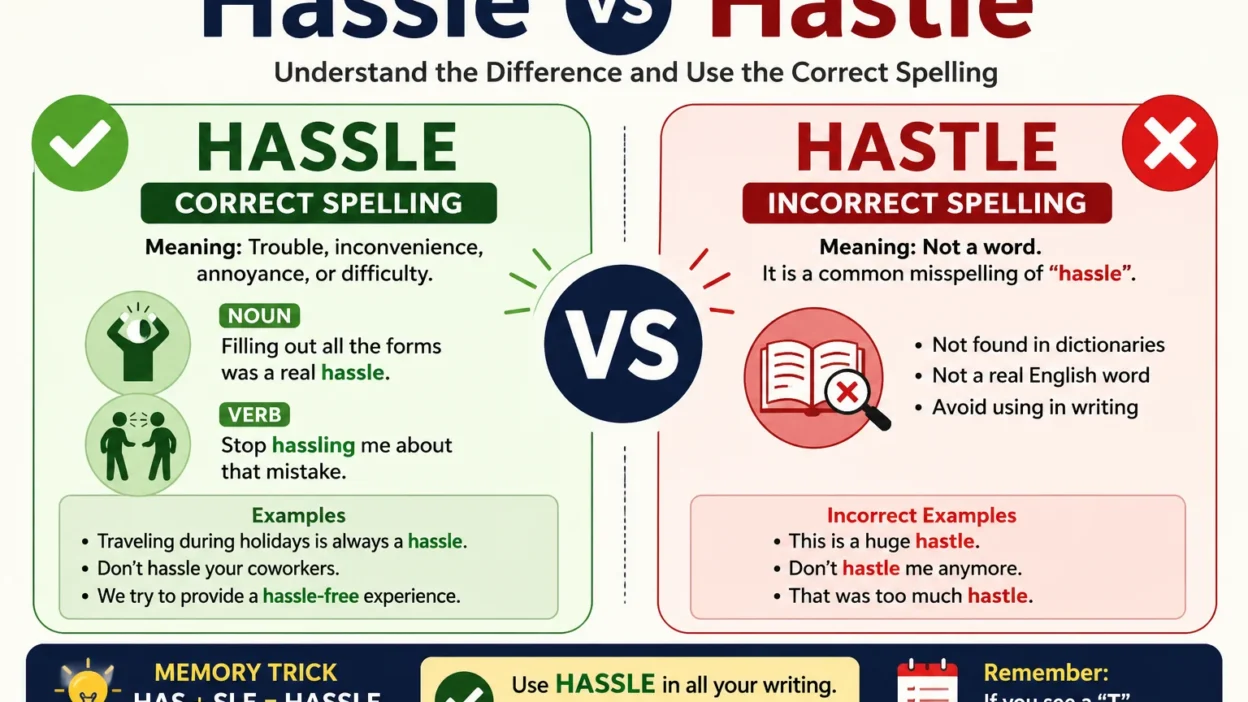
Many English learners and even native speakers get confused about hassle vs hastle because the two words look almost identical.
One spelling is correct and widely accepted, while the other is simply a common misspelling.
Understanding the difference between hassle vs hastle can help you write more accurately in school, work, and everyday communication.
If you’ve ever wondered whether you should write hassle or hastle, you’re not alone.
This guide explains the meaning, correct spelling, pronunciation, examples, grammar, and common mistakes so you’ll never confuse hassle vs hastle again.
Quick Answer
Hassle is the correct English word. It means trouble, inconvenience, annoyance, or difficulty.
Hastle is not a standard English word. It is simply a misspelling of hassle and should be avoided in formal and informal writing.
Hassle vs Hastle Comparison Table
| Feature | Hassle | Hastle |
|---|---|---|
| Correct spelling | ✅ Yes | ❌ No |
| Dictionary word | Yes | No |
| Meaning | Trouble, inconvenience, annoyance | None |
| Part of speech | Noun, Verb | Not recognized |
| Used in formal writing | Yes | No |
| Used in everyday English | Yes | No |
What Does Hassle Mean?
The word hassle refers to a problem, inconvenience, annoyance, or unnecessary difficulty. It can also be used as a verb meaning to bother or repeatedly trouble someone.
As a noun
Meaning: A difficult or annoying situation.
Examples:
- Traveling during holidays is always a hassle.
- Parking downtown can be a real hassle.
- Filling out paperwork took more time than expected.
As a verb
Meaning: To annoy, pressure, or bother someone.
Examples:
- Please don’t hassle your coworkers over small mistakes.
- The customer kept hassling the support team.
What Does Hastle Mean?
Hastle has no official meaning in English.
It does not appear as a standard word in major dictionaries. Whenever you see hastle, it is almost always a typing or spelling mistake for hassle.
Example:
❌ The move was a huge hastle.
✅ The move was a huge hassle.
Main Difference Between Hassle and Hastle
| Feature | Hassle | Hastle |
|---|---|---|
| Is it a real word? | Yes | No |
| Correct English spelling | Yes | No |
| Accepted by dictionaries | Yes | No |
| Should you use it? | Always | Never |
| Grammar checks | Accept | Flag as error |
Pronunciation
| Word | Pronunciation | Sounds Like |
|---|---|---|
| Hassle | HAS-uhl | HASS-ul |
| Hastle | Not applicable | Incorrect spelling |
Even though people sometimes accidentally write hastle, they still pronounce it exactly like hassle.
Grammar Forms of Hassle
| Form | Example |
|---|---|
| Noun | What a hassle! |
| Verb | Stop hassling me. |
| Singular | hassle |
| Plural | hassles |
| Present participle | hassling |
| Past tense | hassled |
| Past participle | hassled |
Why Do People Confuse Hassle and Hastle?
Several reasons explain why this mistake is so common.
Similar pronunciation
People hear the word correctly but accidentally insert an extra t while spelling it.
Fast typing
Typing quickly often leads to common spelling mistakes.
Lack of familiarity
Many people use the word frequently in speech but rarely write it.
Autocorrect issues
Sometimes mobile keyboards fail to correct the misspelling immediately.
Real-Life Examples of Hassle
Business
- Managing paper invoices became less of a hassle after automation.
- Remote meetings reduced travel hassles.
Education
- Registering for classes online saved students a lot of hassle.
- Printing assignments every week became a hassle.
Science
- Automated laboratory systems reduce the hassle of repetitive testing.
- Digital record keeping minimizes administrative hassles.
Everyday Life
- Grocery shopping during rush hour is a hassle.
- Carrying heavy luggage through the airport was a hassle.
Industry Usage Table
| Industry | Example Sentence |
|---|---|
| Business | Digital tools reduce paperwork hassle. |
| Healthcare | Online appointments reduce patient hassle. |
| Education | Learning platforms remove scheduling hassles. |
| Retail | Easy returns reduce customer hassle. |
| Technology | Software updates eliminate setup hassles. |
| Travel | Mobile boarding passes reduce airport hassle. |
Hassle in Common Expressions
These expressions are widely used in English.
| Expression | Meaning |
|---|---|
| No hassle | Easy and convenient |
| Without hassle | Smoothly and easily |
| Save the hassle | Avoid unnecessary trouble |
| Worth the hassle | Worth the effort despite difficulty |
| Too much hassle | More trouble than it’s worth |
Examples:
- We offer hassle-free returns.
- The online form saved everyone the hassle.
- It’s worth the hassle if the results are excellent.
Common Mistakes
| Incorrect | Correct |
|---|---|
| This is a hastle. | This is a hassle. |
| Don’t hastle me. | Don’t hassle me. |
| What a huge hastle. | What a huge hassle. |
| Hassel | Hassle |
| Hastal | Hassle |
Correct vs Incorrect Sentences
❌ Booking tickets was a hastle.
✅ Booking tickets was a hassle.
❌ Stop hastling your brother.
✅ Stop hassling your brother.
❌ That was too much hastle.
✅ That was too much hassle.
Memory Trick to Remember the Correct Spelling
A simple trick is to remember:
HAS + SLE = HASSLE
Notice there is double “s” and no “t.”
If you see a t in the middle, it’s almost certainly spelled incorrectly.
When Should You Use Hassle?
Use hassle whenever you want to describe:
- Problems
- Difficulties
- Annoyances
- Inconvenience
- Repeated bothering
Examples:
- The repair process was a hassle.
- We want to make shopping hassle-free.
- Stop hassling your classmates.
- It wasn’t worth the hassle.
- Online banking removes unnecessary hassles.
Editing Checklist
| Question | Answer |
|---|---|
| Is the word spelled hassle? | ✅ Yes |
| Did you accidentally add a “t”? | ❌ Remove it |
| Is the word recognized in dictionaries? | Hassle only |
| Is it appropriate in formal writing? | Yes |
| Does spell-check approve it? | Yes |
Frequently Asked Questions
Is hassle or hastle correct?
Hassle is correct. Hastle is an incorrect spelling.
Is hastle in the dictionary?
No. Standard English dictionaries do not recognize hastle as a valid word.
Can hassle be used as both a noun and a verb?
Yes. It can describe a problem (noun) or mean to bother someone (verb).
Why do people write hastle?
Most people accidentally insert the letter t because of pronunciation or typing habits.
What does hassle-free mean?
“Hassle-free” means easy, convenient, and without unnecessary problems.
Conclusion
Understanding hassle vs hastle is simple once you know the spelling rule. Hassle is the only correct English word and means trouble, inconvenience, or annoyance.
It can also function as a verb meaning to bother someone repeatedly. Hastle, on the other hand, is merely a common misspelling and should never be used in professional, academic, or everyday writing.