Many writers wonder whether companywide vs company wide is the correct spelling in business communication.
Since both versions appear online and in workplace documents, it’s easy to become confused.
Knowing when to use each form can make your writing look more professional and grammatically accurate.
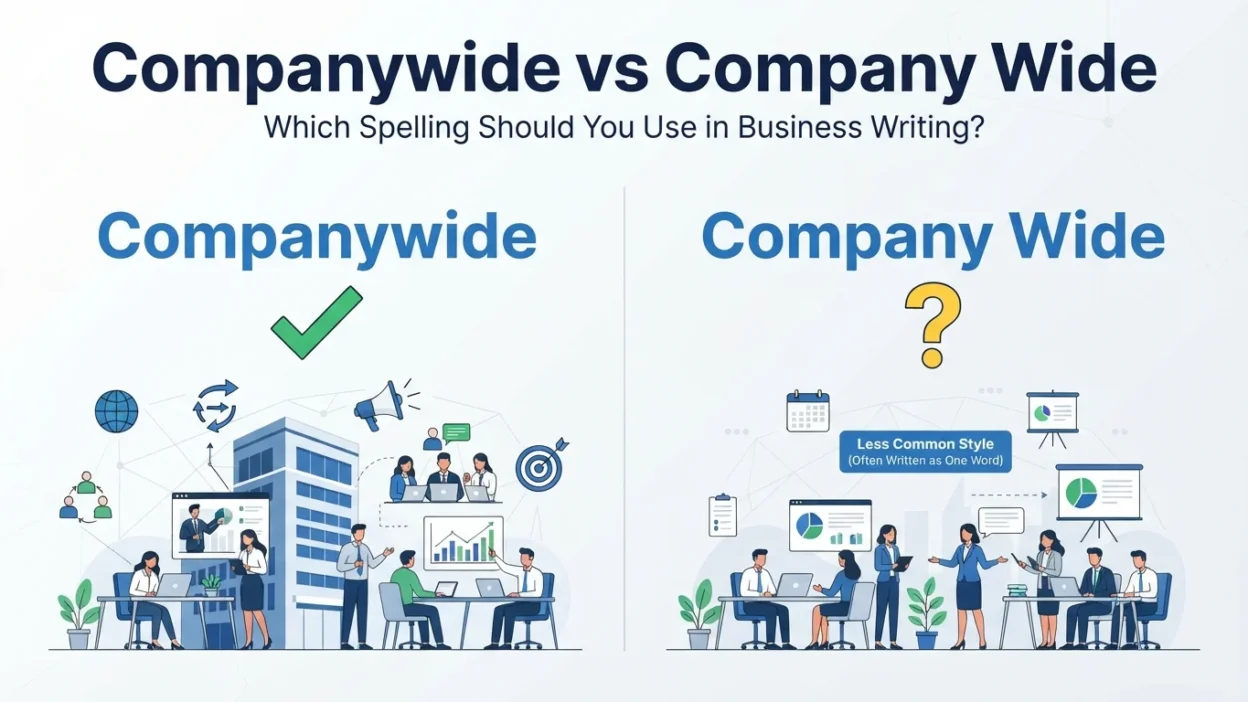
In modern English, companywide vs company wide is mainly a style choice, but one version is far more common in business writing.
This guide explains the meaning, spelling differences, grammar rules, examples, and best usage practices so you can confidently choose the correct form in emails, reports, policies, and official documents.
Quick Answer
Companywide (one word) is the preferred and most widely accepted spelling in modern English.
Company wide (two words) is less common but may appear in older writing or when following a specific style guide. For consistency, most organizations use companywide.
Companywide vs Company Wide: Comparison Table
| Feature | Companywide | Company Wide |
|---|---|---|
| Spelling | One word | Two words |
| Modern usage | Preferred | Less common |
| Business writing | Recommended | Occasionally used |
| Dictionaries | Commonly listed | Sometimes accepted |
| Professional appearance | More polished | Acceptable in some contexts |
What Does Companywide Mean?
Companywide is an adjective meaning throughout an entire company or affecting every department, office, or employee.
It describes something that applies to the whole organization rather than one team or location.
Examples
- The CEO announced a companywide meeting.
- We introduced a companywide safety policy.
- Employees received a companywide email.
- The organization launched a companywide training program.
What Does Company Wide Mean?
Company wide has the same meaning as companywide, but it is written as two separate words.
Although some publications still use this spelling, many modern style guides and businesses prefer the closed compound form companywide.
Examples
- The company wide celebration was successful.
- A company wide policy was introduced.
Many editors would revise these to:
- The companywide celebration was successful.
- A companywide policy was introduced.
Companywide vs Company Wide: The Main Difference
The primary difference is spelling rather than meaning.
| Feature | Companywide | Company Wide |
|---|---|---|
| Meaning | Entire company | Entire company |
| Grammar | Compound adjective | Open compound adjective |
| Preferred today | Yes | Less often |
| Common in business | Very common | Sometimes |
Both communicate the same idea, but companywide is generally considered the standard modern form.
Why Is Companywide More Common?
English often combines frequently used word pairs into a single compound word over time.
Examples include:
- Nationwide
- Worldwide
- Statewide
- Systemwide
- Schoolwide
Similarly, companywide has become the preferred spelling because it is concise and consistent with other compound adjectives.
Grammar Forms
| Form | Part of Speech | Example |
|---|---|---|
| Company | Noun | The company hired new staff. |
| Wide | Adjective | The road is wide. |
| Companywide | Compound adjective | Companywide training begins Monday. |
| Company wide | Open compound adjective | Company wide policies were updated. |
In most professional writing, the compound adjective companywide is preferred.
When Should You Use Companywide?
Use companywide whenever you’re referring to something that affects the entire organization.
Examples
- Companywide bonus program
- Companywide announcement
- Companywide policy
- Companywide software upgrade
- Companywide survey
- Companywide performance review
These expressions are common in business documents and corporate communication.
Real-Life Examples in Different Contexts
Business
- A companywide restructuring improved efficiency.
- The HR department introduced a companywide wellness initiative.
Education
- The private education company implemented a companywide curriculum update.
- A companywide learning platform improved employee development.
Healthcare
- The healthcare organization adopted companywide safety standards.
- Employees completed companywide compliance training.
Technology
- Engineers completed a companywide software migration.
- IT launched a companywide cybersecurity program.
Retail
- Stores participated in a companywide holiday sale.
- Management issued a companywide pricing update.
Industry Usage Table
| Industry | Preferred Form | Example |
|---|---|---|
| Corporate | Companywide | Companywide policy |
| Healthcare | Companywide | Companywide compliance training |
| Technology | Companywide | Companywide software rollout |
| Finance | Companywide | Companywide audit |
| Manufacturing | Companywide | Companywide quality standards |
| Retail | Companywide | Companywide promotion |
Across industries, companywide is the preferred choice.
Companywide vs Company Wide in Style Guides
Different publishers may have different preferences, but many modern style guides and corporate writing manuals favor companywide.
| Writing Style | Preferred Form |
|---|---|
| Business writing | Companywide |
| Corporate emails | Companywide |
| Employee handbooks | Companywide |
| Internal policies | Companywide |
| Older publications | Company wide (sometimes) |
If your organization has a style guide, always follow it for consistency.
Why People Confuse Companywide vs Company Wide
There are several reasons for the confusion.
| Reason | Explanation |
|---|---|
| Both mean the same thing | The meaning doesn’t change. |
| Older documents | Older publications often use two words. |
| Different style guides | Some organizations have unique preferences. |
| English compound words evolve | Many compounds eventually become one word. |
Since both versions appear online, writers often assume both are equally preferred.
Common Mistakes
Here are some frequent mistakes involving companywide vs company wide.
| Incorrect | Correct |
|---|---|
| company wide policy (in modern business writing) | companywide policy |
| company wide meeting | companywide meeting |
| company wide announcement | companywide announcement |
| company wide email | companywide email |
Correct vs Incorrect Sentences
❌ We held a company wide meeting yesterday.
✅ We held a companywide meeting yesterday.
❌ The company wide survey begins Monday.
✅ The companywide survey begins Monday.
❌ Management announced a company wide policy.
✅ Management announced a companywide policy.
Memory Trick to Remember the Difference
A simple way to remember the correct spelling is this:
Think about similar words:
- Worldwide
- Nationwide
- Schoolwide
- Systemwide
Since these are written as one word, companywide follows the same pattern.
How to Choose the Right Form
| Situation | Best Choice |
|---|---|
| Business reports | Companywide |
| HR documents | Companywide |
| Internal emails | Companywide |
| Corporate policies | Companywide |
| Older publications | Company wide may appear |
| Modern professional writing | Companywide |
When in doubt, choose companywide for consistency and professionalism.
Best Alternatives to Companywide
If you want to avoid repeating the word, consider these alternatives:
| Alternative | Example |
|---|---|
| Organization-wide | Organization-wide initiative |
| Across the company | Across the company, employees participated. |
| Throughout the company | Throughout the company, new policies were adopted. |
| Company-wide (hyphenated, if required by a style guide) | Company-wide training session |
| Enterprise-wide | Enterprise-wide security update |
These alternatives can improve variety while keeping your writing clear.
Frequently Asked Questions
Is companywide one word or two?
Companywide as one word is the preferred modern spelling.
Is company wide incorrect?
No. It is understandable, but it is less common in today’s business writing.
Which form is better for professional documents?
Most organizations recommend companywide because it is concise and consistent.
Should I hyphenate company-wide?
Some style guides allow company-wide before a noun, but many businesses simply use companywide.
Do both forms have the same meaning?
Yes. Both refer to something affecting the entire company.
Conclusion
Understanding companywide vs company wide is mainly about choosing the preferred spelling rather than learning different meanings. Both forms refer to something that applies throughout an organization, but companywide is the modern, widely accepted choice in business, corporate, and professional writing.
Using companywide consistently makes your documents look polished, aligns with current writing standards, and improves readability. Unless your organization’s style guide specifies otherwise, companywide is the best option for reports, emails, policies, and official communications.