The worn vs warn question confuses many English learners because the two words look and sound somewhat similar.
However, they have completely different meanings and grammatical functions.
Understanding worn vs warn will help you avoid common writing and speaking mistakes in everyday English.
In this guide, you’ll learn the meaning, difference, pronunciation, grammar, and correct usage of worn and warn.
We’ll also cover real life examples, common mistakes, memory tricks, comparison tables, FAQs, and professional usage so you can confidently choose the correct word every time.
Quick Answer
The difference between worn vs warn is simple:
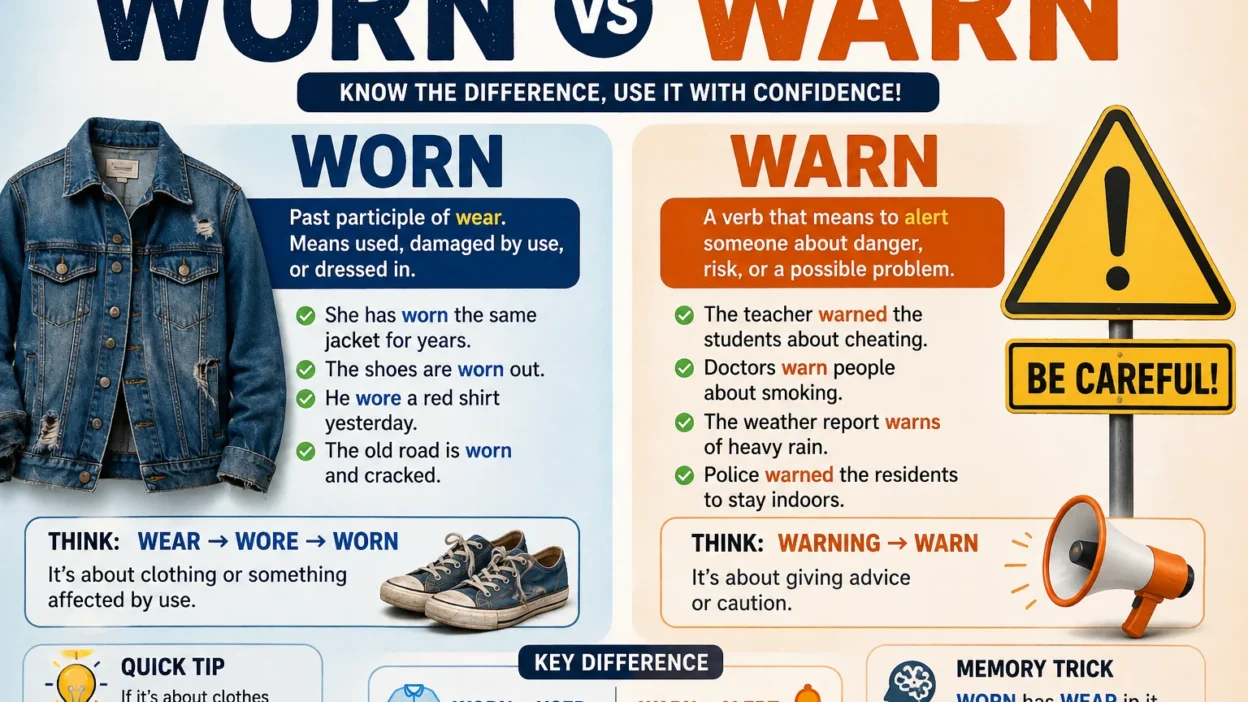
- Worn is the past participle of wear, meaning something has been used or is being worn.
- Warn is a verb that means to alert someone about danger or a possible problem.
Worn vs Warn: Main Difference
| Feature | Worn | Warn |
|---|---|---|
| Part of Speech | Verb (past participle), adjective | Verb |
| Meaning | Used, damaged from use, or dressed in | To alert or caution someone |
| Base Verb | Wear | Warn |
| Common Usage | Worn shoes, worn clothes | Warn people, warn students |
| Related Idea | Clothing or condition | Advice or caution |
What Does “Worn” Mean?
Worn is the past participle of the verb wear. It refers to something that has been used, damaged through use, or is being dressed in.
Examples
- She has worn the same jacket for years.
- My shoes are worn out.
- He had worn a blue suit to the meeting.
- The old bridge looked worn after decades of use.
Common Uses of Worn
- Worn clothes
- Worn shoes
- Worn furniture
- Worn-out batteries
- Worn expression
What Does “Warn” Mean?
Warn means to tell someone about danger, risk, or a possible problem before it happens.
Examples
- The teacher warned the students about cheating.
- Doctors warn people about smoking.
- Weather experts warn of heavy rain.
- Police warned residents to stay indoors.
Common Uses of Warn
- Warn someone
- Warn against
- Warn about
- Warn of danger
- Warn visitors
Worn vs Warn Comparison Table
| Aspect | Worn | Warn |
|---|---|---|
| Meaning | Used or dressed in | Give a warning |
| Action | Wearing or damaged by use | Giving advice or caution |
| Verb Form | Past participle of wear | Base verb |
| Pronunciation | /wɔːrn/ | /wɔːrn/ |
| Example | The carpet is worn. | They warn drivers daily. |
Grammar Forms Table
Worn
| Form | Example |
|---|---|
| Base Verb | wear |
| Past Tense | wore |
| Past Participle | worn |
| Present Participle | wearing |
Warn
| Form | Example |
|---|---|
| Base Verb | warn |
| Past Tense | warned |
| Past Participle | warned |
| Present Participle | warning |
How to Use Worn Correctly
Use worn when talking about:
- Clothing someone has on
- Objects damaged through use
- Past actions involving wear
Examples
- She has worn glasses since childhood.
- His boots were badly worn.
- The tires looked worn after the trip.
- The sofa is old and worn.
How to Use Warn Correctly
Use warn whenever someone gives advice or alerts another person about danger.
Examples
- Parents warn children about strangers.
- Scientists warn of climate change.
- The manager warned employees about the deadline.
- Doctors warn patients about unhealthy habits.
Real-Life Examples
Business
| Worn | Warn |
|---|---|
| The office chairs are worn. | Managers warn employees about scams. |
Education
| Worn | Warn |
|---|---|
| Students wore worn uniforms. | Teachers warn students before exams. |
Healthcare
| Worn | Warn |
|---|---|
| Nurses replaced worn gloves. | Doctors warn patients about infections. |
Science
| Worn | Warn |
|---|---|
| Equipment became worn over time. | Scientists warn about pollution. |
Transportation
| Worn | Warn |
|---|---|
| Worn tires reduce safety. | Road signs warn drivers of sharp turns. |
Why People Confuse Worn vs Warn
There are several reasons people mix up these words.
- They have similar pronunciation.
- Both begin with the letters “w.”
- English learners often focus on spelling rather than meaning.
- Their pronunciation is nearly identical in many accents.
The meanings, however, are completely unrelated.
Common Mistakes
Correct vs Incorrect Sentences
| Incorrect | Correct |
|---|---|
| The police worn us. | The police warned us. |
| My shoes are warn out. | My shoes are worn out. |
| Doctors worn people about smoking. | Doctors warn people about smoking. |
| She has warn this dress before. | She has worn this dress before. |
| The sign worn visitors. | The sign warned visitors. |
Memory Trick
Remember this simple trick:
- Worn contains wear → think about clothing or something used.
- Warn contains warning → think about danger or advice.
Another easy reminder:
Wear → Wore → Worn
Warn → Warning
Industry Usage Table
| Industry | Worn Example | Warn Example |
|---|---|---|
| Manufacturing | Worn machinery | Warn workers of hazards |
| Construction | Worn tools | Warn about falling objects |
| Aviation | Worn aircraft parts | Warn pilots of storms |
| Healthcare | Worn equipment | Warn patients about medicine |
| Education | Worn textbooks | Warn students about plagiarism |
| Sports | Worn shoes | Coaches warn athletes about injuries |
How to Choose Between Worn and Warn
| Step | Question | Choose |
|---|---|---|
| 1 | Talking about clothing? | Worn |
| 2 | Talking about something damaged? | Worn |
| 3 | Giving advice? | Warn |
| 4 | Alerting someone to danger? | Warn |
| 5 | Referring to the verb wear? | Worn |
Everyday Sentence Examples
Worn
- His jeans are worn.
- I’ve worn this watch for years.
- The carpet has become worn.
- Her shoes look worn out.
- The old book has worn pages.
Warn
- Please warn me before you arrive.
- Police warned drivers about icy roads.
- Teachers warn students about deadlines.
- Experts warn against fake websites.
- They warned everyone to evacuate.
Worn vs Warn in Professional Writing
Professional writing requires using these words precisely.
Use worn when describing equipment, clothing, materials, or objects that have deteriorated through use.
Use warn when discussing safety instructions, legal notices, health advice, or risk management.
People Also Ask
Is worn the same as warn?
No. Worn relates to wearing or being used, while warn means to alert someone.
Is worn a verb?
Yes. It is the past participle of wear and can also function as an adjective.
What is the past tense of warn?
The past tense is warned.
How do you remember worn vs warn?
Think wear → worn and warning → warn.
Can worn describe people?
Yes. It can describe someone looking tired or exhausted.
Example:
She looked worn after working all night.
FAQs
What is the main difference between worn vs warn?
Worn refers to clothing or something used over time, while warn means to give advice or caution.
Is “warn out” correct?
No. The correct phrase is worn out.
Can worn be an adjective?
Yes. For example: The old jacket looks worn.
Does warn always involve danger?
Usually, yes. It refers to cautioning someone about risk, problems, or possible consequences.
Are worn and warn pronounced the same?
In many English accents, they are pronounced almost identically, which is why learners often confuse them.
Conclusion
Understanding worn vs warn is essential for clear and accurate English. Although these words sound alike, their meanings are completely different. Worn relates to wearing something or something becoming damaged through use, while warn means to alert someone about danger or a possible problem.
By remembering that worn comes from wear and warn relates to warning, you’ll avoid common mistakes and use both words correctly in everyday conversations, academic writing, and professional communication.