Have you ever heard someone say a child is a chip off the old block and wondered what it really means?
This popular English idiom describes a person, usually a child, who closely resembles a parent in appearance, behavior, or talents.
Understanding a chip off the old block helps you use this expression naturally in conversations and writing.
Many English learners confuse this phrase with other family-related idioms or even misspell it as “chip off the block.”
In reality, a chip off the old block has a specific meaning and history. This guide explains its definition, origin, usage, examples, grammar, common mistakes, and practical tips so you can use it confidently.
Quick Answer
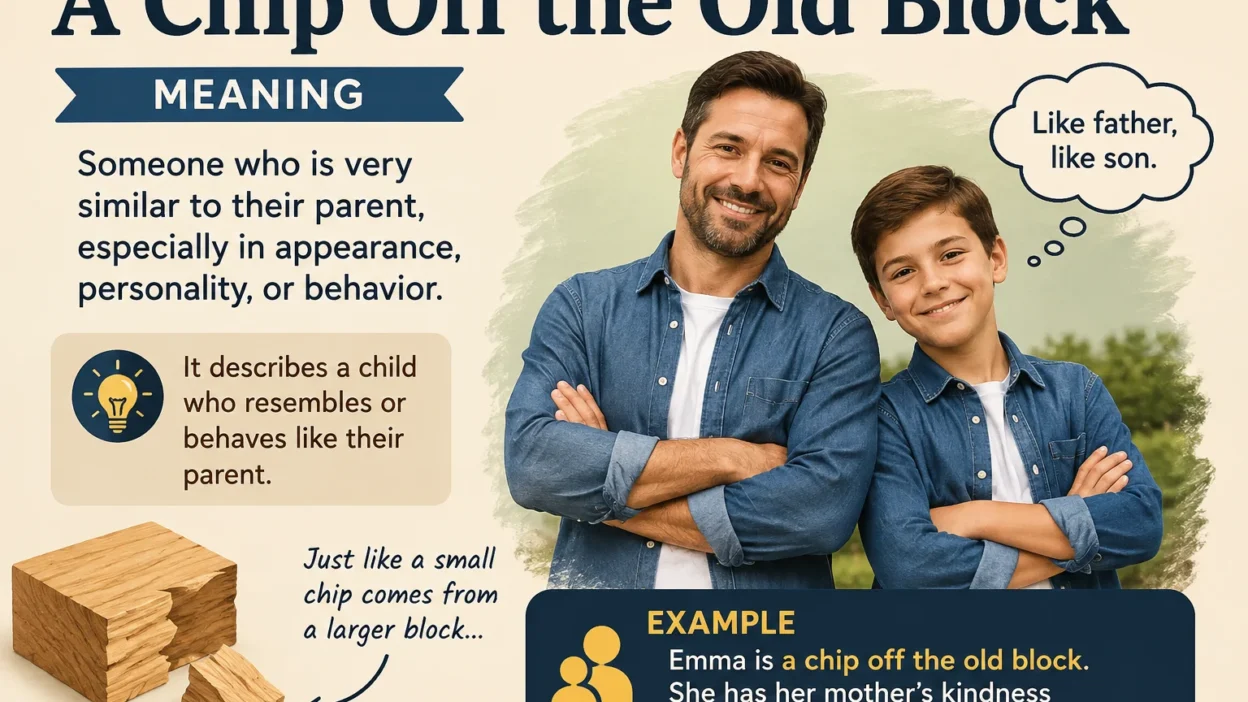
A chip off the old block means someone is very similar to their parent or close family member, especially in personality, appearance, habits, or abilities.
It is a positive idiom commonly used to describe children who inherit their parents’ qualities or talents.
What Does “A Chip Off the Old Block” Mean?
The idiom a chip off the old block refers to someone who strongly resembles their parent or another older family member.
The phrase suggests that just as a small chip comes from a larger block of wood or stone, a child comes from their parent and shares many of the same characteristics.
Simple Definition
| Idiom | Meaning |
|---|---|
| A chip off the old block | A person who closely resembles a parent in personality, appearance, or behavior |
Origin of “A Chip Off the Old Block”
The expression dates back to the 1600s. Originally, it referred to a small piece (chip) cut from a larger block of wood.
Over time, people began using it figuratively to describe children who inherited their parents’ traits.
Today, it remains one of the most common family-related idioms in English.
When to Use “A Chip Off the Old Block”
Use this idiom when talking about someone who behaves or looks like a parent.
Common Situations
| Situation | Example |
|---|---|
| Family resemblance | Emma is a chip off the old block. She has her mother’s smile. |
| Sports | Jake plays football just like his father—a chip off the old block. |
| Business | Olivia runs her company exactly like her father did. |
| Music | Liam sings beautifully, just like his grandmother. |
| Leadership | She’s definitely a chip off the old block when leading her team. |
Grammar and Sentence Forms
The idiom functions as a noun phrase.
Grammar Table
| Structure | Example |
|---|---|
| Subject + be + a chip off the old block | Sarah is a chip off the old block. |
| He’s a chip off the old block | He’s a chip off the old block when it comes to cooking. |
| She’s a real chip off the old block | She’s a real chip off the old block. |
| They’re chips off the old block | The twins are chips off the old block. |
Real-Life Examples
Family
Sophia loves painting just like her mother. She’s a chip off the old block.
Business
Daniel started his own company and manages it exactly like his father did.
Education
Emily enjoys mathematics because her father is a math professor.
Sports
The young tennis player has inherited his mother’s excellent footwork.
Science
A researcher follows the same field of study as her famous scientist father.
Arts
The son became an award-winning actor just like his father.
Examples in Different Contexts
| Context | Sentence |
|---|---|
| Business | Michael is a chip off the old block and runs the family company brilliantly. |
| Education | Mia is a chip off the old block because she loves teaching like her mother. |
| Sports | The young athlete is a chip off the old block. |
| Science | She became a scientist just like her father. |
| Music | He’s a chip off the old block with his musical talent. |
| Politics | She’s a chip off the old block and speaks confidently like her father. |
Similar Idioms and Their Differences
Although these expressions are related, they are not identical.
| Expression | Meaning | Difference |
|---|---|---|
| A chip off the old block | Child resembles parent | Most common family idiom |
| Like father, like son | Sons resemble fathers | Specifically about fathers and sons |
| Like mother, like daughter | Daughters resemble mothers | Gender-specific |
| The apple doesn’t fall far from the tree | Children resemble parents | Focuses on inherited qualities generally |
| Runs in the family | Trait shared among relatives | Refers to inherited characteristics, not one person |
Professional and Industry Usage
Although mostly informal, this idiom appears in many professional settings.
| Industry | Example Usage |
|---|---|
| Journalism | The young athlete is a chip off the old block. |
| Sports Commentary | His son is clearly a chip off the old block. |
| Business | She’s a chip off the old block in leadership style. |
| Entertainment | Critics called the actor a chip off the old block. |
| Education | Teachers describe students who share parents’ talents. |
How to Use the Idiom Correctly
Follow these simple steps.
| Step | Action |
|---|---|
| 1 | Identify a strong resemblance. |
| 2 | Make sure the comparison is positive or neutral. |
| 3 | Use the complete idiom. |
| 4 | Place it after a linking verb like is or was. |
| 5 | Avoid changing the wording. |
Common Mistakes
Many learners misuse this expression.
Correct vs Incorrect
| Incorrect | Correct |
|---|---|
| Chip off the block | A chip off the old block |
| A chip from the old block | A chip off the old block |
| She is chip off the old block | She is a chip off the old block. |
| He looks like a chip off old block | He looks like a chip off the old block. |
| A chip of the old block | A chip off the old block |
Why Do People Confuse This Idiom?
There are several reasons.
| Reason | Explanation |
|---|---|
| Missing “old” | Many shorten the phrase incorrectly. |
| Missing article | People forget the word “a. |
| Similar idioms | Learners confuse it with “apple doesn’t fall far from the tree.” |
| Literal thinking | Some think it refers to wood instead of family resemblance. |
Memory Trick
Imagine a carpenter cutting a large block of wood.
A small chip comes directly from that block and naturally looks exactly like it.
Likewise, a child often resembles a parent.
Remember:
Chip = Child
Old Block = Parent
Practice Sentences
Fill in the blank mentally.
- Emma loves baking just like her mother. She is a chip off the old block.
- Ryan became an engineer like his father. He’s a chip off the old block.
- The young musician is a chip off the old block because she inherited her mother’s talent.
- Everyone says Alex is a chip off the old block because he has his father’s personality.
People Also Ask
Is “a chip off the old block” positive or negative?
Usually positive. It often praises similarities between a child and a parent, although it can occasionally be neutral.
Can you use it for adults?
Yes. Adults can also be described as a chip off the old block if they resemble a parent.
Is the idiom formal?
No. It is mostly informal but acceptable in everyday writing, journalism, and speeches.
Can it describe appearance only?
Yes. It can describe appearance, personality, habits, skills, or talents.
Is “chip off the block” correct?
No. The correct expression is a chip off the old block.
FAQs
What does “a chip off the old block” mean?
It means someone closely resembles their parent or older family member in personality, appearance, or abilities.
Where did the idiom come from?
It originated from woodworking, where a small chip comes from a larger block, symbolizing family resemblance.
Can it be used outside families?
Rarely. It is mainly used for family relationships but may occasionally describe someone following a mentor closely.
Is it common in American and British English?
Yes. It is widely understood and used in both American and British English.
What is another idiom with a similar meaning?
“The apple doesn’t fall far from the tree” has a very similar meaning.
Conclusion
A chip off the old block is a timeless English idiom that describes someone who closely resembles a parent in looks, behavior, personality, or talent.
Its roots in woodworking make it easy to remember: a small chip naturally resembles the larger block it came from.
Use the complete phrase exactly as written, avoid shortened versions like “chip off the block,” and apply it whenever you want to highlight family resemblance.
Learning this idiom will make your English sound more natural, expressive, and fluent in both conversation and writing.