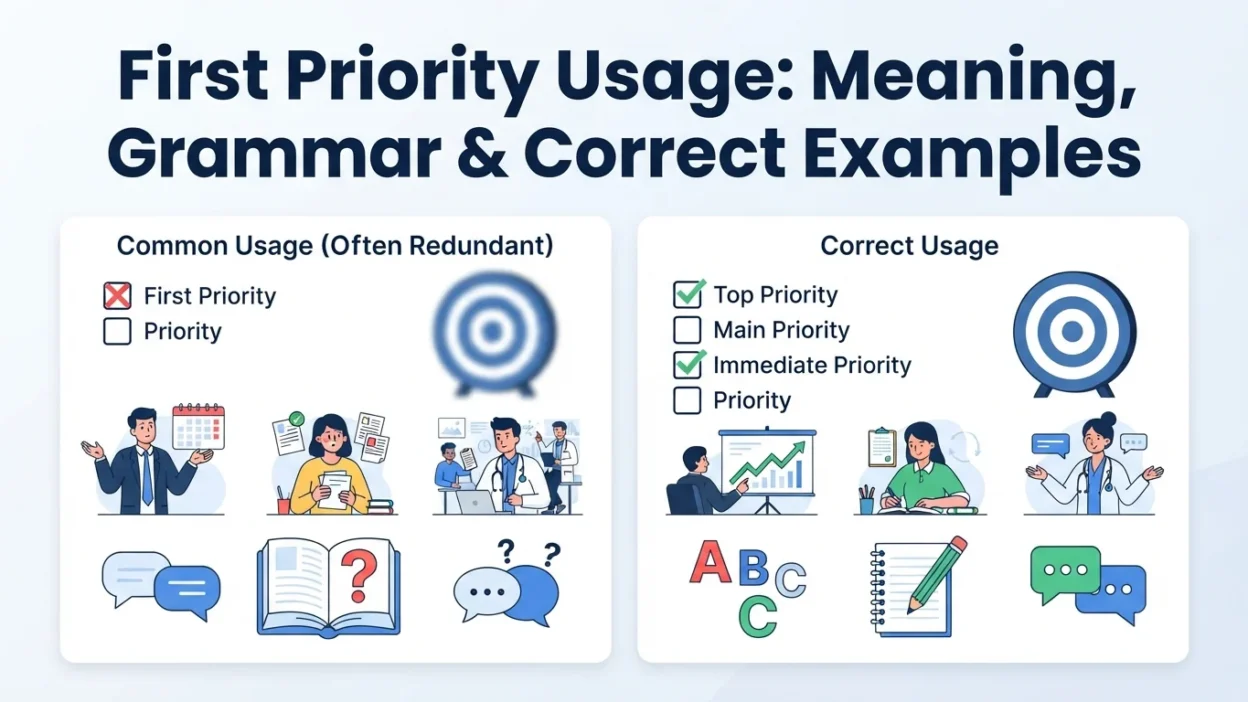
The phrase first priority usage often raises questions among English learners and professionals.
Some people believe saying first priority is unnecessary because the word priority already means something that comes first.
Others argue that the phrase is acceptable when used for emphasis. Understanding first priority usage helps you communicate more clearly in business, education, and everyday conversations.
Whether you’re writing emails, preparing reports, or speaking in meetings, knowing when to use first priority can improve your grammar and writing style.
This guide explains its meaning, correct usage, grammar, examples, common mistakes, and professional applications.
You’ll also learn whether the phrase is redundant and discover practical tips for using it naturally.
Quick Answer
First priority is commonly used in modern English to emphasize the most important task or goal.
While some style guides consider it slightly redundant because priority already means something of highest importance, it is widely accepted in business and everyday communication.
What Does “First Priority” Mean?
First priority refers to the most important task, responsibility, or objective that should receive attention before anything else.
Although priority itself means something that comes first in importance, adding first emphasizes that nothing else is more important.
Examples
- Customer safety is our first priority.
- Completing the project is my first priority.
- Education should remain the government’s first priority.
Is “First Priority” Grammatically Correct?
Yes. First priority is grammatically correct.
However, some editors and grammar experts consider it redundant because priority originally meant “precedence in rank or importance.”
Today, the phrase is widely accepted because the meaning of priority has expanded, allowing people to talk about multiple priorities.
Main Comparison Table
| Phrase | Correct | Common Usage | Notes |
|---|---|---|---|
| First priority | ✔ | Very common | Adds emphasis |
| Top priority | ✔ | Very common | Preferred in business |
| Main priority | ✔ | Common | Natural expression |
| Highest priority | ✔ | Formal | Strong emphasis |
| Priority | ✔ | Standard | Simple and concise |
Why Do People Say “First Priority”?
People often use first priority to make their message stronger and clearer.
It helps listeners immediately recognize what deserves the most attention.
For example:
- Employee safety is our first priority.
- Finishing the assignment is my first priority.
Is “First Priority” Redundant?
Technically, some language experts say yes.
Historically, the word priority already meant “the first in order.”
However, modern English frequently uses expressions like:
- First priority
- Top priority
- Highest priority
These are accepted because people often have multiple priorities that need ranking.
First Priority vs Priority
| Feature | First Priority | Priority |
|---|---|---|
| Meaning | Most important priority | Important task or goal |
| Emphasis | Strong | Moderate |
| Business Usage | Very common | Common |
| Everyday English | Common | Common |
| Formal Writing | Acceptable | Often preferred |
Grammar of “First Priority”
The phrase functions as a noun phrase.
Structure:
Ordinal adjective + noun
| Word | Part of Speech |
|---|---|
| First | Ordinal adjective |
| Priority | Noun |
Example:
“Our first priority is customer satisfaction.”
Grammar Forms Table
| Form | Example |
|---|---|
| Singular | My first priority is health. |
| Plural | Our priorities have changed. |
| With adjective | Our highest priority is safety. |
| Possessive | His first priority is education. |
| Predicate | Safety remains our first priority. |
How to Use “First Priority” Correctly
Use first priority when emphasizing the single most important goal.
Examples:
- Safety is our first priority.
- Your recovery is our first priority.
- Customer satisfaction remains our first priority.
- Completing the report is my first priority today.
Real-Life Examples
Business
- Customer satisfaction is our first priority.
- Reducing costs became the company’s first priority.
Education
- Student learning is the school’s first priority.
- Passing the final exam became her first priority.
Healthcare
- Patient safety remains our first priority.
- Emergency treatment is the hospital’s first priority.
Government
- Public security is the government’s first priority.
- Disaster relief became the first priority after the storm.
Science
- Data accuracy is every researcher’s first priority.
- Laboratory safety should always be the first priority.
Professional Usage Table
| Industry | Example |
|---|---|
| Healthcare | Patient care is our first priority. |
| Education | Student success is our first priority. |
| Business | Customer satisfaction is our first priority. |
| Construction | Worker safety is our first priority. |
| Technology | Data security is our first priority. |
| Hospitality | Guest comfort is our first priority. |
Better Alternatives to “First Priority”
Sometimes another phrase sounds more natural.
| Alternative | Best Use |
|---|---|
| Top priority | Business writing |
| Highest priority | Formal reports |
| Main priority | Everyday speech |
| Primary concern | Professional communication |
| Chief objective | Academic writing |
| Most important goal | General writing |
Common Mistakes
| Incorrect | Correct |
|---|---|
| This is my first priorities. | This is my first priority. |
| Safety are our first priority. | Safety is our first priority. |
| Our priority first is customers. | Our first priority is customers. |
| Customer first priority. | Customer satisfaction is our first priority. |
| My first priority are exams. | My first priority is my exams. |
Why People Get Confused
Several factors cause confusion.
- The original meaning of priority implies “first.”
- Modern English allows multiple priorities.
- Different style guides give different recommendations.
- Business communication frequently uses the phrase.
Memory Trick
Remember this simple rule:
Use “first priority” when you want extra emphasis.
If emphasis is unnecessary, simply use priority.
Think:
- Priority = important
- First priority = most important
Choosing the Right Expression
| Situation | Recommended Phrase |
|---|---|
| Business meeting | Top priority |
| Formal report | Highest priority |
| Casual conversation | First priority |
| Academic writing | Priority or primary concern |
| Speech | First priority |
Tips for Using “First Priority”
- Use it for emphasis.
- Avoid repeating it too often.
- Choose top priority in formal business writing if preferred.
- Keep sentences simple and direct.
- Make sure the priority is clearly identified.
Frequently Asked Questions
Is “first priority” correct English?
Yes. It is grammatically correct and widely accepted in modern English.
Is “first priority” redundant?
Some style guides consider it slightly redundant because priority originally meant “first.” However, modern usage accepts it.
Which is better: “first priority” or “top priority”?
Both are correct. Top priority is often preferred in business writing, while first priority is common in everyday English.
Can I use “first priority” in professional emails?
Yes. It is commonly used in professional communication to emphasize importance.
Should I avoid “first priority” in academic writing?
Not necessarily. However, some academic style guides prefer simply priority or highest priority for conciseness.
Conclusion
Understanding first priority usage helps you write and speak more confidently.
Although some grammar experts view the phrase as slightly redundant, it is widely accepted in modern English and commonly used to emphasize the most important task or goal.
If you’re communicating in business, education, healthcare, or everyday situations, first priority clearly highlights what deserves immediate attention.
For formal writing, alternatives like top priority or highest priority may sometimes sound more polished, but first priority remains a correct and effective expression when used appropriately.