The spatter vs splatter debate often confuses English learners, writers, and even native speakers because both words describe liquid scattering in different ways.
Although they sound similar and are sometimes used interchangeably, they have distinct meanings depending on the amount, force, and context of the liquid being dispersed.
Understanding spatter vs splatter helps you choose the right word in writing, conversation, science, art, and forensic discussions.
In this guide, you’ll learn the meaning of each word, their differences, grammar, realn life examples, common mistakes, professional usage, and simple memory tricks so you’ll never confuse them again.
Quick Answer
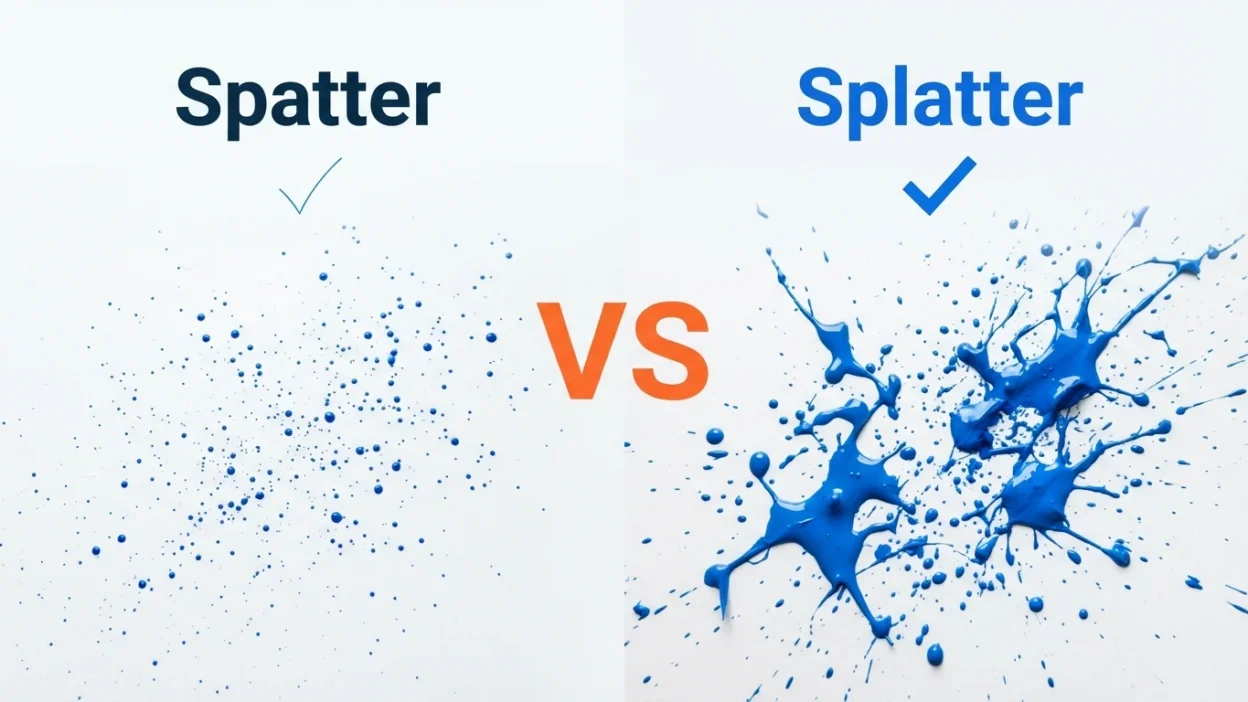
Spatter refers to small drops of liquid scattered lightly or irregularly.
Splatter refers to larger, heavier, or more forceful drops spreading over a surface.
The main difference is the amount and force of the liquid.
Spatter vs Splatter Comparison Table
| Feature | Spatter | Splatter |
|---|---|---|
| Meaning | Scatter small droplets | Scatter larger or forceful droplets |
| Force | Light | Strong |
| Amount | Small | Large |
| Typical Context | Rain, paint, blood, mud | Paint, food, mud, blood |
| Tone | Controlled or gentle | Messy or explosive |
| Can Be Verb? | Yes | Yes |
| Can Be Noun? | Yes | Yes |
What Does Spatter Mean?
Spatter means to scatter small drops of a liquid onto a surface.
It usually suggests tiny droplets spread lightly rather than creating a large mess.
Examples
- Rain spattered against the window.
- Mud spattered onto my shoes.
- Small paint drops spattered across the canvas.
- Blood spatter helped investigators reconstruct the scene.
In many technical fields, especially forensic science, spatter is the preferred term.
What Does Splatter Mean?
Splatter means to scatter liquid in larger, thicker, or more forceful drops.
It often implies a messy or dramatic spread.
Examples
- Tomato sauce splattered all over the stove.
- The balloon splattered paint across the wall.
- The truck splattered muddy water everywhere.
- Oil splattered while frying chicken.
Splatter usually creates a larger mess than spatter.
Main Difference Between Spatter and Splatter
| Point | Spatter | Splatter |
|---|---|---|
| Size of Drops | Small | Large |
| Force | Gentle | Strong |
| Mess Level | Light | Heavy |
| Visual Effect | Fine droplets | Thick scattered liquid |
| Common Impression | Slight scattering | Explosive scattering |
A simple rule:
Small drops = Spatter
Big messy drops = Splatter
Spatter vs Splatter in Everyday Usage
Although dictionaries recognize both words, everyday English tends to use them differently.
Examples:
- Rain spattered on the windshield.
- Oil splattered on the kitchen counter.
- The painter accidentally splattered paint everywhere.
- Mud spattered the side of the car.
Native speakers often associate splatter with larger, more noticeable messes.
Grammar Forms of Spatter and Splatter
| Form | Spatter | Splatter |
|---|---|---|
| Base Verb | Spatter | Splatter |
| Third Person | Spatters | Splatters |
| Present Participle | Spattering | Splattering |
| Past Tense | Spattered | Splattered |
| Past Participle | Spattered | Splattered |
| Noun | Spatter | Splatter |
When Should You Use Spatter?
Use spatter when talking about:
- Light rain
- Tiny paint drops
- Small blood droplets
- Fine mud spots
- Small liquid particles
Examples
- The rain spattered softly on the roof.
- Paint spattered across the artist’s apron.
- The laboratory analyzed blood spatter patterns.
When Should You Use Splatter?
Use splatter when describing:
- Cooking oil
- Thick paint
- Mud thrown by vehicles
- Explosions of liquid
- Large messy spills
Examples
- The soup splattered all over the microwave.
- Grease splattered from the frying pan.
- Paint splattered onto the ceiling.
Real-Life Examples in Different Fields
Business
| Situation | Correct Word |
|---|---|
| Paint factory accident | Splatter |
| Ink droplets during printing | Spatter |
Example:
The printing machine produced ink spatter on several pages.
Education
Teachers may explain the difference using paint experiments.
Example:
Students watched paint spatter across the paper before creating a larger paint splatter.
Science
Scientists describe droplets differently depending on their size.
Example:
Researchers measured water spatter under controlled conditions.
Forensic Science
One of the best-known professional uses is blood spatter analysis.
Investigators examine blood spatter patterns to understand how an incident occurred.
Cooking
Most cooking accidents involve splatter.
Example:
Hot oil splattered onto the stovetop.
Professional Usage Table
| Industry | Preferred Word | Reason |
|---|---|---|
| Forensics | Spatter | Technical terminology |
| Cooking | Splatter | Larger hot droplets |
| Painting | Both | Depends on droplet size |
| Meteorology | Spatter | Light rain droplets |
| Automotive | Splatter | Mud thrown by tires |
| Printing | Spatter | Small ink droplets |
Why Do People Confuse Spatter and Splatter?
Several reasons cause confusion:
- They sound almost identical.
- Both involve scattered liquid.
- Their meanings overlap.
- Some dictionaries mention similar definitions.
- Casual conversation often treats them as synonyms.
The biggest distinction is simply the size and force of the droplets.
Memory Trick to Remember the Difference
| Word | Memory Trick |
|---|---|
| Spatter | Think small spots of liquid. |
| Splatter | Think splash + scatter = splatter, creating a bigger mess. |
Easy shortcut:
Spatter = Small
Splatter = Splashy
Common Mistakes
| Incorrect Sentence | Correct Sentence |
|---|---|
| Oil spattered everywhere after frying. | Oil splattered everywhere after frying. |
| Fine rain splattered the window. | Fine rain spattered the window. |
| Tiny droplets splattered lightly. | Tiny droplets spattered lightly. |
| Thick paint spattered across the room. | Thick paint splattered across the room. |
Process for Choosing the Correct Word
| Question | Choose |
|---|---|
| Are the droplets tiny? | Spatter |
| Is the liquid lightly scattered? | Spatter |
| Is there a large messy splash? | Splatter |
| Was the liquid thrown forcefully? | Splatter |
| Is it forensic terminology? | Usually Spatter |
Examples Comparing Both Words
| Situation | Correct Usage |
|---|---|
| Light rain | Rain spattered the sidewalk. |
| Frying bacon | Grease splattered across the stove. |
| Water balloon | Water splattered everyone nearby. |
| Paintbrush flick | Paint spattered the paper. |
| Car driving through mud | Mud splattered the windows. |
| Blood evidence | Blood spatter was analyzed carefully. |
Tips to Avoid Mixing Them Up
- Think about droplet size.
- Notice how much force is involved.
- Use spatter for fine droplets.
- Use splatter for messy, forceful scattering.
- Remember that forensic experts usually say blood spatter, not blood splatter.
Frequently Asked Questions
Is spatter the same as splatter?
No. Spatter usually means small droplets, while splatter refers to larger, messier drops.
Which word is used in forensic science?
Spatter is the accepted technical term, especially in blood spatter analysis.
Can both words be nouns and verbs?
Yes. Both function as nouns and verbs.
Is splatter more informal?
Not exactly. It simply describes a larger or more forceful scattering of liquid and is common in everyday English.
Can rain splatter?
Heavy rain can splatter, but light rain more commonly spatters.
Which word should I use for cooking oil?
Use splatter, because hot oil usually spreads in larger, forceful droplets.
Conclusion
Understanding spatter vs splatter is easier once you focus on the size and force of the liquid droplets. Spatter describes fine, light scattering and is common in scientific and forensic contexts, while splatter refers to larger, messier, or more forceful liquid spread, especially in cooking, painting, and everyday situations.
Choosing the correct word makes your writing more precise and natural. Whenever you’re unsure, remember the simple rule: small droplets spatter, big messy drops splatter.